LONDON: A buying spree by Japan’s SoftBank Vision Fund (SVF), which counts the Kingdom’s Public Investment Fund as its top international backer, was highlighted on Wednesday when the parent company disclosed a 20 percent rise in net profit in the nine months to the end of last December at 1.01trillion yen ($925.2 million).
SVF listed 19 companies where it has holdings, many acquired since the first close of the fund in May 2017 when it unveiled a $93 billion war chest, which has since grown to more than $97.7 billion.
SVF has stakes in Arm Holdings, the UK chip maker, Slack Technologies, the business chat tool, Brain Corporation, the AI-based autonomous driving system developer, and Mapbox, the US geographical information platform, among others.
Affiliated fund, Delta, has only one asset, the Chinese ride-sharing company, DiDi.
Reuters reported on Wednesday that DiDi, which bought out Uber’s China business in 2016, was setting up an electric car sharing service with 12 automakers, including the local partners of Ford and the Renault-Nissan-Mitsubishi alliance.
Didi was quoted as saying it would build an “open new energy car-sharing system” that would allow members to use vehicles on demand through an app-based system.
SVF has invested $27.5 billion during the accounting period in tech companies that also include visual computing company NVIDIA, and co-working company WeWork. Since the end of the reporting period, SVF has acquired a 15 percent stake in Uber for $7.7 billion, and its swelling portfolio has grown to 26 companies.
Parent group SoftBank, which has a controlling stake in US mobile carrier Sprint, confirmed on Wednesday that it had launched preparations for a Tokyo listing of its domestic mobile phone business.
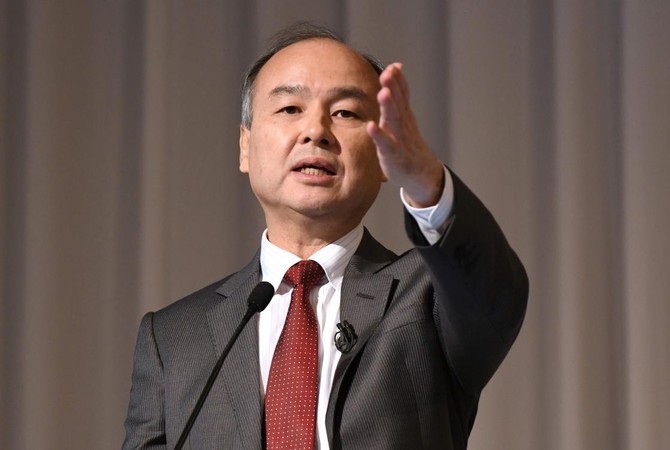
Headed by Japanese billionaire Masayoshi Son, SoftBank repeated that it is interested in buying companies in fields such as robotics, artificial intelligence and consumer technologies as automation gathers pace.
The relationship with the Kingdom will work both ways with Bloomberg reporting in 2017 that SoftBank planned to invest $25 billion in Saudi Arabia over the next three to four years.
At October’s Future Investment Initiative held in Riyadh, PIF and the Vision Fund signed a Memorandum of Understanding to create a ‘Solar Energy Plan 2030’ for the Kingdom.
The new initiative included an agreement to develop Saudi Arabia’s first 3-gigawatt solar generation capacity in 2018. This will take place through the Saudi Electricity Company, which is 74.3 percent owned by PIF.
Additionally, both parties will explore the possibility of the Vision Fund taking a significant minority equity stake in SEC, and work to identify opportunities to establish solar and battery manufacturing ecosystems in the Kingdom, which in turn will support sector diversification and job creation, it was said at FII.
“Rapid technology advancement and scale have transformed solar power into an attractive source of electricity,” said Son.
Son told a financial media conference in Japan on Wednesday, following publication of the latest financial data that group companies such as Arm and Yahoo! Japan were doing well, and he planned to invest in more companies that he called “unicorns.”
One such company he mentioned was Wag, a US venture connecting dog owners with dog walkers online, which Son called the “dog version of Uber.”


![]()
Saudi-backed SoftBank Vision’s war chest approaches $100bn
Saudi-backed SoftBank Vision’s war chest approaches $100bn

Latest updates


© 2026 SAUDI RESEARCH & PUBLISHING COMPANY, All Rights Reserved And subject to Terms of Use Agreement.