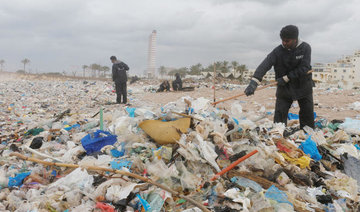
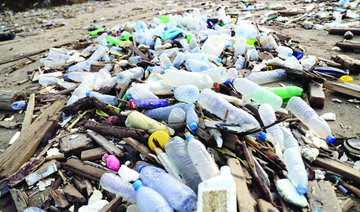
BEIRUT: Lebanon is facing a public health crisis because of its failing waste management system with more than three-quarters of the country’s solid waste either being dumped in landfill sites and burned or buried, according to one study.
The report by the American University of Beirut said that all but 10-12 percent of the country’s waste was suitable for recycling or use as organic fertilizers, yet 77 percent of waste was sent to landfill sites or improperly buried.
Lebanon’s Deputy Prime Minister and Minister of Health, Ghassan Hasbani, said random waste incineration, or burning, was directly affecting people’s health. He urged the Cabinet to develop a waste management plan, and said Lebanon needed to “provide treatment, as a national priority, to those harmed by the state’s failure to secure a safe environment.”
Hasbani said the country had about 940 randomly sited waste dumps, with open-air waste incineration being carried out in 150 sites every week. As a result, the risk of lung disease among nearby residents had more than doubled.
At a joint press conference with Human Rights Watch representatives at the Ministry of Health on Monday, the health minister revealed there were 1,200 lung cancer patients and 1,090 colon cancer patients in Lebanon.
Hasbani said the average cost of treating a lung cancer patient is $13,000 compared with $5,000 in 2012. He called on the government to allocate additional budgets for treating cancer patients. “It’s a human health issue,” he said.
Human Rights Watch (HRW) recently launched a campaign calling on the Lebanese government to introduce a national law and develop a sustainable strategy for waste management.
“Burning waste in the open air puts the residents’ health at risk,” said Lama Fakih, director of HRW in Beirut. “The absence of an effective plan for addressing waste incineration is a violation of Lebanon’s international obligations.”
Lebanon faces a renewed waste management crisis with the Costa Brava (in Beirut’s southern suburbs) and Burj Hammoud (in the city’s east) landfills expected to reach maximum capacity this year, two years earlier than government predictions. The two sites were designed to hold waste only until another solution could be found.
Bassam Khawaja, the Lebanon and Kuwait researcher in the Middle East and North Africa division at HRW, said the Lebanese people “must demand real plans and radical solutions.”
Khawaja said that “about 90 percent of Lebanon’s solid waste contains substances that can be either composted or recycled, yet only 8 percent was being recycled and 15 percent being composted. There isn’t a suitable recycling option in Beirut.”
HRW interviewed more than 100 people living in areas close to landfill sites, as well as public health experts, government officials, doctors and activists. Researchers also visited landfill sites and took photographs using drones.


![]()

Lebanon’s waste crisis ‘a threat to public health’
Lebanon’s waste crisis ‘a threat to public health’

Latest updates


© 2026 SAUDI RESEARCH & PUBLISHING COMPANY, All Rights Reserved And subject to Terms of Use Agreement.