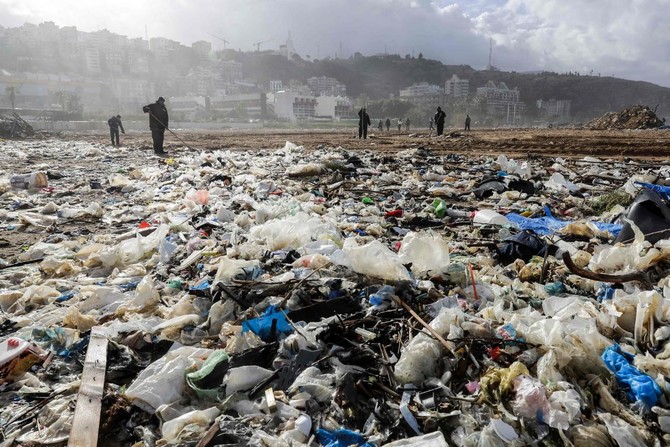
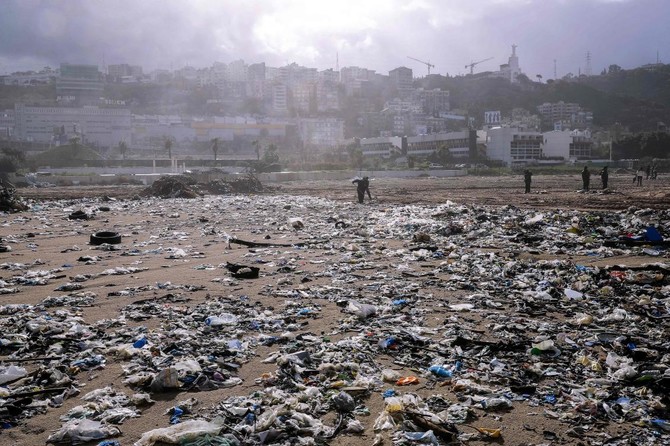
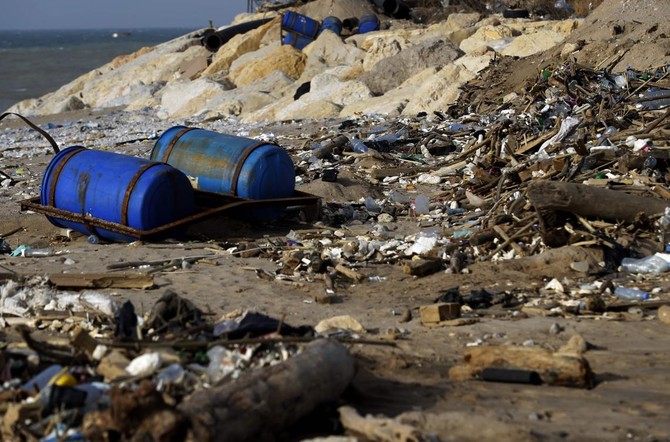
DUBAI: Lebanon’s garbage crisis resurfaced Monday as rubbish was found strewn across a Lebanese beach, believed to have been washed down by stormy weather from a nearby landfill site on the coast – a claim the government denies.
Images of the beach, covered in a blanket of rubbish were shared across social media prompting outcries from residents and politicians alike. It comes as Human Rights Watch (HRW) launched a campaign over health and environmental concerns prompted by the decision to burn the vast amounts of trash that have built up in the country’s landfills.
“The sea has filled with garbage because officials who lack conscience and competency are in charge of the waste file,” Kataeb Party chief MP Sami Gemayel told local news channels.
The rubbish on the beach, near the Zouk Mosbeh/Nahr Al-Kalb river, is believed to have been washed down from the Burj Hammoud landfill during a storm the day before.
“The Council for Development and Reconstruction (CDR) is in charge of overseeing these works and there is an environment minister and a government. They are all to blame and they must be held responsible for what we are witnessing today [Monday],” Gemayel said.
The politician said the council had not taken measures to prevent such an incident from occurring, sighting the absence of wave breakers as the main reason for the landfill’s garbage spewing onto the beach and into the sea.
However the CDR issued a statement denying the landfill’s role in the beach pollution, but videos shared on social media appear to show otherwise.
The statement, translated from Arabic, read: “This news is completely false, in our knowledge the garbage disposal os surrounded by concrete and there is no way for the sea to enter. It is strange that the waves took the garbage from Ghadeer and Burj Hammoud and put them in Keserwan [Zouk Mosbeh/Nahr el-Kalb] without them having any effect on the coast in between.”
Prime Minister Saad Al-Hariri has since ordered an immediate clean-up of the coast.
The Lebanese garbage crisis began in the summer of 2015 after the closure of the Naamah landfill site after it had reached capacity. For months after, with no alternative site, Beirut’s streets became filled with large piles of rubbish that stretched for miles.
Eventually the Burj Hammoud landfill was expanded – but even that was insufficient to cope with the increase bulk of waste produced by the nation and HRW says illegal sites were created by the Lebanese government.
#StopTheBurning
But the beach incident is just the latest in the ongoing crisis. HRW launched #StopTheBurning campaign last week after it was revealed that staff at the landfills had been instructed to burn the vast amounts of garbage leftover by the 2015 crisis.
And HRW is now calling on the Lebanese government to cease the burning, and is rallying support through online messages and billboards across the country.
“We are pressing the government to end the dangerous practice of open burning, and finally pass a national waste management law and strategy that fulfills the right to health and a clean environment and comply with international law,” HRW researcher Bassam Khawaja told Arab News.
The government had resorted to burning large quantities of rubbish in landfills in a short-term plan to rid the Mediterranean country of its trash, but the health consequences are severe, according the HRW report.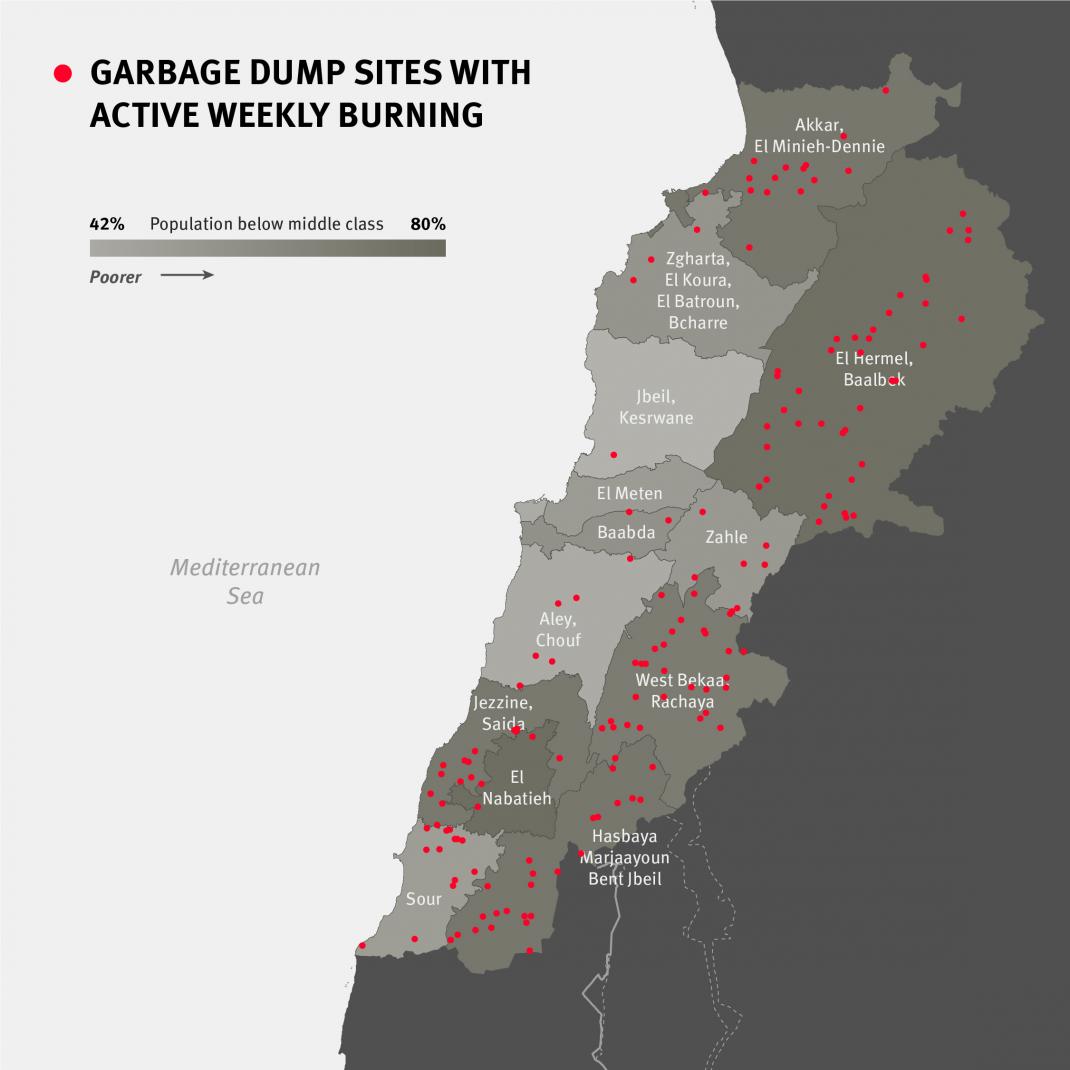
“Human Rights Watch has found that government’s failure to stop the widespread open burning of waste at more than 150 dumps violates Lebanon’s obligation to protect the health of its residents under international human rights law,” Khawaja added.
Open burning has increased in Beirut and Mount Lebanon after the waste management system collapsed in 2015, with a 330 percent increase at the latter site alone, according to the Civil Defense and Lebanon’s fire department.
“Open burning of waste is harming nearby residents’ health one garbage bag at a time, but authorities are doing virtually nothing to bring this crisis under control,” said Nadim Houry, interim Beirut director at HRW.
“People may think the garbage crisis started in 2015, but this has been going on for decades as the government jumps from one emergency plan to the next while largely ignoring the situation outside Beirut and surrounding areas,” Houry added.


![]()
![]()
![]()
![]()

Lebanon’s trash crisis returns, but did it ever disappear in the first place?
Lebanon’s trash crisis returns, but did it ever disappear in the first place?


Latest updates


© 2026 SAUDI RESEARCH & PUBLISHING COMPANY, All Rights Reserved And subject to Terms of Use Agreement.