No end to crisis in sight as Lebanon’s garbage mountains grow

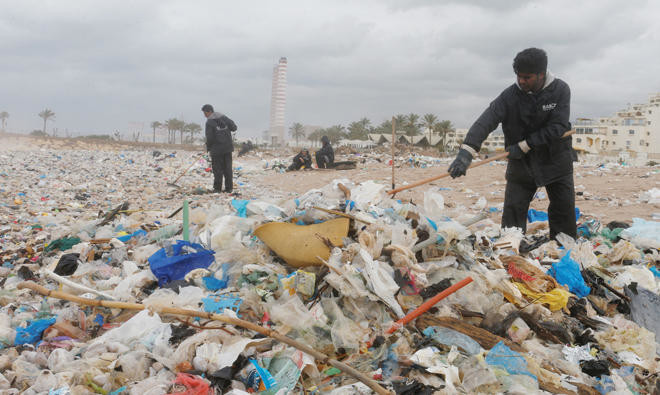
Garbage mountains have mushroomed across Lebanon since the 1990s. (Reuters)
Updated 04 February 2018
Follow

No end to crisis in sight as Lebanon’s garbage mountains grow

BEIRUT: Arpi Kruzian has lived on the coastline east of Beirut for three decades. But now her balcony has a different view: A massive mound of trash rising on the Mediterranean.
“This used to be the sea,” she said outside her home. “One day we looked out, we couldn’t see the sea.”
Trucks and bulldozers have piled waste at a land reclamation site there since last year. “In the summer, we died from the stench,” she said. “You can’t control the smell ... it seeps in from under the doors.”
Landfills and dumpsites — many infamously known as “garbage mountains” — have mushroomed across Lebanon since the 1990s.
The mess peaked in 2015 when the capital’s main landfill shut down, after running well beyond its expiry date.
Heaps of rubbish festered in the summer heat for months. Politicians wrangled over what to do, and the trash crisis of 2015 sparked a protest movement. It became a glaring symbol of a sectarian power system unable to meet basic needs like electricity and water.
The government has since managed to get the waste off the streets and out of Beirut, partly through more landfills.
But residents and environmentalists accuse it of failing to reach a permanent solution — warning of dire consequences on the Mediterranean and public health.
Last month, the Cabinet agreed to expand two seaside landfills at the outskirts of Beirut. Both had started as stop-gaps to resolve the 2015 crisis.
“Lebanon seems to be addicted to these coastal landfills,” said Bassam Khawaja, Lebanon researcher at Human Rights Watch (HRW). “They cannot keep jumping from one emergency solution to the next ... It is remarkable that we don’t have a national law regulating waste.”
Authorities have not conducted any studies on the environmental impact of the two dumps, near the Beirut airport and the Bourj Hammoud neighborhood, he said.
The expansion will include a composting plant at the landfill by the airport — which Khawaja said would be “an important step if it actually happens.”
Lebanon has relied on a string of temporary fixes since an emergency waste plan in the late 1990s, after the end of its 15-year civil war, he said. The government has left local municipal councils to their own devices without the right resources or funding, especially outside the capital.
For residents and activists, the mess stems from corruption and gridlock at the heart of government, where private firms allied to politicians routinely fight over lucrative contracts.
A HRW report in December said hundreds of unsanitary, makeshift dumps have spread across the country. The US-based group said 150 of them burn rubbish out in the open every week. Government officials have repeatedly banned open burning.
The environment ministry could not be reached for comment after repeated requests.
The ministry has crafted an outline for a waste system that focuses on recycling and gradually closing dumpsites, which Cabinet approved this month.
Environment Minister Tarek Khatib says his office is fulfilling its duties. “We will launch a garbage plan in cooperation with the municipalities,” he said last week, when piles of refuse washed up on the shore north of Beirut.
Photos circulated widely showed plastic bags and rot covering the beach after a storm. Officials have traded blame over such incidents in the run-up to parliamentary elections in May.
Over the past year, Joe Salem has watched the hill of rubbish growing on the coast east of Beirut from his window. He gave the workers at his aluminum factory surgical masks and filled the place with air fresheners.
“When a customer comes in, the smell of scum and dirt enters,” he said, pointing at the dumpsite behind the mall in the Dora suburbs.
“We can’t open the windows. We spend our time with the rats,” Salem added. “It’s a catastrophe for the environment, for the people who live in the street.”
But complaining to authorities is hopeless, he said. “People (object) and shut roads and do this and that. Nobody answers them.”


Syrian military tells civilians to evacuate contested area east of Aleppo amid rising tensions

Updated 15 January 2026
Follow

Syrian military tells civilians to evacuate contested area east of Aleppo amid rising tensions

  • Syria’s military has announced it will open a “humanitarian corridor” for civilians to evacuate from an area in Aleppo province
  • This follows several days of intense clashes between government forces and the Kurdish-led Syrian Democratic Forces

DAMASCUS: Syria’s military said it would open a corridor Thursday for civilians to evacuate an area of Aleppo province that has seen a military buildup following intense clashes between government and Kurdish-led forces in Aleppo city.
The army’s announcement late Wednesday — which said civilians would be able to evacuate through the “humanitarian corridor” from 9 a.m. to 5 p.m. Thursday — appeared to signal plans for an offensive in the towns of Deir Hafer and Maskana and surrounding areas, about 60 kilometers (40 miles) east of Aleppo city.
The military called on the Kurdish-led Syrian Democratic Forces and other armed groups to withdraw to the other side of the the Euphrates River, to the east of the contested zone.
Syrian government troops have already sent troop reinforcements to the area after accusing the SDF of building up its own forces there, which the SDF denied. There have been limited exchanges of fire between the two sides, and the SDF has said that Turkish drones carried out strikes there.
The government has accused the SDF of launching drone strikes in Aleppo city, including one that hit the Aleppo governorate building on Saturday shortly after two Cabinet ministers and a local official held a news conference there.
The tensions in the Deir Hafer area come after several days of intense clashes last week in Aleppo city that ended with the evacuation of Kurdish fighters and government forces taking control of three contested neighborhoods. The fighting killed at least 23 people, wounded dozens more, and displaced tens of thousands.
The fighting broke out as negotiations have stalled between Damascus and the SDF, which controls large swaths of northeast Syria, over an agreement to integrate their forces and for the central government to take control of institutions including border crossings and oil fields in the northeast.
Some of the factions that make up the new Syrian army, which was formed after the fall of former President Bashar Assad in a rebel offensive in December 2024, were previously Turkiye-backed insurgent groups that have a long history of clashing with Kurdish forces.
The SDF for years has been the main US partner in Syria in fighting against the Daesh group, but Turkiye considers the SDF a terrorist organization because of its association with the Kurdistan Workers’ Party, or PKK, which has waged a long-running insurgency in Turkiye. A peace process is now underway.
Despite the long-running US support for the SDF, the Trump administration has also developed close ties with the government of interim Syrian President Ahmad Al-Sharaa and has pushed the Kurds to implement the integration deal. Washington has so far avoided publicly taking sides in the clashes in Aleppo.
The SDF in a statement warned of “dangerous repercussions on civilians, infrastructure, and vital facilities” in case of a further escalation and said Damascus bears “full responsibility for this escalation and all ensuing humanitarian and security repercussions in the region.”
Adm. Brad Cooper, commander of US Central Command, said in a statement Tuesday that the US is “closely monitoring” the situation and called for “all parties to exercise maximum restraint, avoid actions that could further escalate tensions, and prioritize the protection of civilians and critical infrastructure.” He called on the parties to “return to the negotiating table in good faith.”
Al-Sharaa blasts the SDF
In a televised interview aired Wednesday, Al-Sharaa praised the “courage of the Kurds” and said he would guarantee their rights and wants them to be part of the Syrian army, but he lashed out at the SDF.
He accused the group of not abiding by an agreement reached last year under which their forces were supposed to withdraw from neighborhoods they controlled in Aleppo city and of forcibly preventing civilians from leaving when the army opened a corridor for them to evacuate amid the recent clashes.
Al-Sharaa claimed that the SDF refused attempts by France and the US to mediate a ceasefire and withdrawal of Kurdish forces during the clashes due to an order from the PKK.
The interview was initially intended to air Tuesday on Shams TV, a broadcaster based in Irbil — the seat of northern Iraq’s semi-autonomous Kurdish region — but was canceled for what the station initially said were technical reasons.
Later the station’s manager said that the interview had been spiked out of fear of further inflaming tensions because of the hard line Al-Sharaa took against the SDF.
Syria’s state TV station instead aired clips from the interview on Wednesday. There was no immediate response from the SDF to Al-Sharaa’s comments.