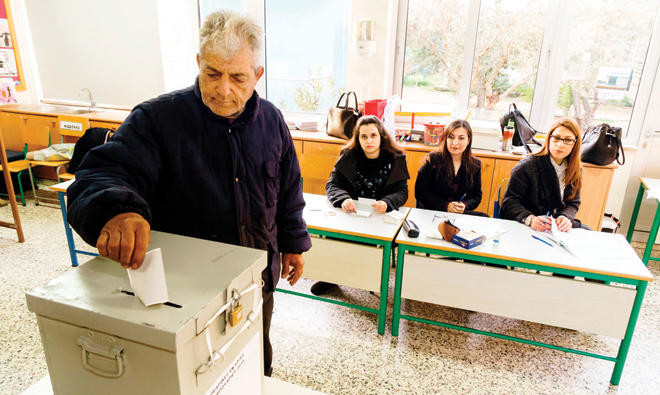
NICOSIA: Voters in Cyprus cast ballots Sunday in a presidential run-off, with incumbent Nicos Anastasiades and his leftist challenger sparring over who is best placed to reunify the island and boost a fragile economic recovery.
In a first round on Jan. 28, conservative Anastasiades garnered 35.5 percent of the ballots, while Communist-backed opponent Stavros Malas came second with 30 percent.
Sunday's head-to-head showdown is a rerun of the 2013 vote that saw Anastasiades cruise into office amid a financial meltdown in the Greek-majority European Union member.
But, with last week's losing candidates refusing to back either hopeful and apathy rising, it looks set to be closer — even though the former lawyer remains favorite to secure a second and final five-year term.
"I warmly appeal to every citizen, do not abandon the right to choose who will be the next president," Anastasiades said as he voted in his home town Limassol.
"To abstain is like letting someone else decide for you."
After making his choice on Sunday, Malas insisted "today is the day that young people decide on their future", and pledged support for those still suffering from the economic crisis.
At a polling station in Nicosia the focus was firmly on reunification efforts and the economy.
"I voted for Anastasiades as I think he is the perfect choice to run the country at this time," petrol station owner George Souglis, 73, told AFP.
"In the future he will continue to do a lot on the economy and Cyprus problem."
Not everyone appeared so convinced by the incumbent.
"We need a change," said Nikolas Petros, 67, who had to close his business due to the economic troubles.
"In politics, especially the Cyprus issue, it has just been promises, promises. On the economy we have had too many problems."
As always, the nearly 44-year division of the eastern Mediterranean island between the internationally recognized Republic of Cyprus in the south and a Turkish-backed statelet in the north looms large.
Anastasiades, 71, has pledged fresh talks with Turkish Cypriot leader Mustafa Akinci despite the acrimonious collapse last July of UN-backed negotiations that came closer than ever to sealing a deal.
Dovish former health minister Malas, 50, is one of the loudest proponents for finally reunifying the island and has slammed his opponent for not doing enough to reach an agreement.
The first-round success of the candidates seen as most keen on a deal has sparked hope that progress can be made.
But there remain major obstacles, including over the future of some 40,000 Turkish troops in the north, and deep scepticism that Nicosia or a nationalist government in Ankara are willing to compromise.
"The wider political framework in which this president comes to power is not conducive for a settlement," said University of Nicosia professor Hubert Faustmann.
This time around the economy has been a dominant issue for the roughly 550,000-strong Greek Cypriot electorate as the island recovers from a 2013 financial crisis.
Anastasiades has claimed credit for an impressive recovery since agreeing a harsh 10-billion euro (more than $12-billion) bailout just weeks after taking power.
But major challenges remain despite record numbers of tourists.
The economy is still smaller than before 2013, employment remains around 11 percent and banks are awash with bad loans.
AKEL -- the left-wing party backing Malas -- was in charge ahead of the crisis and is widely held responsible for tanking the economy.
After a lacklustre race, no candidate has captured the imagination of voters -- especially young Greek Cypriots.
There was a record low turnout of just over 71 percent in the first round.
After the first three hours of voting Sunday 10.9 percent of registered voters had cast their ballots.


![]()
Cyprus votes in close presidential run-off
Cyprus votes in close presidential run-off



Latest updates


© 2026 SAUDI RESEARCH & PUBLISHING COMPANY, All Rights Reserved And subject to Terms of Use Agreement.