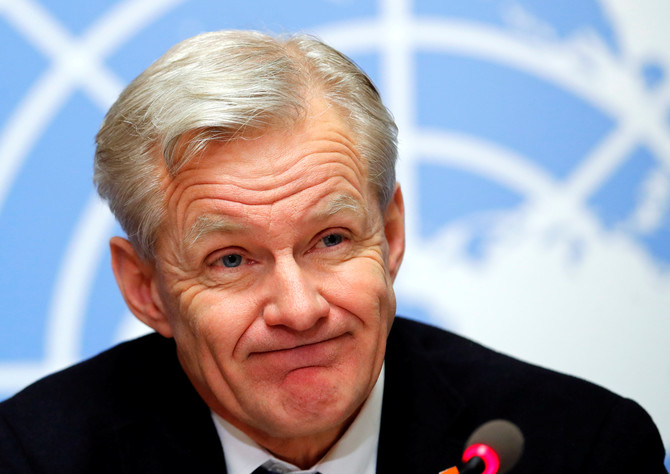
GENEVA: A United Nations humanitarian task force has been unable to make deliveries to desperate Syrians for the past two months as President Bashar Assad’s government has witheld approval for aid convoys, the UN humanitarian adviser said on Thursday.
Before they can move into besieged areas or across front lines, the convoys require letters from the government and security guarantees from armed groups.
“It’s an all-time low in giving us the facilitation letters,” adviser Jan Egeland told reporters after meeting senior diplomats in Geneva.
Insurgents fighting Assad’s forces were also creating obstacles, contributing to the worst situation since 2015, he said.
Egeland called on Russia, Turkey and Iran to de-escalate the fighting in Idlib governorate, which he said was “screaming for a cease-fire.”
“When we need their ability to influence the parties the most, in this bleak hour for humanitarian work, humanitarian diplomacy seems to be totally impotent. We’re getting nowhere at the moment.”
This week Russia convened a Syrian peace congress in Sochi. Egeland said it had so far not resulted in any progress but he hoped that it would.
Air strikes hit two crowded markets in Idlib this week, killing at least 31 people, and have deprived hundreds of thousands of health care.
“I told the members of the humanitarian task force, we cannot have conventional warfare in what is essentially a refugee camp,” Egeland said.
Further north, a Turkish offensive in Afrin district has displaced about 15,000 people, Egeland said, adding: “There are also reports...that local authorities have made it hard for people to flee from the Afrin area.”
And outside Damascus, the rebel-held enclave of Eastern Ghouta, where almost 400,000 people are under siege and about 750 need urgent medical evacuation, desperately needs a pause in the fighting, he said.
“We have indications from both sides that they want it, but it hasn’t happened. And it’s both sides that have to help us here. There are air raids, fighting from the government side, but there is a barrage of mortars and grenades going from this area going into civilian neighborhoods in Damascus.”
He also said 112 people had been killed by explosions in the town of Raqqa since it was recaptured from Daesh fighters in October because people had been allowed back to their homes before the town had been cleared of bombs.

UN calls on Russia, Iran and Turkey to break Syria aid deadlock
US Embassy resumes mechanism meetings ‘at full capacity’
- Next meeting is scheduled for Feb. 25, settling debate in Lebanon over committee’s fate after postponement of January session
- Beirut hopes resumption will allow US to press Israel for concessions in return for commitments to ceasefire security terms
BEIRUT: The US Embassy in Beirut said on Friday that the mechanism committee will meet on Feb. 25 to discuss next steps on Lebanon’s security.
The US-led five-member committee was established in the wake of the Israel-Hezbollah war in late 2024.
In a statement issued jointly with US Central Command, the embassy said that “the military coordination framework, as established in the cessation of hostilities agreement outlined on Nov. 27, 2024, remains fully in place and is operating at full capacity, with the same goals, participants and leadership.”
The embassy also listed upcoming meetings dates for March 25, April 22 and May 20, saying “these engagements will continue to serve as the primary forum for military coordination among the participating parties,” and adding that the mechanism will remain the key platform for such coordination.
A committee meeting had been tentatively scheduled for Feb. 18, but the participating parties did not receive official confirmation from the US.
A Lebanese official told Arab News that the Feb. 25 meeting would be limited to military personnel, with no civilian participation. “The US Embassy’s statement emphasized the participation of all parties, including the French side,” the source added.
The mechanism committee meetings constitute the only approved channel of communication for addressing military issues related to the cessation of hostilities between Lebanon and Israel.
The embassy’s announcement settled the debate in Lebanon over the committee’s fate after the postponement of a meeting scheduled for this month, amid Israeli pressure on Lebanon to convert civil negotiations into bilateral talks with US participation.
A Lebanese official closely following the work conducted by the mechanism committee previously told Arab News that there was “a structural crisis within the mechanism committee, specifically within the US delegation.”
The mechanism committee has held a series of meetings at the Ras Al-Naqoura border crossing. These meetings were described as technical and military in nature, and focused on establishing field communication mechanisms, addressing issues arising from violations, and ensuring continued coordination in line with the terms of the signed agreement. Civilian representatives from Lebanon and Israel were later added to the committee’s meetings.
At the beginning of December, Lebanon appointed former ambassador Simon Karam to head the Lebanese delegation to the Military Technical Committee for Lebanon. Karam attended meetings on two occasions, Dec. 3 and 19, during which he highlighted Lebanon’s demand that displaced residents be allowed to return to border villages as a prerequisite for discussing any economic buffer zone. A meeting scheduled for Jan. 14 was later postponed.
The Lebanese state hopes that the resumption of the mechanism’s meetings will enable the US to secure concessions from Israel in exchange for its commitment to the terms of the agreement to cease military operations, including the withdrawal from positions Israel still occupies inside Lebanese territory.
According to the official source, Lebanon is seeking through this request “to facilitate the next stages of the process of establishing the state monopoly on arms, particularly north of the Litani River.” The source said this followed the Lebanese army’s confiscation of illegal weapons south of the Litani, a step the US welcomed, while Hezbollah has refused to disarm north of the Litani line.
Another official source familiar with previous mechanism committee meetings said that “the Lebanese side stated that Israeli army violations on Lebanese territory provide Hezbollah with a justification to commit to its refusal to surrender its weapons.”
Lebanese army commander Gen. Rodolphe Haykal is scheduled to visit Washington next week, and will present to the Council of Ministers on Feb. 5 the next stages of the army’s plan to confine weapons between the Litani and Awali rivers.
According to the media office at the Presidential Palace, Lebanese President Joseph Aoun and Gen. Haykal reviewed on Friday the latest security developments in the south, amid repeated Israeli strikes and potential escalation risks along the border.
They also discussed Gen. Haykal’s meetings with US officials to “look into ways to support the army and coordinate on security issues at the border.”
Haykal also met Maj. Gen. Patrick Gauchat, head of mission and chief of staff of the UN Truce Supervision Organization at the command’s headquarters.
On Friday, an Israeli drone strike targeted a car in Seddiqin, Tyre, killing Mohammed Ahmad Youssef, the Lebanese Ministry of Health said.
Israeli army spokesman Avichay Adraee claimed that the strike was carried out in response to “Hezbollah violations,” accusing the party of “rebuilding itself.”
Israeli reconnaissance aircraft continued to fly over Beirut and its southern suburb throughout the day, in what Lebanon considered a violation of its airspace.
Meanwhile, the Lebanese army conducted armored patrols in the border town of Yaroun on Friday morning, after the Israeli army entered the town on Thursday night.