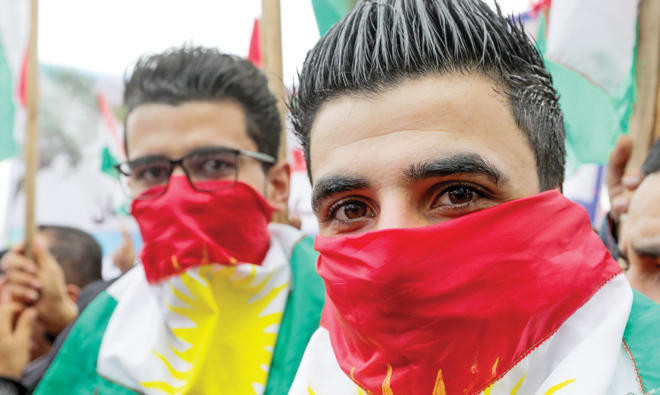
BEIRUT: Authorities in Syria’s Kurdish autonomous region said on Sunday they would not attend peace talks in Russia’s Sochi next week because of Turkey’s offensive against the Kurdish enclave of Afrin.
“We said before that if the situation remained the same in Afrin we could not attend Sochi,” regional official Fawza Al-Yussef said.
Turkey is one of the sponsors of the talks in the Black Sea resort on Monday and Tuesday, along with Russia and Iran.
Turkey’s military offensive in Afrin “contradicts the principle of political dialogue,” Yussef said.
Turkey launched operation “Olive Branch” on Jan. 20 against the Syrian Kurdish People’s Protection Units (YPG) militia in Afrin, supporting Syrian opposition fighters with ground troops and air strikes.
Ankara says the YPG is a “terrorist” offshoot of the outlawed Kurdistan Workers’ Party (PKK), which is proscribed as a terror group by Ankara and its Western allies.
The Sochi talks come after multiple failed rounds of UN-brokered talks to end Syria’s seven-year war.
On Saturday, Syria’s main opposition group, the Syrian Negotiation Commission (SNC), also said it would not attend the negotiations.
The commission accused President Bashar Assad’s regime and its Russian backers of continuing to rely on military might — and showing no willingness to enter into honest negotiations.
The opposition announcement came after two days of separate UN-backed peace talks came to a close in Vienna.
“This round of negotiations was an international test for the regime, and the test ended yesterday (Friday),” the opposition Syrian Negotiation Commission’s Nasr Al-Hariri told reporters in Vienna.
In the SNC’s initial announcement of a boycott, the group said on its Twitter account Friday night that “Russia has not succeeded in promoting its conference.”
“The SNC has decided not to participate at Sochi after marathon negotiations with the UN and representatives of countries involved in Syria,” it added.
Dozens of rebel groups had already refused to join the talks in the Black Sea resort next Monday and Tuesday organized by Moscow, and the question of whether the main opposition would attend overshadowed the Vienna talks.
Those talks stretched late into Friday night, with both regime officials and the SNC meeting separately with UN Syria envoy Staffan de Mistura — who did not strike an especially optimistic tone after the gruelling negotiations.
As with eight previous rounds of failed UN-backed talks in Geneva, there was no sign that the warring sides had met face to face at discussions intended to lay the groundwork for a new post-war constitution.
De Mistura, speaking to reporters, admitted there had been a disheartening lack of progress up until now.
“I share the immense frustration of millions of Syrians inside and outside the country at the lack of a political settlement to date,” he said.
UN Secretary-General Antonio Guterres will send his Syria peace negotiator to the conference in Russia, a spokesman said in New York.
De Mistura stressed the legitimacy of the UN-led talks over Russia’s parallel peace push, however, saying firmly that a political transition for Syria “is to be reached in the UN-led Geneva process.”
“I hope that the forthcoming Syrian national dialogue congress in Sochi will contribute to a revived and credible intra-Syrian process under the UN in Geneva,” he added.
Haid Haid, a consulting research fellow at Chatham House think-tank, said Russia’s long-term strategic interests were at play in Sochi.
“They want to present themselves as peace brokers, not only in Syria but in the Middle East in general, a role traditionally carried out by the Americans,” Haid said.
“For the Russians to take this role, they have to do what the Americans were not able to do” — find a solution in Syria, he said.

Kurds ‘will not join Sochi peace talks’
Basic services resume at Syrian camp housing Daesh families as government takes control
AL HOL: Basic services at a camp in northeast Syria holding thousands of women and children linked to Daesh group are returning to normal after government forces captured the facility from Kurdish fighters, a United Nations official said on Thursday.
Forces of Syria’s central government captured Al-Hol camp on Jan. 21 during a weekslong offensive against the Kurdish-led and US-backed Syrian Democratic Forces, or SDF, that had been running the camp near the border with Iraq for a decade. A ceasefire deal has since ended the fighting.
Celine Schmitt, a spokesperson for the UN refugees agency told The Associated Press that the interruption of services occurred for two days during the fighting around the camp.
She said a UNHCR team visited the recaptured came to establish “very quickly the delivery of basic services, humanitarian services,” including access to health centers. Schmitt said that as of Jan. 23, they were able to deliver bread and water inside the camp.
Schmitt, speaking in Damascus, said the situation at Al-Hol camp has been calm and some humanitarian actors have also been distributing food parcels. She said that government has named a new administrator for the camp.
Camp residents moved to Iraq
At its peak after the defeat of Daesh in Syria in 2019, around 73,000 people were living at Al-Hol. Since then the number has declined with some countries repatriating their citizens. The camp’s residents are mostly children and women, including many wives or widows of Daesh members.
The camp’s residents are not technically prisoners and most have not been accused of crimes, but they have been held in de facto detention at the heavily guarded facility.
The current population is about 24,000, including 14,500 Syrians and nearly 3,000 Iraqis. About 6,500 from other nationalities are held in a highly secured section of the camp, many of whom are Daesh supporters who came from around the world to join the extremist group.
The US last month began transfering some of the 9,000 Daesh members from jails in northeast Syria to Iraq. Baghdad said it will prosecute the transfered detainees. But so far, no solution has been announced for Al-Hol camp and the similar Roj camp.
Amal Al-Hussein of the Syria Alyamama Foundation, a humanitarian group, told the AP that all the clinics in the camp’s medical facility are working 24 hours a day, adding that up to 150 children and 100 women are treated daily.
She added that over the past 10 days there have been five natural births in the camp while cesarean cases were referred to hospitals in the eastern province of Deir Ezzor or Al-Hol town.
She said that there are shortages of baby formula, diapers and adult diapers in the camp.
A resident of the camp for eight years, who spoke on condition of anonymity due to concerns over the safety of her family, said there have been food shortages, while the worst thing is a lack of proper education for her children.
“We want clothes for the children, as well as canned food, vegetables and fruits,” she said, speaking inside a tent surrounded by three of her daughters, adding that the family has not had vegetables and fruits for a month because the items are too expensive for most of the camp residents.
‘Huge material challenges’
Mariam Al-Issa, from the northern Syrian town of Safira, said she wants to leave the camp along with her children so that thy can have proper education and eat good food.
“Because of the financial conditions we cannot live well,” she said. “The food basket includes lentils but the children don’t like to eat it any more.”
“The children crave everything,” Al-Issa said, adding that food at the camp should be improved from mostly bread and water. “It has been a month since we didn’t have a decent meal,” she said.
Thousands of Syrians and Iraqis have returned to their homes in recent years, but many only return to find destroyed homes and no jobs as most Syrians remain living in poverty as a result of the conflict that started in March 2011.
Schmitt said investment is needed to help people who return home to feel safe. “They need to get support in order to have a house, to be able to rebuild a house in order to have an income,” she said.
“Investments to respond and to overcome the huge material challenges people face when they return home,” she added.
Forces of Syria’s central government captured Al-Hol camp on Jan. 21 during a weekslong offensive against the Kurdish-led and US-backed Syrian Democratic Forces, or SDF, that had been running the camp near the border with Iraq for a decade. A ceasefire deal has since ended the fighting.
Celine Schmitt, a spokesperson for the UN refugees agency told The Associated Press that the interruption of services occurred for two days during the fighting around the camp.
She said a UNHCR team visited the recaptured came to establish “very quickly the delivery of basic services, humanitarian services,” including access to health centers. Schmitt said that as of Jan. 23, they were able to deliver bread and water inside the camp.
Schmitt, speaking in Damascus, said the situation at Al-Hol camp has been calm and some humanitarian actors have also been distributing food parcels. She said that government has named a new administrator for the camp.
Camp residents moved to Iraq
At its peak after the defeat of Daesh in Syria in 2019, around 73,000 people were living at Al-Hol. Since then the number has declined with some countries repatriating their citizens. The camp’s residents are mostly children and women, including many wives or widows of Daesh members.
The camp’s residents are not technically prisoners and most have not been accused of crimes, but they have been held in de facto detention at the heavily guarded facility.
The current population is about 24,000, including 14,500 Syrians and nearly 3,000 Iraqis. About 6,500 from other nationalities are held in a highly secured section of the camp, many of whom are Daesh supporters who came from around the world to join the extremist group.
The US last month began transfering some of the 9,000 Daesh members from jails in northeast Syria to Iraq. Baghdad said it will prosecute the transfered detainees. But so far, no solution has been announced for Al-Hol camp and the similar Roj camp.
Amal Al-Hussein of the Syria Alyamama Foundation, a humanitarian group, told the AP that all the clinics in the camp’s medical facility are working 24 hours a day, adding that up to 150 children and 100 women are treated daily.
She added that over the past 10 days there have been five natural births in the camp while cesarean cases were referred to hospitals in the eastern province of Deir Ezzor or Al-Hol town.
She said that there are shortages of baby formula, diapers and adult diapers in the camp.
A resident of the camp for eight years, who spoke on condition of anonymity due to concerns over the safety of her family, said there have been food shortages, while the worst thing is a lack of proper education for her children.
“We want clothes for the children, as well as canned food, vegetables and fruits,” she said, speaking inside a tent surrounded by three of her daughters, adding that the family has not had vegetables and fruits for a month because the items are too expensive for most of the camp residents.
‘Huge material challenges’
Mariam Al-Issa, from the northern Syrian town of Safira, said she wants to leave the camp along with her children so that thy can have proper education and eat good food.
“Because of the financial conditions we cannot live well,” she said. “The food basket includes lentils but the children don’t like to eat it any more.”
“The children crave everything,” Al-Issa said, adding that food at the camp should be improved from mostly bread and water. “It has been a month since we didn’t have a decent meal,” she said.
Thousands of Syrians and Iraqis have returned to their homes in recent years, but many only return to find destroyed homes and no jobs as most Syrians remain living in poverty as a result of the conflict that started in March 2011.
Schmitt said investment is needed to help people who return home to feel safe. “They need to get support in order to have a house, to be able to rebuild a house in order to have an income,” she said.
“Investments to respond and to overcome the huge material challenges people face when they return home,” she added.
© 2026 SAUDI RESEARCH & PUBLISHING COMPANY, All Rights Reserved And subject to Terms of Use Agreement.