

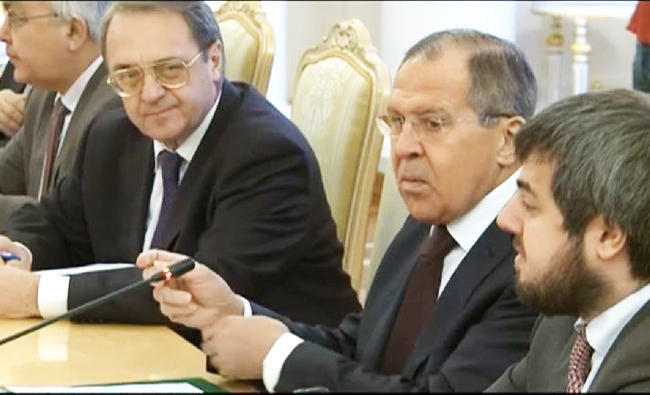
Kurds invited to join peace congress in Sochi: Lavrov

Russian Foreign Minister Sergei Lavrov accuses Washington of stoking separatist sentiment among Syria's Kurds as Turkey pressed an offensive against US-backed Kurdish militia in northern Syria. (AFP)
Updated 23 January 2018
Follow

Kurds invited to join peace congress in Sochi: Lavrov

MOSCOW: Russia said on Monday it has invited Kurds to take part in an upcoming Syrian peace congress in Sochi on Jan. 29-30 despite a Turkish offensive against Kurdish militia in northern Syria.
“Kurdish representatives have been included on the list of Syrians invited to participate in the Syrian National Dialogue Congress which will take place in Sochi,” Foreign Minister Sergei Lavrov said.
Together with regime backer Iran and rebel supporter Turkey, Russia — a key backer of Syrian President Bashar Assad — wants to convene a peace conference with the aim of agreeing on a new constitution for post-war Syria.
The peace talks have been planned for January 29 and 30.
Lavrov also said that Syrian Kurds should play a role in the “future political process.”

Territorial integrity
“This role should certainly be ensured,” he said but added that all of Syria’s ethnic groups should respect the country’s sovereignty and territorial integrity.
Lavrov accused Washington of stoking separatist sentiment among Syria’s Kurds. “Washington continues to encourage separatist sentiments among Kurds” while ignoring the “delicate” nature of the issue, Lavrov said.
“This is either a lack of understanding of the situation or an absolutely conscious provocation.”
Separately, Russian President Vladimir Putin’s spokesman Dmitry Peskov — asked whether the Turkish offensive would complicate the Sochi congress — declined to comment, but said that the preparations for the conference were under way.
Fledgling radio station aims to be ‘voice of the people’ in Gaza

Updated 15 February 2026
Follow

Fledgling radio station aims to be ‘voice of the people’ in Gaza

  • The electricity crisis is one of the most serious and difficult problems in the Gaza Strip, says Shereen Khalifa Broadcaster

DEIR EL-BALAH: From a small studio in the central city of Deir El-Balah, Sylvia Hassan’s voice echoes across the Gaza Strip, broadcast on one of the Palestinian territory’s first radio stations to hit the airwaves after two years of war.

Hassan, a radio host on fledgling station “Here Gaza,” delivers her broadcast from a well-lit room, as members of the technical team check levels and mix backing tracks on a sound deck. “This radio station was a dream we worked to achieve for many long months and sometimes without sleep,” Hassan said.

“It was a challenge for us, and a story of resilience.”

Hassan said the station would focus on social issues and the humanitarian situation in Gaza, which remains grave in the territory despite a US-brokered ceasefire between Israel and Hamas since October.

“The radio station’s goal is to be the voice of the people in the Gaza Strip and to express their problems and suffering, especially after the war,” said Shereen Khalifa, part of the broadcasting team.

“There are many issues that people need to voice.” Most of Gaza’s population of more than 2 million people were displaced at least once during the gruelling war.

Many still live in tents with little or no sanitation.

The war also decimated Gaza’s telecommunications and electricity infrastructure, compounding the challenges in reviving the territory’s local media landscape. “The electricity problem is one of the most serious and difficult problems in the Gaza Strip,” said Khalifa.

“We have solar power, but sometimes it doesn’t work well, so we have to rely on an external generator,” she added.

The station’s launch is funded by the EU and overseen by Filastiniyat, an organization that supports Palestinian women journalists, and the media center at the An-Najah National University in Nablus, in the occupied West Bank.

The station plans to broadcast for two hours per day from Gaza and for longer from Nablus. It is available on FM and online.

Khalifa said that stable internet access had been one of the biggest obstacles in setting up the station, but that it was now broadcasting uninterrupted audio.

The Gaza Strip, a tiny territory surrounded by Israel, Egypt, and the Mediterranean Sea, has been under Israeli blockade even before the attack on Oct. 7, 2023, which sparked the war. Despite the ceasefire, Israel continues to strictly control the entry of all goods and people to the territory.

“Under the siege, it is natural that modern equipment necessary for radio broadcasting cannot enter, so we have made the most of what is available,” she said.