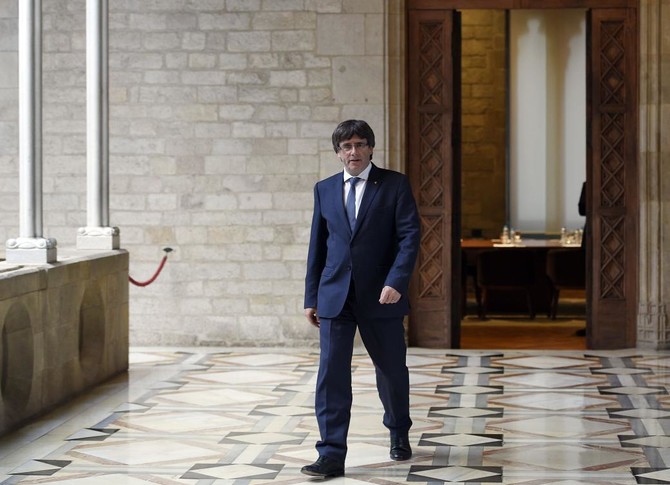
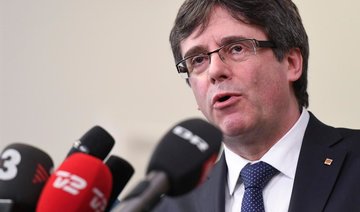
MADRID: Spain’s constitutional court on Saturday announced it was blocking Catalonia’s ousted separatist leader Carles Puigdemont from returning to power in the region while he remains the subject of legal action.
The court said in a statement that its 12 magistrates had decided unanimously “to preventively suspend the investiture of Puigdemont unless he appears in the (regional) parliament in person with prior judicial authorization.”
Puigdemont, who fled to Belgium after the Catalan parliament declared independence in October, was earlier this week chosen as a candidate to lead Catalonia again, with the regional parliament set to vote for a new leader on Tuesday in Barcelona.
However, he faces arrest for rebellion, sedition and misuse of public funds over his attempt to break Catalonia away from Spain as soon as he returns to the country.
Puigdemont has said he could be sworn in to office remotely via videoconference from Brussels, a plan Spain’s central government opposes.
He has also said he would rather return to Spain, but without any risk of arrest.
The constitutional court warned all members of the Catalan parliament of “their responsibilities” and warned against disobeying the order to suspend any investiture.
The magistrates said they needed six more days to consider a government bid to annul the nomination of Puigdemont as a candidate for the regional presidency.
“The government must use every tool made available by the laws and the constitution to make sure that a fugitive, someone who is on the run from the law and the courts, cannot be illegitimately be sworn in,” Spain’s Deputy Prime Minister Soraya Saenz de Santamaria said Friday after the government lodged the legal bid to keep Puigdemont from returning to power.
After the court’s announcement, Puigdemont tweeted that “even the constitutional court has rejected the tricks of Moncloa,” referring to the prime minister’s official residence.
Prime Minister Mariano Rajoy said on Twitter that “the government would continue to do its duty in respecting the law.”
Catalonia’s ousted separatist government pushed ahead with an independence referendum on October 1 despite it having been banned by the Constitutional Court.
It won the public vote but Catalonia’s independence declaration on October 27 was short-lived as Rajoy moved to stop the crisis in a region deeply divided over secession.
He imposed direct rule on the semi-autonomous region, sacked its government including Puigdemont, dissolved its parliament and called snap elections.

Spanish court suspends Puigdemont’s return to power in Catalonia
Bangladesh criticizes India over fugitive leader Hasina’s speech
DHAKA: Bangladesh said on Sunday it was “surprised” and “shocked” that India had allowed fugitive former prime minister Sheikh Hasina to make a public address in New Delhi.
Hasina, 78, fled to neighboring India in August 2024 after a student-led uprising ended her iron-fisted 15-year rule. She made her first public speech since then in an audio address to a packed press club in Delhi on Friday.
She was found guilty in absentia by a Dhaka court in November of incitement, issuing an order to kill and inaction to prevent atrocities and was sentenced to be hanged.
“The government and the people of Bangladesh are surprised and shocked,” Dhaka’s foreign ministry said in a statement.
“Allowing the event to take place in the Indian capital and letting mass murderer Hasina openly deliver her hate speech... constitute a clear affront to the people and the Government of Bangladesh.”
It said allowing Hasina to make the speech set “a dangerous precedent” that could “seriously impair bilateral relations.”
Bangladesh voters go to the polls on February 12 to choose new leaders after a period of turmoil that followed the overthrow of Hasina’s autocratic government.
Hasina said in her audio address that “Bangladesh will never experience free and fair elections” under interim leader Muhammad Yunus.
More than 100,000 people watched the address, which was broadcast online.
Bangladesh has asked India to extradite Hasina, but New Delhi has yet to comment on the request.
India’s past support for Hasina has frayed relations between the South Asian neighbors since her overthrow.
Hasina, 78, fled to neighboring India in August 2024 after a student-led uprising ended her iron-fisted 15-year rule. She made her first public speech since then in an audio address to a packed press club in Delhi on Friday.
She was found guilty in absentia by a Dhaka court in November of incitement, issuing an order to kill and inaction to prevent atrocities and was sentenced to be hanged.
“The government and the people of Bangladesh are surprised and shocked,” Dhaka’s foreign ministry said in a statement.
“Allowing the event to take place in the Indian capital and letting mass murderer Hasina openly deliver her hate speech... constitute a clear affront to the people and the Government of Bangladesh.”
It said allowing Hasina to make the speech set “a dangerous precedent” that could “seriously impair bilateral relations.”
Bangladesh voters go to the polls on February 12 to choose new leaders after a period of turmoil that followed the overthrow of Hasina’s autocratic government.
Hasina said in her audio address that “Bangladesh will never experience free and fair elections” under interim leader Muhammad Yunus.
More than 100,000 people watched the address, which was broadcast online.
Bangladesh has asked India to extradite Hasina, but New Delhi has yet to comment on the request.
India’s past support for Hasina has frayed relations between the South Asian neighbors since her overthrow.
© 2026 SAUDI RESEARCH & PUBLISHING COMPANY, All Rights Reserved And subject to Terms of Use Agreement.