BARCELONA: Catalans will go to the polls on Thursday to elect a regional Parliament in a bitterly contested vote that has become an unofficial ballot on whether the semi-autonomous region will pursue independence or realign itself with Madrid.
The stakes could scarcely be higher: Should the separatists prevail it could ultimately end Spanish Prime Minister Mariano Rajoy’s tenure, while an anti-secessionist victory could lead to the dismantling of Catalonia’s “independista” apparatus including Catalan-language state media.
Opinion polls indicate the vote is too close to call, with separatist parties forecast to win 65-69 seats; 68 are required for a majority.
The election follows Catalonia’s Oct. 1 independence referendum that overwhelmingly endorsed creating a Catalan republic but which Madrid denounced as illegal amid state violence that injured hundreds of voters.
Catalonia’s President Carles Puigdemont duly declared independence, leading Rajoy to suspend Catalonia’s semi-autonomy, sack the regional government and call new elections for Dec. 21.
Many separatist leaders stand accused of sedition and are in prison, exile or on bail.
The political turmoil has led more than 2,000 Catalan companies which, combined, account for around half of the region’s GDP, to move their headquarters elsewhere, according to pro-unionist organization Societat Civil Catalana.
Thursday’s vote, like the previous 2015 elections, has split on pro-independence and unionist lines, with parties on the left and right in both camps. These blocs are reasonably stable, so big swings in either direction seem improbable.
On the pro-independence side stand Junts per Catalunya, the new banner for Puigdemont’s ailing PDeCAT party, which has recruited civic leaders to broaden its appeal.
“Our electoral approach is to try to re-confirm the sovereigntist majority of the past two years in Parliament,” said Jordi Xucla, a Junts per Catalunya spokesman. “If this happens, we can go forward with the same strategy.”
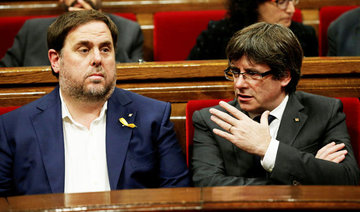
Also pushing independence is the leftist Esquerra Republicana de Catalunya (ERC), which was part of a coalition with PDeCAT in 2015 and whose leader, Oriol Junqueras, remains in prison. Its slogan is “Democracy always wins.”
“It’s a not a clean electoral process,” said ERC spokesman Ernest Maragall. “We’re fighting this election with one arm tied behind our backs. We will try to win to follow the path to a real and full republic.”
Spain ranks second-lowest in Western Europe for judicial independence and separatist politicians say voting for them can help to end the incarceration of what they say are political prisoners, a call that could garner support from voters unsure about independence but appalled by Madrid’s approach to Catalonia’s constitutional convulsions.
“It’s perhaps the only way separatists can counter the disappointment that followed the declaration of independence, which was totally anti-climactic,” Antonio Barroso, Teneo Intelligence managing director. “By taking this approach they hope to re-mobilize their support and maximize turnout.”
That seemed evident at a November 11 demonstration attended by Arab News which drew 750,000 protesters and where shouts of “freedom” and “Puigdemont is our president” were common cries. Yet the atmosphere was reserved, a famous Catalan trait; Catalonia, which accounts for a fifth of Spain’s economy, is a peaceful, plentiful region – this is not Bucharest in 1989.
“I’m here because Spain is unjust. I give my support to all the prisoners. Today is more for democracy than independence,” said Pau, 23, a media studies student wearing the independence flag, the Estelada, as a cape.
Cuidadanos is the most significant party opposed to independence. Founded in Catalonia, it was originally center-left, but drifted to the right as it became a national movement. Rajoy’s right-wing PP, created by former ministers of Spain’s long-ruling dictator Francisco Franco, is projected to attract only 5.4 percent of votes. Catalonia’s political affiliations reflect its demographics. Official statistics indicate that 50 percent of residents describe themselves as Catalans living in Catalonia and overwhelmingly support independence.
The remainder have a closer affiliation to Spain – during the 20th century, migrant workers arrived from poorer regions to work in Catalonia’s industrial sector and their descendants are Catalans, but they remain culturally, ethnically and linguistically different.
“Ethnic Catalans come mostly from rural areas, but they’re also the bourgeois - these people are richer, better connected, and more educated,” said Jorge San Miguel Lobeto, a political scientist and Ciudadanos adviser.
Support for independence has surged from just 14 percent in 2006, since when Rajoy has been instrumental in denying Catalonia greater autonomy, which along with Spain’s severe post-2008 recession emboldened the separatist cause.
“Many voters support independence because it appears to be an easier solution: to get a new state as a way of punishing traditional politics,” said Juan Rodriguez Teruel, professor of political sciences at the University of Valencia.
Those sentiments were evident in Girona, the wealthy cathedral city where Puigdemont served as mayor after his exile to Belgium.
“He went to Europe to tell Europe what’s happening here,” said Mireia, a 24-year-old pro-independence social worker born in Girona to Andalusian parents. “Madrid is manipulating the Spanish press, so he had to leave.”
Marc, 31, a cake-maker from La Bisbal D’emporda, a small town nearby, had set up a stall in Plaça de la Independencia.
“To protect our Catalan identity, we need independence. Madrid doesn’t recognize us as Catalans, so we need to go,” said Marc, who believes Madrid’s crackdown strengthened the secessionists’ ranks. “Those who voted for independence in October will vote for independence parties again, and those who didn’t but don’t like to be repressed will do so too.”


![]()

Stakes could hardly be higher in Catalonia’s polls
Stakes could hardly be higher in Catalonia’s polls

Latest updates






© 2026 SAUDI RESEARCH & PUBLISHING COMPANY, All Rights Reserved And subject to Terms of Use Agreement.