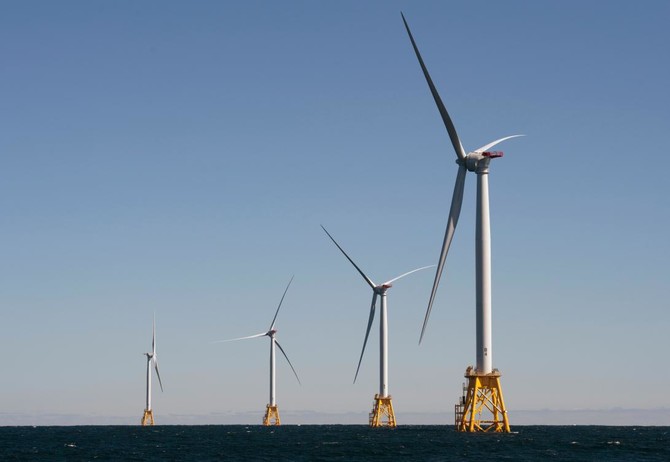
WASHINGTON: Sinovel, one of China’s leading wind turbine-makers, was found guilty Wednesday of stealing proprietary technology from US firm AMSC, causing it $800 million in losses, the Justice Department said.
A Wisconsin jury convicted Beijing-based Sinovel Wind Group, of conspiracy to commit trade secret theft, theft of trade secrets, and wire fraud after an 11-day trial.
It said that in 2011, Sinovel recruited an Austria-based AMSC employee who stole source code from its computers that formed the basis of its technology for regulating the flow of electricity from wind turbines to electrical grids.
At the time AMSC, formerly known as American Superconductor, was selling its technology to Sinovel. Obtaining that code allowed Sinovel to drop its orders to the US company as it took the technology for its own, causing AMSC an estimated $800 million in losses.
Losing Sinovel orders plunged AMSC into “severe financial hardship,” as the company’s market value fell by $1 billion (SR3.75 billion) and it was forced to cut 700 jobs, more than half of its global workforce.
“Sinovel nearly destroyed an American company by stealing its intellectual property,” said acting assistant attorney general John Cronan.
“As today’s jury verdict demonstrates, this type of conduct, by any corporation — anywhere — is a crime, and won’t be tolerated.”
In a statement to the Shanghai Stock Exchange, where it is listed, Sinovel said on Thursday that it is “well prepared to take active measures to protect our interests and use legal means to strictly defend our legitimate rights and interests.”
It promised to “protect the rights and interests of the company’s medium and small shareholders” and “release information on the development of this case in a timely manner according to relevant regulations.”
Shares in the firm ended down 3.92 percent at 1.47 yuan on Thursday.
The US government has repeatedly warned of Chinese companies, both private and government-related, seeking to steal US trade secrets and technology.
Last week, a Chinese software developer was sentenced to five years in prison for stealing computer source code from IBM to hand over to a Chinese government agency.

China wind turbine-maker Sinovel guilty of stealing US trade secrets
Egypt defies African FDI trend with inflows of $11bn in 2025: UNCTAD
RIYADH: Egypt emerged as Africa’s top destination for foreign direct investment in 2025, attracting an estimated $11 billion in inflows in a year marked by declining investment across the continent.
According to UNCTAD’s latest Global Investment Trends Monitor, the North African country ranked ahead of other major African economies despite a sharp regional slowdown.
The performance underscores Egypt’s relative resilience at a time when foreign investment into Africa has normalized following an unusually strong 2024, which UNCTAD said was inflated by a single large project. As a result, the 2025 data reflects a return to more typical investment levels across the continent.
“Among African economies, inflows to Angola reached an estimated $3 billion, marking a return to positive values after nine consecutive years of net divestments,” the report stated.
It added: “Egypt, with inflows of $11 billion, remained the largest FDI host country in Africa.”
While Egypt solidified its position as Africa’s leading FDI host, other notable movements on the continent included Mozambique, where inflows surged 80 percent to $6 billion, driven by renewed activity in major liquified natural gas projects.
Angola also saw a positive shift, recording an estimated $3 billion in FDI after nine consecutive years of net divestments.
UNCTAD noted that Egypt’s strength extended beyond headline inflows, with the country also contributing to an increase in greenfield investment activity across Africa. While the number of greenfield projects fell globally and across most lower-income economies, Africa recorded a 5 percent increase in project numbers in 2025, supported in part by growth in Egypt and Côte d’Ivoire.
Globally, FDI flows rose by 14 percent in 2025 to approximately $1.6 trillion, though growth was heavily concentrated in developed economies, which saw a 43 percent increase.
In contrast, flows to developing economies declined by 2 percent, with the least developed countries particularly affected; three-quarters experienced stagnant or falling investment.
The report highlighted that new project announcements remained weak globally amid elevated policy uncertainty, with international project finance declining for the fourth consecutive year.
Looking ahead, UNCTAD warned that geopolitical tensions, regional conflicts, and economic fragmentation could continue to suppress real investment activity in 2026, even as financing conditions are expected to ease.
For Africa, sustaining FDI inflows will require navigating persistent challenges such as financing constraints, risk perceptions, and structural vulnerabilities.