

With Drogba and Eto’o as ambassadors, Morocco plays up long-shot 2026 World Cup bid

Morocco believes its fifth bid for the World Cup is 'a candidacy for the whole continent'. (AP)
Updated 23 January 2018
Follow

With Drogba and Eto’o as ambassadors, Morocco plays up long-shot 2026 World Cup bid

CASABLANCA: Morocco is “fully mobilized” for its long-shot bid to host the 2026 World Cup, hoping to be a candidate “for the whole of Africa,” top sports officials said Tuesday.
The kingdom “is not a non-starter — it’s a real candidate,” Moulay Hafid Elalamy said in his first public appearance as chairman of the country’s 2026 bid committee.
“We are going to put in all our energy,” he told a news conference in Casablanca, brushing off criticisms that the campaign had been delayed.
“Our record is and will be irreproachable.”
Morocco’s fifth bid, announced in August, faces fierce competition from a three-nation ticket of the United States, Mexico, and Canada.
Fouzi Lekjaa, head of the Royal Moroccan Football Federation (FRMF), said he hoped the North African country’s bid would be “a candidacy for the whole continent.”
“Between 1930 to 2030 — 100 years — the African continent has only organized the World Cup once,” Lekjaa said, referring to the 2010 tournament in South Africa, which beat a previous bid by Morocco.
“It should not remain on the margin.”
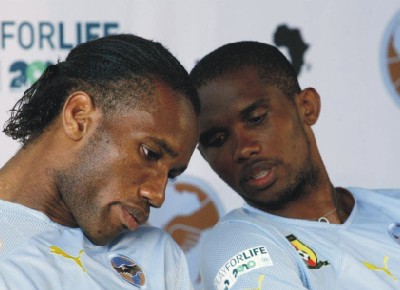
The committee has enlisted Ivory Coast legend and former Chelsea star Didier Drogba along with Cameroon international striker Samuel Eto’o to promote its bid.
The host will be chosen on Jun. 13, but the way the choice is made marks a change by FIFA, the sport’s world governing body.
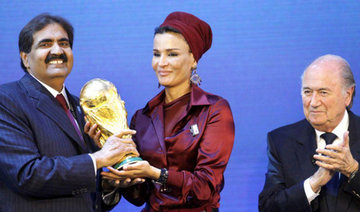
The decision used to be made by FIFA’s executive committee, but after suspicions over its selection of Russia and Qatar in December 2010, sparking a scandal that dethroned president Sepp Blatter, the committee was stripped of some powers and renamed the FIFA Council.
The new-look council must rubber-stamp the bids, but the final decision will be taken in a vote of the 211 national federations at a congress in Moscow.
Morocco’s bid committee hope to win support from the 53 members of the Confederation of African Football.
CAF president Ahmad Ahmad has urged the sport’s bodies across the continent to offer “free and massive support” to the kingdom.
The bid committee on Tuesday’s unveiled their leadership team, social media channels and logo: Red leaves on a black and white football surrounding a star that symbolizes “unity and brilliance.”
Responding to a question on human rights, newly added to FIFA’s selection criteria, Elalamy said Morocco had made progress on women’s and family rights.
The kingdom was “one of the safest countries in the world,” he added.
The committee also played up Morocco’s infrastructure, including a high-speed railway, ports, stadiums and hotel capacity.
They did not reveal how much was to be spent on the bid, but said each of the last two bids had cost around $15 million.

Jordan make history as they reach Arab Cup final for first time with narrow victory over Saudi Arabia

Updated 13 sec ago
Follow

Jordan make history as they reach Arab Cup final for first time with narrow victory over Saudi Arabia

  • Green Falcons left to rue squandered chances as they miss out on what would have been their first final appearance in the competition since 2002
  • Semi-final victory comes during a stellar year for Jordan in which they also qualified for the World Cup for the first time ever

DOHA: A header by Nizar Al-Rashdan gave Jordan a 1-0 victory in a tense match against Saudi Arabia on Monday and sent them to their first Arab Cup final.

Deprived of the services of Yazan Al-Naimat, who suffered a devastating knee injury in their quarter-final against Iraq, Jordan delivered a brave performance, greatly limiting the Saudi attacking threat across the 90 minutes.

The semi-final at Al-Bayt Stadium in Qatar attracted the highest attendance of the tournament so far, a vibrant crowd of 62,825. Both sides began cautiously, with Jordan lining up in a robust 5-4-1 formation that sought to restrict Salem Al-Dawsari and Saleh Abou Al-Shamat in the final third.

The game opened up a little after the break, as a tactical change from Jordan helped them gain greater control on the counterattack. Mohammed Abu Zrayq in particular proved influential down the right flank as he stretched the Saudi defense and gave the Nashama more attacking momentum.

The decisive moment, however, came from the opposite side. Mahmoud Al-Mardi delivered a dipping cross from the left, catching the Green Falcons’ defense off guard, and Al-Rashdan rose to head home the only goal of the match in the 66th minute.

Saudi Arabia responded with a series of substitutions, including the introduction of Al-Qadsiah midfielder Musab Al-Juwayr. The former Al-Hilal player helped link play between Al-Dawsari and Feras Al-Brikan down the left channel as the Saudis pressed for the equalizer.

Al-Brikan and then Saleh Al-Shehri both went close but Yazeed Abulaila stood firm in goal, producing a crucial save just minutes after Jordan took the lead.

The match ended on a particularly sour note for Saudi Arabia when last man Waleed Al-Ahmed was shown a straight red card in the closing moments after bringing down an opponent to halt a counterattack, as Jordan saw out their historic victory.

They now face Morocco, who earlier in the day defeated the UAE 3-0, in the final on Thursday.