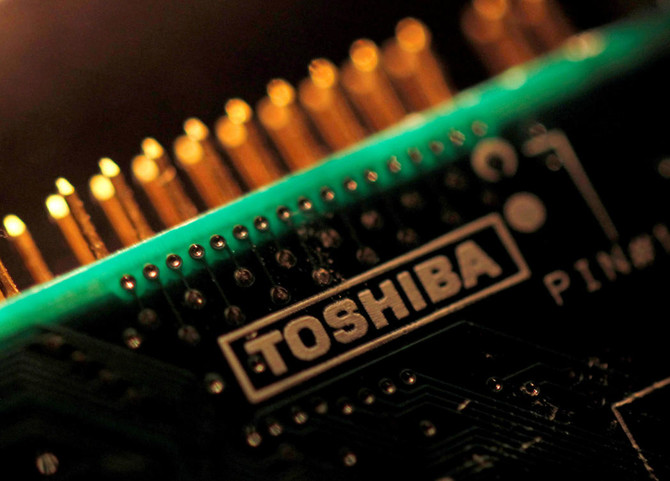
Toshiba completes $2.16 billion sale of Westinghouse claims

Liabilities at Westinghouse plunged Toshiba into crisis last year, and the beleaguered Japanese firm put up its prized memory chip business — the world’s second-biggest producer of NAND memory chips — for $18 billion. (Reuters)
Updated 23 January 2018
Follow

Toshiba completes $2.16 billion sale of Westinghouse claims

TOKYO: Toshiba said on Tuesday it has completed the sale of its claims against bankrupt US nuclear unit Westinghouse Electric, a move that allows the Japanese conglomerate to replenish its depleted capital base and remain listed.
The $2.16 billion sale, to a group of hedge funds led by the Baupost Group, will also come with tax benefits and improves Toshiba’s balance sheet by about ¥410 billion.
Liabilities at Westinghouse plunged Toshiba into crisis last year, and the beleaguered Japanese firm put up its prized memory chip business — the world’s second biggest producer of NAND memory chips — for $18 billion.
Toshiba also plans to transfer its stake in Westinghouse to Canada’s Brookfield Business Partners for $1 by March 31. Both deals will help clear a path for Westinghouse to emerge from bankruptcy.
The sale of the claims and a new share issue worth ¥600 billion to overseas funds have helped Toshiba avoid falling into negative net worth for a second consecutive year, allowing it to remain a listed company.
The funds have also meant that it faces less pressure to complete the sale of the chip unit to a consortium led by US private equity firm Bain Capital and some shareholders are pushing Toshiba to reconsider.
Toshiba, however, is sticking with its efforts to complete the sale of the chip unit by the end of March, saying it needs to further bolster the capital base.


Saudi Fund for Development, Omani Ministry of Finance sign MoU to establish industrial city

Updated 6 sec ago
Follow

Saudi Fund for Development, Omani Ministry of Finance sign MoU to establish industrial city

RIYADH: The CEO of the Saudi Fund for Development, Sultan bin Abdulrahman Al-Murshid, and the Omani Minister of Finance, Sultan bin Salem Al-Habsi, signed a development memorandum of understanding to support the establishment of the Thumrait Industrial City Project in Oman.

The project is funded by Saudi Arabia through the SFD with $40 million.

The signing ceremony was attended by the Saudi Ambassador to Oman, Ibrahim bin Saad bin Bishan, and several officials from both sides.

The MoU aims to develop the industrial, logistical, developmental, and social sectors in the Dhofar Governorate through the establishment of the integrated Thumrait Industrial City, covering an area of ​​approximately 3.94 million sq. meters.

The city will be equipped with all necessary infrastructure services. The project includes the construction and equipping of administrative and service buildings as well as public facilities. It also includes road works and electrical installations, as well as water networks and the construction of two wastewater treatment plants.

Engineering consultancy services will also be provided, reflecting the expected developmental impact in enhancing the industrial and service sectors in the governorate.

The CEO of the SFD affirmed that this MoU reflects the Kingdom’s efforts, through the fund, to support development sectors in Oman and strengthen the close development partnership between the two sides.

This will be achieved through the implementation of high-quality projects that contribute to developing infrastructure and creating an integrated and stimulating environment for industrial and logistical activities, which will positively impact the empowerment of the private sector and enhance economic as well as social development.

For his part, the Omani Minister of Finance emphasized that the signing of this agreement stems from a desire to strengthen developmental, economic, and investment relations and encourage partnerships across various sectors between the two countries.

At a time when the world is getting fragmented due to geopolitical tensions and ongoing wars, Saudi Arabia’s development fund is becoming a beacon of hope, as it continues to provide soft loans and grants for emerging economies.

Established in 1974 and commencing operations in 1975, the Saudi Fund for Development has financed more than 800 development projects in over 100 countries, with a cumulative value exceeding $21 billion.

SFD’s financing spans across multiple sectors, including health, education, and transport, as well as water and energy, with the aim of improving living conditions, enhancing capacity building, and creating job opportunities for millions of people in emerging nations.