

Pakistan, Saudi Fund for Development reaffirm strategic economic partnership

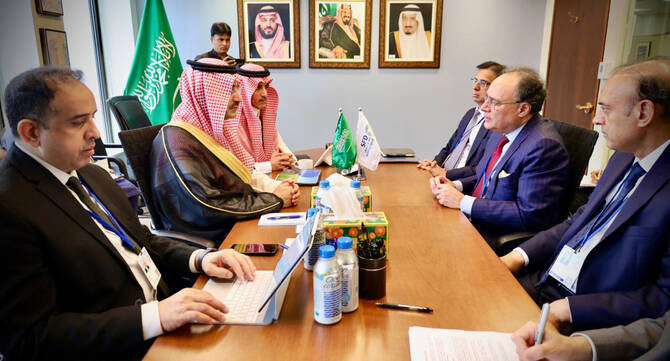
Pakistan’s Finance Minister Muhammad Aurangzeb in a meeting with the CEO of the Saudi Fund for Development (SFD) in Washington, USA, on October 15, 2025. (Foreign Ministry)
Short Url
Updated 15 October 2025
Follow

Pakistan, Saudi Fund for Development reaffirm strategic economic partnership

  • SFD has financed about $1.2 billion in Pakistan projects and over $533 million in grants since 1976
  • Saudi Arabia remains Pakistan’s top remittance source with about 2.64 million Pakistani workers

ISLAMABAD: Pakistan’s Finance Minister Muhammad Aurangzeb this week met the CEO of the Saudi Fund for Development (SFD) to reaffirm Pakistan’s strategic partnership with the Kingdom as Islamabad seeks to deepen ties with one of its most important development and financing partners amid a renewed push to attract investment and support reforms.

Saudi Arabia has long been a pillar of Pakistan’s external financing and household income mix. SFD says it has financed more than 18 development projects and programs worth about $1.2 billion, alongside over $533 million in grants since 1976. 

“Senator Aurangzeb also met H.E. Sultan Abdulrahman Al-Marshad ... where he reaffirmed the strategic partnership between Pakistan and the Kingdom of Saudi Arabia,” the finance division said in a statement after the meeting between the Pakistani finance minister and SFD CEO.

The meeting formed part of the finance minister’s broader Washington schedule on the sidelines of the IMF–World Bank Annual Meetings, where Pakistan has pressed its case for investment, climate-resilient development, and support for a reform program aimed at stabilizing growth and strengthening the external account.

Aurangzeb’s discussion with Al-Marshad also covered infrastructure priorities, notably the M-6 highway and the ML-1 railway line upgrade, as well as skills development and digital infrastructure, areas aligned with Pakistan’s broader push to improve logistics, productivity and public service delivery. SFD, for its part, has highlighted ongoing health, hydropower and transport initiatives in Pakistan and notes that in 2024 it signed 17 loan agreements worth SR3.7 billion (approximately $985 million) across 13 countries, signaling continued capacity to support partner economies.

The meeting underscores a decades-long relationship that blends development lending with short-term balance-of-payments support. SFD notes cumulative Pakistan operations spanning social infrastructure, transport, energy, water and sanitation. The Kingdom has also supported Pakistan with a $3 billion State Bank deposit, repeatedly rolled over, most recently in December 2024, and deferred oil payments of about $1.2 billion under a facility agreed in February 2025 to ease near-term pressures.

Meanwhile, about 2.64 million Pakistanis live and work in Saudi Arabia, and the Kingdom is the largest single source of workers’ remittances to Pakistan. 

According to the State Bank of Pakistan, remittances from Saudi Arabia totaled around $737 million in August 2025 and $751 million in September 2025, the highest among all source countries. 


Afghans in Pakistan say resettlement hopes dashed after US froze visa applications

Updated 10 sec ago
Follow

Afghans in Pakistan say resettlement hopes dashed after US froze visa applications

  • Thousands fleeing Taliban rule in 2021 now face stalled US immigration cases, uncertain legal status in Pakistan
  • Refugees fear policy shift could trigger deportations as Islamabad pressures undocumented Afghans to leave

ISLAMABAD: Afghans stranded in Pakistan while awaiting US resettlement said on Thursday Washington’s decision to pause immigration applications has shattered their expectations of relocation and left them vulnerable to possible mass deportations by Islamabad.

 The policy, announced by the Trump administration earlier this week, halts processing of green cards, citizenship petitions and Special Immigrant Visas (SIV) from 19 countries already under a partial travel ban, including Afghanistan and Somalia.

For thousands who fled Afghanistan after the Taliban seized power in 2021, the move has upended years of waiting.

 “It was very shocking, a traumatic situation, what we had hoped for, it went against our aspirations,” said Ihsan Ullah Ahmadzai, an Afghan journalist and human rights activist living in Pakistan.

He said the pause risked giving Pakistani authorities “a green light” to deport Afghans whose US cases are now indefinitely on hold.

Pakistan has ordered undocumented foreigners to leave or face expulsion, a directive that has intensified pressure on Afghan refugees who viewed US immigration processing as their only viable route to safety.

For Afghan refugee Fatima Ali Ahmadi, the decision has deepened uncertainty.

“I’m sad about my future because of this I can’t reach my hopes. I want to be an athlete and a journalist, but it’s impossible in Pakistan or Afghanistan,” she said, adding that she fled to Pakistan to escape Taliban threats.

She urged the US government to allow vulnerable Afghans to continue their cases. “We are just looking for safety and a chance to rebuild our lives,” she said.