BRUSSELS: Eurozone finance ministers approved a fresh cash injection for Greece on Monday to put the country on the road to finally leaving its long and painful bailout program later this year.
The 6.7-billion-euro tranche is the latest from Greece’s third financial rescue package since 2010, when its debt crisis brought the euro close to collapse.
The current program agreed in 2015 runs until August this year, after which the southern European nation hopes to fully return to market financing and get back on its own two feet.
EU Economic Affairs Commissioner Pierre Moscovici said after finance ministers gave the green light to the latest tranche at a meeting in Brussels that 2018 “will be a decisive year for Greece.”
“This will be the year when Greece finally leaves this long period of financial assistance, marked by very hard tests for the Greek people, but which allow Greece to emerge stronger and more resilient,” France’s Moscovici told a news conference.
Portugal’s Mario Centeno, head of the Eurogroup of 19 finance ministers from the single currency, said they would also start technical work on debt relief for Athens, although that still faces opposition from Germany.
Greece’s huge debt pile is equivalent to an unsustainable 180 percent of its annual economic output.
“Looking ahead we can start with the technical work on debt relief measures,” Centeno said, particularly those that linked debt relief to economic growth.
The latest tranche will be split into 5.7 billion euros paid in February and the remaining one billion paid later in the spring once eurozone officials have checked that Greece has carried out all the reforms, the Eurogroup said in a statement.
Centeno, chairing the Eurogroup for the first time after replacing Jeroen Dijssebloem of the Netherlands, said the cash would cover debt servicing, arrears and boosting Greece’s cash reserves, said Centeno.
“This is critical to ensure Greece’s full market access,” he added.
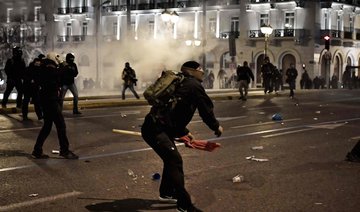
Thousands of people demonstrated in Athens one week ago against the set of around 100 austerity measures imposed by Greece’s creditors, which include a politically-charged curb on industrial action.
The reforms also allow for the foreclosure and auction of properties owned by bankrupted borrowers. Both measures were fiercely opposed by leftists and trade unions.
The Greek government insists that the changes are limited, and Prime Minister Alexis Tsipras rejected criticism “as a shameless lie” that his left-wing administration was out to make strikes illegal.
Debt-laden Greece has received three multi-billion-euro bailouts since 2010.
The current rescue program — a package worth 86 billion euros agreed after months of talks that almost saw Greece crash out of the euro — is financially supported by eurozone states but not the International Monetary Fund.


Greece gets fresh cash on road to leaving bailout

Greece gets fresh cash on road to leaving bailout



In rare overlap, Chinese Muslims observe Ramadan with Lunar New Year
- Lunar New Year started on Feb. 17 and is celebrated for another two weeks
- Chinese Indonesians make up about 3 percent of the Indonesian population
JAKARTA: Every year, on the first day of Lunar New Year, Febriani visits relatives and gathers for a feast with her Chinese Muslim family, part of a long-standing tradition honoring their ethnic heritage.
But this year, as Thursday marks the beginning of Ramadan, she is celebrating two important occasions within the same week, in a rare overlap that last took place in 1995.
“I’m very happy and grateful that Lunar New Year and Ramadan are celebrated so closely. I observe both every year, so it’s truly special,” she told Arab News.
Widely observed across Asia, the Lunar New Year or Chinese New Year festival is believed to date back to the 14th century B.C., to the times of the Shang Dynasty, China’s earliest ruling dynasty, when people celebrated good harvests.
In 2026, it started on Feb. 17 and is celebrated for another two weeks. For many, celebrations typically involve elaborate feasts, giving children pocket money in red envelopes, and watching dragon dance parades.
In Indonesia, Chinese-descent citizens make up an estimated 3 percent of the country’s Muslim-majority population of more than 280 million. While most are either Buddhists or Christians, a small minority professes Islam.
For 25-year-old Febriani, both Lunar New Year and Ramadan are equally meaningful.
“The two celebrations teach us to strengthen bonds, to share with one another, and to become closer to family,” she said.
“They are both important to me because they happen only once every year and they’re always an occasion to gather with the extended family. It is also a chance to self-reflect and strengthen relationships with your loved ones.”
For Naga Kunadi, whose family lives in Central Java’s Cepu district, Chinese New Year is all about embracing his ethnic identity.
Earlier in the week, his family was busy preparing for the new year’s feast, which was a fusion of Chinese and Indonesian dishes, such as claypot tofu, meatball soup and shumai, or steamed dumplings.
“To celebrate Chinese New Year, we prepared halal Chinese food at home. It’s also a way to introduce to my children the traditions from our Chinese side, but there’s a bit of a fusion because my wife is Javanese,” Kunadi told Arab News.
Kunadi, an Islamic teacher at the Lautze Mosque in Jakarta, sees both Chinese New Year and Ramadan as opportunities to teach important life values for his two children.
Upholding Chinese New Year traditions with his family is for him a way of preserving his ethnic heritage.
“We want to preserve cultural values as long as it does not clash with our religion,” he said.
“If we leave our culture behind, we might lose our identity, so this is something I want to teach my children.”
The fasting month of Ramadan, on the other hand, gives him a chance to teach and practice honesty.
“I want to focus on the religious and moral aspects during the holy month of Ramadan, when we practice honesty on a personal level,” Kunadi said.
“There’s always an opportunity to eat or snack in secret without anybody knowing, but we train ourselves not to do that. For me, Ramadan is a time for everyone to put honesty into practice, including myself and my children.”


