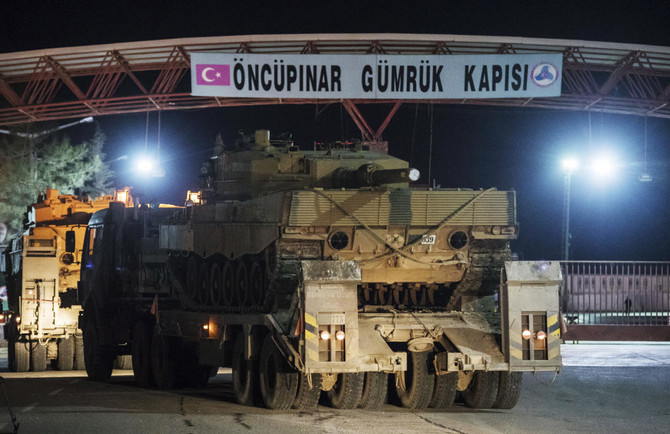
ANKARA: Turkish tanks and ground troops surged across the border into northwest Syria on Sunday, on the second day of Operation Olive Branch against Kurdish forces in Afrin.
The ground assault, supported by 25,000 fighters from the Free Syrian Army (FSA), followed a day of air strikes and artillery shelling that continued on Sunday. The Turkish military said they struck more than 150 Kurdish military targets.
The operation is aimed at driving out Syrian Kurdish forces of the People’s Protection Units (YPG), which Turkey views as a terrorist group linked to the outlawed PKK.
The Turkish military said their forces had driven several kilometers into Afrin and captured the villages of Shinkal and Hay Ughlu, but the YPG said they had repelled the attack.
Analysts told Arab News they believed Turkey had obtained limited Russian support for the military operation by agreeing to limit it to a 30-kilometer zone on the border, rather than capturing all of Afrin.
Kerim Has, a lecturer in Turkish-Russian relations at Moscow University, said there appeared to be an agreement between Ankara and Moscow on specific targets and a strict deadline, which meant a limited operation by the Turkish military.
“Moscow probably did give the green light by opening the airspace over Afrin and withdrawing its soldiers from the region on the condition that the territory captured by Turkey would be turned over to Assad regime control after some time freed from the YPG,” he said.
Metin Gurcan, a former military officer and security analyst at the Istanbul Policy Center, said the military operation would face difficulties.
“The terrain of Afrin is hilly, which makes it challenging for armor and favorable for guerilla warfare, providing shelter against airstrikes,” he told Arab News. “The resistance of the YPG forces will also determine the duration.”
The military operation also risks straining Turkey’s ties with the US, which views the YPG as an ally in the fight against Daesh. The US has moved to allay such fears. Pentagon spokesman Major Adrian Rankine-Galloway said: “We recognize Turkey’s security concerns regarding the PKK, a US-designated foreign terrorist organization. The US does not provide any support to the PKK.”
However, Abdullah Agar, a security expert and retired special warfare and commando officer, said: “The US has tested Ankara’s most profound sensitivities, which relate to state security and the unitary state, and that has resulted in Turkey’s determination in this operation.
“I don’t believe in the sincerity of the US statements on this operation. The Pentagon has always preferred to support, train and equip the groups Turkey considers terror groups. Its sincerity will be tested through its policy toward, and actions against, the PKK.”
Syrian opposition spokesman Yahya Al-Aridi told Arab News the military operation was taking place because extremist Kurdish parties such as the PYD and PKK posed a threat to the local population in Afrin, and to Turkey.
Al-Aridi rejected President Bashar Assad’s claims that the Turkish offensive was part of Ankara’s support for extremist groups.
“Anything that does not suit the regime is labelled terrorism,” he said. “The PYD and PKK are the ones who are terrorizing the local population.”
Hisham Marwa, a representative of Syria’s opposition High Negotiations Committee, told Arab News many Syrian people in the area were opposed to Kurdish militants who were pursuing their own agenda.
Marwa voiced concern about the plight of civilians. “We do not want civilians to be affected by the conflict. Kurds are Syrians too, and their safety is a sensitive matter for all Syrians.”
He called on Kurdish militants to respect the human rights of the local population and avoid any confrontation with the Free Syrian Army.
Jaish Al-Thuwar, an Arab group affiliated to YPG forces in Afrin, denied reports on Sunday that they had switched sides and joined opposition forces taking part in the Turkish operation.