

Turkey begins Afrin operation; shells Syrian Kurds

1 / 2
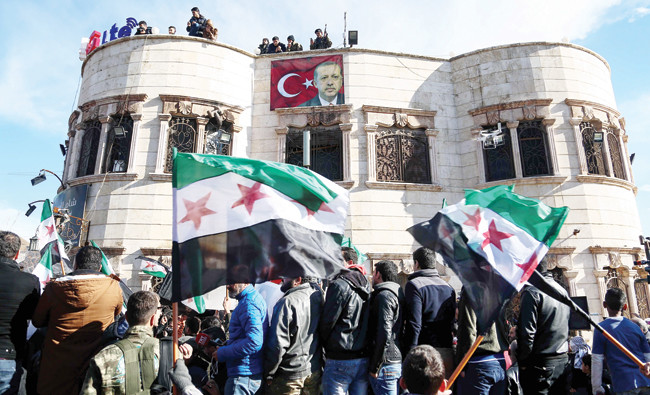
People wave flags during a demonstration in the opposition-held town of Azaz, northern Syria, on Friday, in support of a Turkish military operation in Afrin. (AFP)
2 / 2
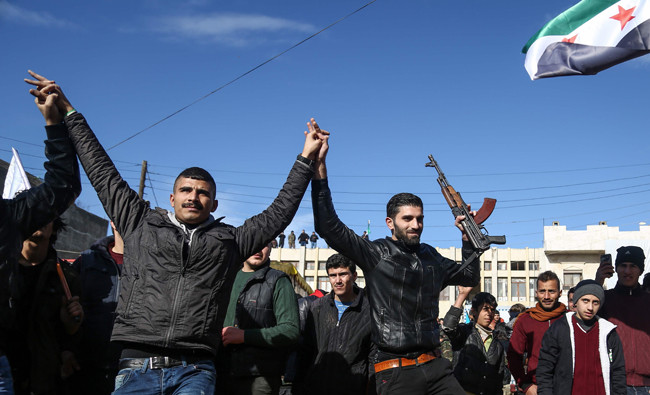
Syrians demonstrate in the rebel-held town of Azaz in northern Syria on January 19, 2018, in support of a joint rebel and Turkish military operation against Syrian-Kurdish forces in Afrin. (AFP)
Updated 22 January 2018
Follow

Turkey begins Afrin operation; shells Syrian Kurds

ANKARA: The Turkish military on Friday shelled several Democratic Union Party (PYD) targets in the besieged Syrian border town of Afrin.

Ankara considers the Syrian-Kurdish PYD an offshoot of the outlawed Kurdistan Workers’ Party (PKK), which is waging an insurgency against the Turkish state.

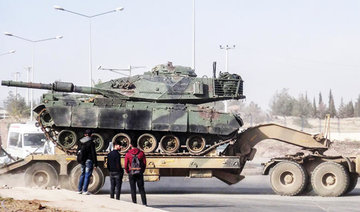
To encircle Kurdish-held Afrin, Ankara-backed Free Syrian Army (FSA) fighters were deployed to Syria’s northern Azaz region near the Turkish border on Thursday. Turkish forces and military equipment were also amassed at the border.

On Friday, about 170 Russian troops began pulling out of the region ahead of Ankara’s imminent military operation there, Turkish media reported.

The state-run Anadolu Agency reported that Russian soldiers are set to withdraw 17 km southward to the Nubul and Zehra districts, which are controlled by the Syrian regime. But there are reports that some Russian police remain in Afrin.

The reported withdrawal, which has not yet been confirmed by Russian official sources, came hours after a meeting between Turkey’s and Russia’s military and intelligence chiefs in Moscow on Thursday. Damascus has warned it could shoot down any Turkish planes in Syrian airspace.

Meanwhile, Turkey’s military has reportedly built its fourth observation post in the de-escalation zone in the Syrian province of Idlib, as part of the Astana deal that was brokered by Ankara, Moscow and Tehran last year.

Turkey was tasked with setting up 14 military observation posts around the zone to monitor de-escalation efforts, but Moscow has accused it of stalling in fulfilling its commitments.

“We are still waiting for Turkey to set up the observation posts as soon as possible,” Russian Foreign Minister Sergey Lavrov said on Jan. 11.

Commentators say an increase in Ankara’s efforts in Idlib is aimed at securing Russia’s blessing for a Turkish offensive in Afrin.

“Russia is trying to play its own game in Afrin,” Timur Akhmetov, a researcher at the Russian International Affairs Council, told Arab News.

“Due to the fact that Moscow’s priority is to strengthen the Syrian government, Russia could be trying to influence the Afrin-based PYD to compromise with Damascus on issues of security.”

But Moscow will only give Afrin to Turkey if it gets something significant in return, he said. “Turkey and Russia may agree on a handover of the canton to the (Syrian) central government,” Akhmetov added.

Enes Ayasli, a research assistant at Sakarya University in Turkey, said Russia, with five military bases in Afrin, is the primary actor that Turkey needs to consider in terms of its operation.

“Contrary to the US, which is adopting a wait-and-see policy, Russia has been using Afrin as a trump card to promote security in western Idlib,” he told Arab News, adding that there is a trade-off between Ankara and Moscow.

But experts are cautious about the full opening of Afrin’s airspace to Turkish flights. “Turkey has missiles and howitzers that can destroy predetermined targets given Afrin’s proximity to the Turkish border,” said Ayasli.

“So it’s not a must for Ankara to wait for approval for the opening of Afrin’s airspace. The operation could be carried out under any circumstances,” he added.

“Turkey’s military plans not only include Afrin but also (the Arab-majority town of) Manbij, where there’s a US military base. The increasing US sphere of influence in Syria is a threat (to Ankara),” he said.

“Properly managing the conflict of interests between Russia and the US will strengthen Turkey’s position in Syria.”
Israel warns will suspend several aid groups from Gaza

Updated 4 sec ago
Follow

Israel warns will suspend several aid groups from Gaza

  • Ministry says organizations that failed to submit list of Palestinian employees have been told their licenses will be revoked from January 1
JERUSALEM: Israel warned on Tuesday that it would suspend from January several aid organizations operating in Gaza for failing to provide details about their Palestinian staff, accusing two Doctors Without Borders employees of links to militant groups.
The Ministry of Diaspora Affairs and Combating Antisemitism said in a statement the move was part of Israel’s decision to “strengthen and update” regulations governing the activities of international NGOs in the Palestinian territory.
“Humanitarian organizations that fail to meet security and transparency requirements will have their licenses suspended,” the ministry said.
It added that organizations which “failed to cooperate and refused to submit a list of their Palestinian employees in order to rule out any links to terrorism” had received formal notice that their licenses would be revoked as of January 1.
The organizations concerned — whose names were not disclosed — were ordered to cease all activities by March 1.
The ministry said the groups were given 10 months to provide the requested information but “nonetheless failed to comply with the requirements.”
The ministry told AFP earlier this month that as of November 25, approximately 100 registration requests had been submitted and “only 14 organization requests have been rejected.”
“The remainder have been approved or are currently under review,” it added.
In its statement on Tuesday, the ministry alleged after an investigation that the international medical charity Doctors Without Borders (MSF) had employed two individuals with links to Palestinian militant groups.
“In June 2024, a member of Palestinian Islamic Jihad was identified as an employee of the organization,” it said.
“In September 2024, another MSF employee was identified as a Hamas sniper.
“Despite repeated requests, the organization did not provide full disclosure regarding the identities and roles of these individuals,” the statement added.
When contacted, MSF said it “would never knowingly employ people engaging in military activity.”
“Any employee who engages in military activity would pose a danger to our staff and our patients.”
The ministry’s statement did not say whether MSF’s license had been revoked.
“In terms of registration, MSF continues to engage and discuss with Israeli authorities,” the charity said. “We have not yet received a decision on re-registration.”
The ministry said its latest measures would not affect the delivery of aid to Gaza.
“Only a limited number of organizations — less than 15 percent — were found to be in violation of the regulatory framework,” it said.
Several NGOs have told AFP the new rules will have a major impact on aid distribution in Gaza.
The amount of aid entering Gaza remains inadequate.
While the October 10 ceasefire agreement stipulated the entry of 600 trucks per day, only 100 to 300 are carrying humanitarian aid, according to NGOs and the United Nations.