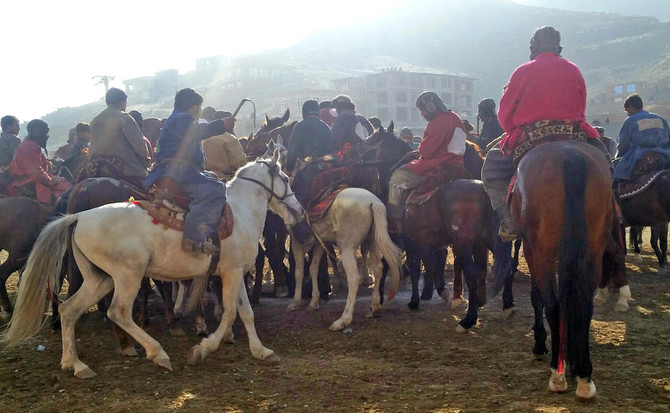
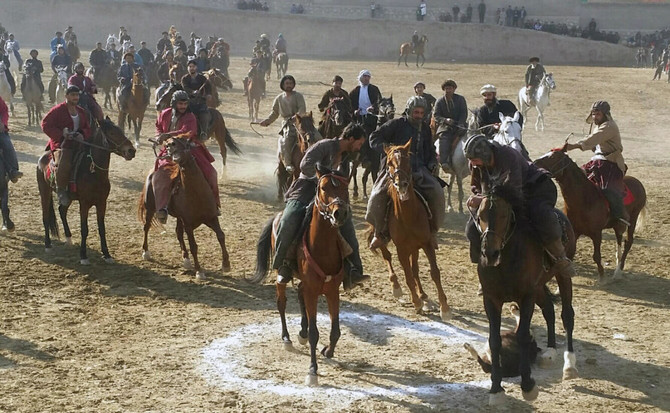
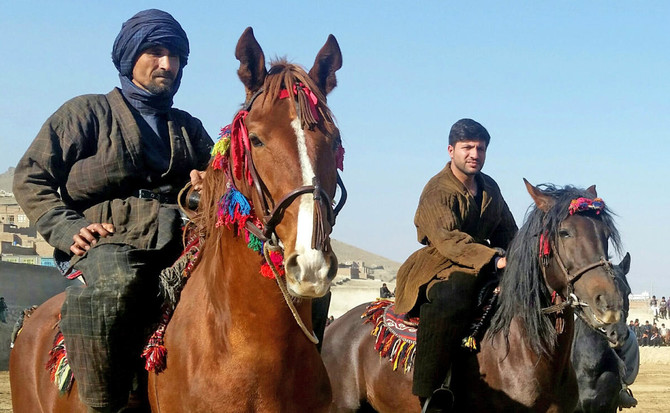
KHAIR KHANA PASS: At the foot of a dusty hill to the north of Kabul, the fierce-looking Afghan wrestlers on horseback rush toward “the circle of justice,” drawn on the ground with lime, vying to be first to pick up the carcass of a 50kg animal.
Anyone who, whip in his teeth, manages to secure the still body, amid the whipping of other riders, gallops a lap of the field before throwing the carcass back in the same circle.
Afghanistan’s most expensive and ancient national sport, Buzkashi, which literally translates as “dragging the goat” in Persian, has been kept alive with much passion for centuries. The country celebrates the game’s season – usually from November or December until the end of March – with weekly matches that attract hundreds of spectators.
While the north takes pride in being the center of the sport, Buzkashi is equally popular in Kabul as well. After Mizar-i-Sharif, the capital of Balk province, Khair Khana Pass is the new center of holding the games nowadays.
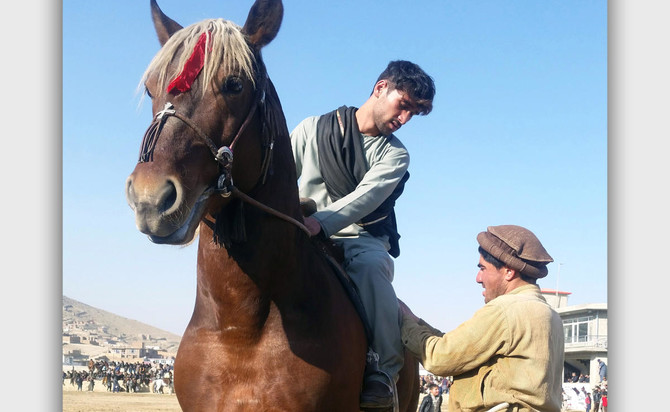
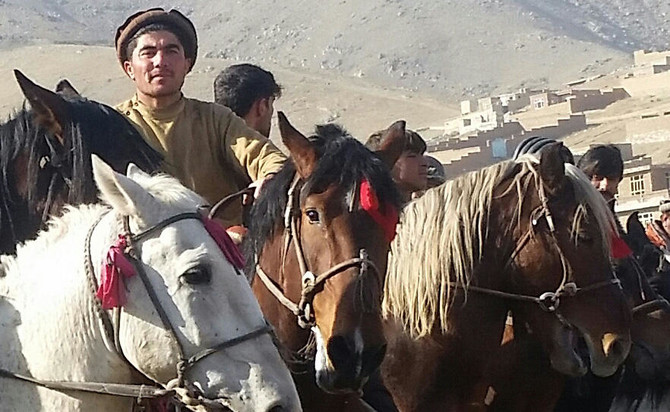
The value of a good Buzkashi steed can go up to $200,000, Mohammad Nayem Karimi, an organizer of the Buzkashi tournament, told Arab News during an event held Friday in Khair Khana Pass, where hundreds of male spectators, plus a few girls, had gathered to cheer the sport.
The annual fee of a master player, called “Chapandaz” in local language, can reach $60,000, four times the official salary of an Afghan minister, according to those involved in the sport.
Feeding a horse is equivalent to the monthly cost of food for a middle-class Afghan family, sometimes reaching $900, they said.
“The cost of a fast and strong horse, the salary of a good Chapandaz and feeding of a horse may sound mad or exaggerated, but it is not. We are trying to keep this national sport alive, for the sake of our country. It is our pride and want to keep this alive at any cost,” said Karimi.
Most of the horses are from Central Asia, from where the game made its way into Afghanistan centuries ago.
Only big traders and senior government officials can afford to sponsor teams or run Buzkashi as a passion or pastime, Raes Abdul Moqim, a prominent player from the north, told Arab News.
The country’s former first Vice President, the late Mohammad Qasim Fahim, and his successor, General Abdul Rashid Dostum, who now lives in exile in Turkey, were among the top sponsors of this game. They both also rode at times as Chapandaz, said Moqim.
With Dostum and Fahim’s departure and other major sponsors assassinated, two of them killed in bomb blasts during Buzkashi matches in the northern areas, the sport faces a tough future. There is lack of attention from authorities, mainly owing to chronic conflicts and shortage of resources, while factional rivalries among commanders in the north have also greatly affected the game.
Buzkashi horses are “bred as a symbol of wealth and power,” said Moqim. There are more than 150 Buzkashi horse owners in Balkh, where some own more than 400 steeds. An event can usually fetch up to 500 horses but this figure can go up to 2,000 in case of wedding celebrations, he added.
Players from various parts of northern Afghanistan, where these matches cannot be held regularly owing to fear of terror attacks, had come in great numbers to take part in the game in Kabul’s pass on Friday, the organizers said.
Four of the top Chapandaz were each given $200 by a trader as a bonus for starring in a recent match.
Twenty-five-year-old Azizullah Barakezai, who came all the way from northern Baghlan to the pass, has been undergoing the tough training to become a Chapandaz for the past 10 years.
“My family has inherited this from my forefathers and I am trying to keep this as long as I can physically and financially,” he said proudly before the game.
“We have a federation for Buzkashi, but it has contributed nothing to keep this sport going. It only exists in name but we are trying our best to keep this [sport] alive,” Barekzai told Arab News. Regional players from neighboring northern countries also take part individually in annual competitions at the start of the Afghan year, which begins in March in the northern city of Mazar-i-Sharif, said Fatehullah, a player from Jowjzan province.
A tradition inherited over generations, Buzkashi is more than a sport for the Afghans, where the steed must be as strong, fast, and brave as its rider to leave a mark on the game.


Carcass battle is a treasured tradition

Carcass battle is a treasured tradition

Fans bid farewell to Japan’s only pandas
TOKYO: Panda lovers in Tokyo said goodbye on Sunday to a hugely popular pair of the bears that are set to return to China, leaving Japan without the beloved animals for the first time in half a century.
Loaned out as part of China’s “panda diplomacy” program, the distinctive black-and-white animals have symbolized friendship between Beijing and Tokyo since the normalization of diplomatic ties in 1972.
Some visitors at Ueno Zoological Gardens were left teary-eyed as they watched Japan’s only two pandas Lei Lei and Xiao Xiao munch on bamboo.
The animals are expected to leave for China on Tuesday following a souring of relations between Asia’s two largest economies.
“I feel like seeing pandas can help create a connection with China too, so in that sense I really would like pandas to come back to Japan again,” said Gen Takahashi, 39, a Tokyo resident who visited the zoo with his wife and their two-year-old daughter.
“Kids love pandas as well, so if we could see them with our own eyes in Japan, I’d definitely want to go.”
The pandas’ abrupt return was announced last month after Japan’s conservative premier Sanae Takaichi hinted Tokyo could intervene militarily in the event of any attack on Taiwan.
Her comment provoked the ire of Beijing, which regards the island as its own territory.
The 4,400 lucky winners of an online lottery took turns viewing the four-year-old twins at Ueno zoo while others gathered nearby, many sporting panda-themed shirts, bags and dolls to celebrate the moment.
Mayuko Sumida traveled several hours from the central Aichi region in the hope of seeing them despite not winning the lottery.
“Even though it’s so big, its movements are really funny-sometimes it even acts kind of like a person,” she said, adding that she was “totally hooked.”
“Japan’s going to be left with zero pandas. It feels kind of sad,” she said.
Their departure might not be politically motivated, but if pandas return to Japan in the future it would symbolize warming relations, said Masaki Ienaga, a professor at Tokyo Woman’s Christian University and expert in East Asian international relations.
“In the future...if there are intentions of improving bilateral ties on both sides, it’s possible that (the return of) pandas will be on the table,” he told AFP.


