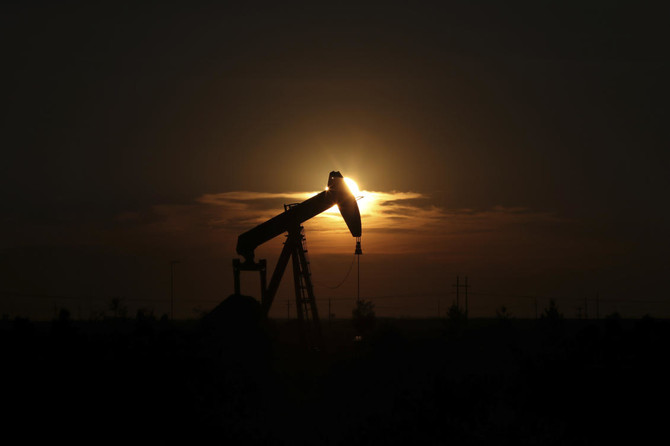
LONDON: The rapid growth of US shale producers will shortly knock Saudi Arabia from second to third place among the world’s oil-producing titans, with only Russia ahead, the International Energy Agency said on Friday.
With Venezuelan output plummeting amid political and economic turmoil, the IEA indicated the Kingdom could lose its number two position in 2018.
“Very soon US crude production may overtake that of Saudi Arabia and also rival Russia’s,” it said.
The backdrop is a tightening market amid a significant fall in Venezuelan production, geopolitical uncertainty, continuing falls in inventory levels and OPEC/Russia supply cuts.
But the upshot, said the agency, is likely to be a sizeable pick-up in non-OPEC production. After adding in barrels from Brazil, Canada and other growth countries, and allowing for falls in Mexico, China and elsewhere, total non-OPEC production will increase by 1.7 million barrels per day (bpd), IEA said in its latest world oil market report.
The agency said: “This represents, after the downturn in 2016 and the steady recovery in 2017, a return to the heady days of 2013-2015 when US-led growth averaged 1.9 million bpd.
The factors contributing to investor interest in oil include the possible unraveling of the Iran nuclear deal and recent demonstrations in the country, disruption to the industry in Libya, and the closure of the Forties pipeline system.
Although these factors might have faded somewhat, there are others at work, said the IEA. “The general perception that the market has been tightening is clearly the overriding factor and, within this overall picture, there is mounting concern about Venezuela’s production.
A plunge in Venezuelan supply cut OPEC crude output to 32.23 million bpd in December, boosting compliance to 129 percent. Declines are accelerating in Venezuela, which posted the world’s biggest unplanned output fall in 2017.”
Said the IEA: “Venezuelan production is now about half the level inherited by president Chavez in 1999 - and in December output was 490,000 bpd a day lower than a year ago, having fallen to 1.61 million bpd.
The agency said it was reasonable to assume that the decline will continue, but it was impossible to say at what rate. But if output and exports sank further, it was fair to assume other producers would probably step in with the flexibility to deliver oil similar in quality to Venezuela’s shipments to the US and elsewhere, including China.
Market tightening in the final months of 2017 was evident and continued into 2018. OECD commercial stocks declined for the fourth consecutive month in November, by 17.9 million barrels, with a large fall in middle distillates, said IEA. Preliminary data for December suggested a further fall of 42.7 million barrels.
“Additionally, global crude oil markets saw an exceptionally tight fourth quarter in 2017 as the large draw in OECD crude stocks coincided with a decline in Chinese implied crude balances.”
On the demand side, estimates for 2017 and 2018 were roughly unchanged at 97.8 million bpd and 99.1 million bpd respectively.
“The slowdown in 2018 demand growth is mainly due to the impact of higher oil prices, changing patterns of oil use in China, recent weakness in OECD demand and the switch to natural gas in several non-OECD countries. Production was steady on a year ago as non-OPEC gains of nearly 1 mb/d offset declines in OPEC.”
The price of Brent crude oil closed earlier this week above $70 for the first time since Dec. 2, 2014, and money managers have placed record bets on the recent upward momentum continuing. Whether or not the recent price rise has run out of steam and “seventy really is plenty” remained to be seen, said the agency.
“However, such are the geopolitical uncertainties and the ever-dynamic prospects for US shale that we should expect a volatile year,” it added.

US crude output to overtake Saudi Arabia “very soon”
Dubai Financial Market reports $288.6m profit for 2025 - up 159%
RIYADH: Dubai Financial Market reported net profit before tax of 1.06 billion dirhams ($288.6 million) in 2025, up 159 percent from a year earlier.
The improved performance was driven by sustained confidence in Dubai’s capital markets and a year of heightened trading activity, with momentum continuing through the fourth quarter.
The results coincided with the exchange marking 25 years since its establishment in 2000, highlighting its evolution into a more globally connected and institutionally active marketplace, according to a report by the Emirates News Agency.
For the full year ending Dec. 31, total consolidated revenues rose to 1.28 billion dirhams, while earnings before interest, tax, depreciation and amortization reached 1.13 billion dirhams, translating into an EBITDA margin of 88 percent.
The results come as Dubai pushes ahead with its D33 agenda to double the emirate’s economy by 2033 and deepen its position as a global financial hub.
The UAE central bank has pointed to solid capital markets momentum and low sovereign risk indicators in 2025, underscoring the confidence backdrop for higher trading activity.
Helal Al-Marri, chairman of DFM, said: “DFM’s performance in 2025 reflects the continued strength of Dubai’s capital markets and the confidence of global investors in the emirate’s economic vision.
“As we mark 25 years since the establishment of DFM, the exchange continues to play a central role within Dubai’s financial ecosystem, supporting transparency, liquidity, and long-term market development in line with the Dubai Economic Agenda D33.”
Fourth-quarter net profit before tax increased to 124.4 million dirhams from 110.6 million dirhams in the same period of 2024, reflecting sustained trading momentum toward year-end.
Market performance remained strong throughout the year, with the DFM General Index rising 17.2 percent and total market capitalization reaching 992 billion dirhams.
Average daily traded value climbed to 692 million dirhams, while total traded value amounted to 174 billion dirhams, marking the highest liquidity levels in more than a decade.
The average daily number of trades rose 31 percent year on year, driven by increased institutional and cross-border activity.
Hamed Ali, CEO of DFM and Nasdaq Dubai, said: “In 2025, DFM continued to build on the progress of recent years, supported by steady trading activity, growing international participation, and ongoing enhancements to our market infrastructure.”
He added: “Our focus throughout the year remained on improving market accessibility, supporting a broad range of investment activity, and ensuring the market continues to operate efficiently for both issuers and investors. As we mark 25 years of DFM, we remain committed to developing the market in line with Dubai’s long-term capital markets ambitions.”
Investor participation broadened further during the year, with 97,394 new participants joining the market, of which 84 percent were foreign.
Foreign investors accounted for 51 percent of total trading value, while institutional investors represented 71 percent of trading activity.
The total investor base reached 1.25 million, reinforcing DFM’s position as a destination for regional and international capital.
Capital-raising activity also expanded DFM’s sectoral footprint.
The exchange hosted Dubai Residential REIT, the region’s first publicly traded residential leasing real estate investment trust, which attracted subscriptions 26 times over and total demand of 56 billion dirhams.
It also saw the secondary public offering of Emirates Integrated Telecommunications Co., alongside the initial public offering of ALEC Holdings, the UAE’s largest construction-sector listing to date, which generated subscriptions of 30 billion dirhams, representing an oversubscription of 21 times.
Innovation and market development remained a focus in 2025, with the launch of a centralized securities lending and borrowing framework and further enhancements to digital platforms, including AI-enabled features on iVestor.
DFM also strengthened its international engagement through global roadshows and partnerships, including a memorandum of understanding with the Taiwan Stock Exchange aimed at supporting cross-border listings and investor outreach.
Looking ahead, the exchange said it remains focused on enhancing liquidity, expanding product offerings, and deepening global connectivity, supported by a strong financial position and a diversified investor base.