ASTANA, Kazakhstan: Fifty-two people were killed Thursday when the bus they were traveling on caught fire in Kazakhstan, the central Asian nation’s emergency services ministry said in a statement.
“On January 18 at 10:30 am (0430 GMT), a bus caught fire ... 55 passengers and two drivers were on board. Five people who managed to escape are receiving medical assistance. The rest died on the spot,” the ministry said, without elaborating on the cause of the blaze.
The bus driver said the passengers were Uzbek nationals while the vehicle was registered in Kazakhstan, emergency services ministry official Ruslan Imankulov said.
He said the fire spread through the bus extremely quickly.
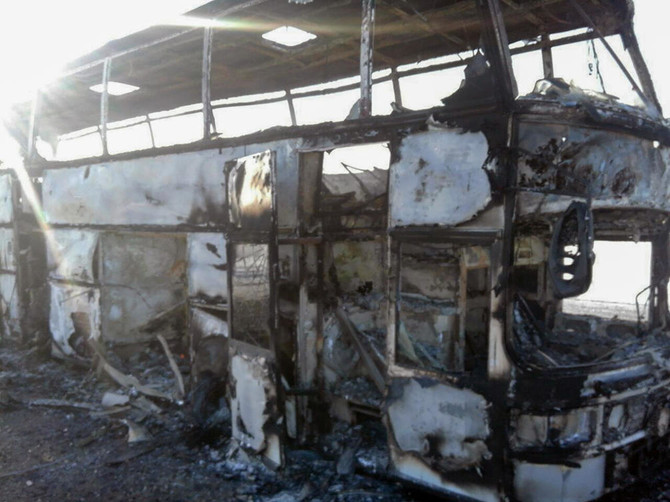
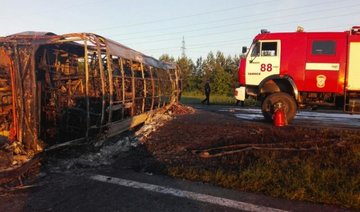
Video broadcast by Russian and Kazakh media showed black smoke and flames billowing from the vehicle on a flat stretch of road carving through a snowy steppe. A photograph taken later showed the vehicle completely charred.
The ministry named the vehicle as a Hungarian-made Ikarus. These buses are still widely used in ex-Soviet nations, even though they are often decades old.
The bus was headed from the Russian city of Samara on the Volga river to the town of Shymkent in southern Kazakhstan, the ministry said.
The tragedy, which struck in the area around the city of Aktobe, came less than three years after 16 people, including three children, died in the country when a minibus collided with a van on April 20, 2015.

52 people killed in Kazakhstan bus fire
Indian teacher who created hundreds of learning centers wins $1 million Global Teacher Prize
- Nagi is the 10th teacher to win the award, which the foundation began handing out in 2015
DUBAI: An Indian teacher and activist known for creating hundreds of learning centers and painting educational murals across the walls of slums won the $1 million Global Teacher Prize on Thursday.
Rouble Nagi accepted the award at the World Governments Summit in Dubai in the United Arab Emirates, an annual event that draws leaders from across the globe.
Her Rouble Nagi Art Foundation has established more than 800 learning centers across India. They aim to have children who never attended school begin to have structured learning. They also teach children already in school.
Nagi also paints murals that teach literacy, science, math and history, among other topics.
The prize is awarded by the Varkey Foundation, whose founder, Sunny Varkey, established the for-profit GEMS Education company that runs dozens of schools in Egypt, Qatar and the UAE.
“Rouble Nagi represents the very best of what teaching can be – courage, creativity, compassion, and an unwavering belief in every child’s potential,” Varkey said in a statement posted to the Global Teacher Prize website. “By bringing education to the most marginalized communities, she has not only changed individual lives, but strengthened families and communities.”
Nagi plans to use the $1 million to build an institute that offers free vocational training.
Stefania Giannini, UNESCO Assistant Director-General for Education, said Nagi’s prize “reminds us of a simple truth: teachers matter.”
In comments carried on the prize website, Giannini said UNESCO was “honored to join the Global Teacher Prize in celebrating teachers like you, who, through patience, determination, and belief in every learner, help children into school — an act that can change the course of a life.”
Nagi is the 10th teacher to win the award, which the foundation began handing out in 2015.
Past winners of the Global Teacher Prize have included a Kenyan teacher from a remote village who gave away most of his earnings to the poor, a Palestinian primary school teacher who teaches her students about non-violence and a Canadian educator who taught a remote Arctic village of Inuit students. Last year’s winner was Saudi educator Mansour Al-Mansour, who was known for his work with the poor in the kingdom.
GEMS Education, or Global Education Management Systems, is one of the world’s largest private school operators and is believed to be worth billions. Its success has followed that of Dubai, where only private schools offer classes for the children of the foreigners who power its economy.