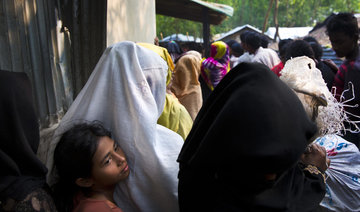
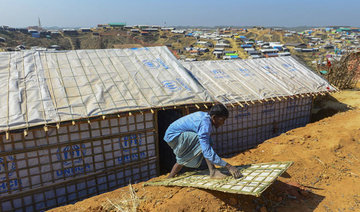
COX’S BAZAR, Bangladesh: Bangladesh has counted more than a million Rohingya refugees living in camps near the border with Myanmar, higher than previous estimates, the head of its registration project said Wednesday as preparations for their return got under way.
The Bangladesh army began biometric registering of the refugees last year after the latest mass influx of Rohingya from Myanmar, where the Muslim minority have faced decades of persecution.
The registration is aimed partly at aiding repatriation of the refugees — a controversial issue as most say they do not want to return.
Bangladesh says it wants to start sending them home next week and has reached an initial agreement with Myanmar to complete the process within two years.
“So far we’ve registered 1,004,742 Rohingya. They are given biometric registration cards,” said Saidur Rahman, a brigadier general with the Bangladesh army who heads the Rohingya registration project.
Several thousand more have yet to be registered, he said.
The figures are higher than those provided by the UN, which estimates there are 962,000 Rohingya living in southeast Bangladesh, near the Myanmar border.
That includes the 655,000 the UN estimates have entered the country since August 25, when the Myanmar military launched a violent crackdown in Rakhine state following attacks by Rohingya militants.
Doctors Without Borders has said at least 6,700 Rohingya Muslims were killed in the first month of the crackdown.
Refugees in Bangladesh have alleged mass rape and widespread arson at the hands of soldiers and the Buddhist majority in Rakhine.
Some of the refugees have been living in Bangladesh for many years, but the repatriation agreement only covers those who have arrived since October 2016.
The two sides said on Tuesday they have agreed to complete the repatriation within a two-year period, the first concrete timeline given for the refugees’ return.
On Wednesday a Bangladesh official said thousands of Rohingya stranded in no man’s land since the latest violence erupted would be among the first to return under the agreement with Myanmar.
“What we’ve proposed to them is that they start with some 6,500 who have been stranded for a long time in no man’s land,” said the official, who asked not to be named.
Rights groups and the UN have expressed serious reservations about starting the process, particularly as Rohingya are still fleeing Rakhine.
There are also questions marks over where returning refugees would live after many of their homes were burned to the ground.
“With memories of rape, killing and torture still fresh in the minds of Rohingya refugees, plans for their return to Myanmar are alarmingly premature,” James Gomez, Amnesty International’s regional director for Southeast Asia and the Pacific, said on Tuesday.
“The obfuscation and denials of the Myanmar authorities give no reason to hope that the rights of returning Rohingya would be protected, or that the reasons for their original flight no longer exist.”

Over a million Rohingya refugees living in camps, Bangladesh says
Shooter kills 9 at Canadian school and residence
- The shooter was found dead with an apparent self-inflicted gunshot wound
- A total of 27 people were wounded in the shooting, including two with serious injuries
TORONTO: A shooter killed nine people and wounded dozens more at a secondary school and a residence in a remote part of western Canada on Tuesday, authorities said, in one of the deadliest mass shootings in the country’s history.
The suspect, described by police in an initial emergency alert as a “female in a dress with brown hair,” was found dead with an apparent self-inflicted gunshot wound, officials said.
The attack occurred in Tumbler Ridge, British Columbia, a picturesque mountain valley town in the foothills of the Rockies.
A total of 27 people were wounded in the shooting, including two with serious injuries, the Royal Canadian Mounted Police said in a statement.
Prime Minister Mark Carney said he was “devastated” by the “horrific acts of violence” and announced he was suspending plans to travel to the Munich Security Conference on Wednesday, where he had been set to hold talks with allies on transatlantic defense readiness.
Police said an alert was issued about an active shooter at Tumbler Ridge Secondary School on Tuesday afternoon.
As police searched the school, they found six people shot dead. A seventh person with a gunshot wound died en route to hospital.
Separately, police found two more bodies at a residence in the town.
The residence is “believed to be connected to the incident,” police said.
At the school, “an individual believed to be the shooter was also found deceased with what appears to be a self?inflicted injury,” police said.
Police have not yet released any information about the age of the shooter or the victims.
“We are devastated by the loss of life and the profound impact this tragedy has had on families, students, staff, and our entire town,” the municipality of Tumbler Ridge said in a statement.
Tumbler Ridge student Darian Quist told public broadcaster CBC that he was in his mechanics class when there was an announcement that the school was in lockdown.
He said that initially he “didn’t think anything was going on,” but started receiving “disturbing” photos about the carnage.
“It set in what was happening,” Quist said.
He said he stayed in lockdown for more than two hours until police stormed in, ordering everyone to put their hands up before escorting them out of the school.
Trent Ernst, a local journalist and a former substitute teacher at Tumbler Ridge, expressed shock over the shooting at the school, where one of his children has just graduated.
He noted that school shootings have been a rarity occurring every few years in Canada compared with the United States, where they are far more frequent.
“I used to kind of go: ‘Look at Canada, look at who we are.’ But then that one school shooting every 2.5 years happens in your town and things... just go off the rails,” he told AFP.
‘Heartbreak’
While mass shootings are extremely rare in Canada, last April, a vehicle attack that targeted a Filipino cultural festival in Vancouver killed 11 people.
British Columbia Premier David Eby called the latest violence “unimaginable.”
Nina Krieger, British Columbia’s minister of public safety, said it was “one of the worst mass shootings in our province’s and country’s history.”
The Canadian Olympic Committee, whose athletes are competing in the 2026 Winter Games in Italy, said Wednesday it was “heartbroken by the news of the horrific school shooting.”
Ken Floyd, commander of the police’s northern district, said: “This has been an incredibly difficult and emotional day for our community, and we are grateful for the cooperation shown as officers continue their work to advance the investigation.”
Floyd told reporters the shooter was the same suspect police described as “female” in a prior emergency alert to community members, but declined to provide any details on the suspect’s identity.
The police said officers were searching other homes and properties in the community to see if there were additional sites connected to the incident.
Tumbler Ridge, a quiet town with roughly 2,400 residents, is more than 1,100 kilometers (680 miles) north of Vancouver, British Columbia’s largest city.
“There are no words sufficient for the heartbreak our community is experiencing tonight,” the municipality said.