Bangladesh agrees with Myanmar to complete Rohingya return in two years

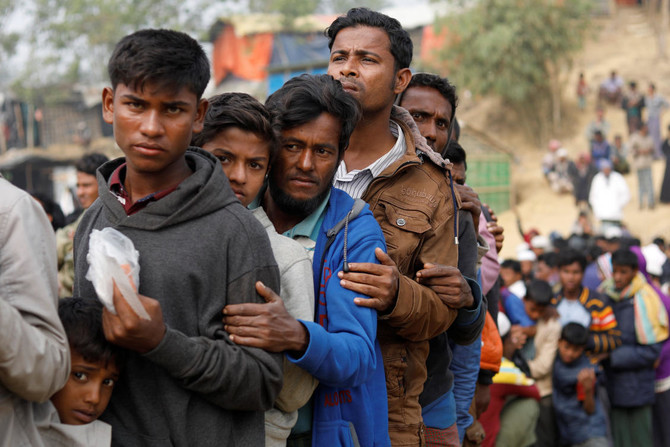
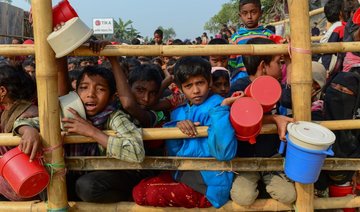
Above, Rohingya refugees line up for daily essentials distribution at Balukhali camp, near Cox's Bazar in Bangladesh on January 15. (Reuters)
Updated 16 January 2018
Follow

Bangladesh agrees with Myanmar to complete Rohingya return in two years

DHAKA: Bangladesh has agreed to complete the process of returning Rohingya Muslims to Myanmar within two years after repatriation begins, the south Asian nation said on Tuesday, following a meeting of the neighbors to implement a pact signed last year.
A statement by the Bangladesh foreign ministry did not say when the process would begin. But it said the return effort envisages “considering the family as a unit,” with Myanmar to provide temporary shelter for those returning before rebuilding houses for them.
The statement said Bangladesh would set up five transit camps, which would send Rohingyas to two reception centers on the Myanmar side of the border.
“Myanmar has reiterated its commitment to stop outflow of Myanmar residents to Bangladesh,” it said.
The meeting in Myanmar’s capital Naypyitaw was the first for a joint working group set up to hammer out the details of the November repatriation agreement.
The Myanmar government has not issued its own statement after the meeting and government spokesman Zaw Htay was not immediately available for comment.
Zaw Htay said earlier, however, that returnees would be able to apply for citizenship “after they pass the verification process.”
A Myanmar agency set up to oversee repatriation said in a statement last Thursday that two temporary “repatriation and assessment camps” and one other site to accommodate returnees had been set up.
Myint Kyaing, permanent secretary at Myanmar’s Ministry of Labour, Immigration and Population, said earlier this month Myanmar would be ready to begin processing least 150 people a day through each of the two camps by January 23.
The Rohingya crisis erupted after Rohingya insurgent attacks on security posts on August 25 in the western state of Rakhine triggered a fierce military response that the UN denounced as ethnic cleansing. Some 650,000 people fled the violence.
Myanmar denies ethnic cleansing, saying its security forces had mounted legitimate counter-insurgency clearance operations.


Prabowo, Trump expected to sign Indonesia-US tariff deal in January 2026

Updated 9 sec ago
Follow

Prabowo, Trump expected to sign Indonesia-US tariff deal in January 2026

  • Deal will mean US tariffs on Indonesian products are cut from a threatened 32 percent to 19 percent
  • Jakarta committed to scrap tariffs on more than 99 percent of US goods

JAKARTA: Indonesia expects to sign a tariff deal with the US in early 2026 after reaching an agreement on “all substantive issues,” Jakarta's chief negotiator said on Tuesday.

Indonesia’s Coordinating Minister for Economic Affairs Airlangga Hartarto met with US trade representative Jamieson Greer in Washington this week to finalize an Indonesia-US trade deal, following a series of discussions that took place after the two countries agreed on a framework for negotiations in July.

“All substantive issues laid out in the Agreement on Reciprocal Trade have been agreed upon by the two sides, including both the main and technical issues,” Hartarto said in an online briefing.

Officials from both countries are now working to set up a meeting between Indonesian President Prabowo Subianto and US President Donald Trump. 

It will take place after Indonesian and US technical teams meet in the second week of January for a legal scrubbing, or a final clean-up of an agreement text.

“We are expecting that the upcoming technical process will wrap up in time as scheduled, so that at the end of January 2026 President Prabowo and President Trump can sign the Agreement on Reciprocal Trade,” Hartarto said.  

Indonesian trade negotiators have been in “intensive” talks with their Washington counterparts since Trump threatened to levy a 32 percent duty on Indonesian exports. 

Under the July framework, US tariffs on Indonesian imports were lowered to 19 percent, with Jakarta committing to measures to balance trade with Washington, including removing tariffs on more than 99 percent of American imports and scrapping all non-tariff barriers facing American companies. 

Jakarta also pledged to import $15 billion worth of energy products and $4.5 billion worth of agricultural products such as soybeans, wheat and cotton, from the US. 

“Indonesia will also get tariff exemptions on top Indonesian goods, such as palm oil, coffee, cocoa,” Hartarto said. 

“This is certainly good news, especially for Indonesian industries directly impacted by the tariff policy, especially labor-intensive sectors that employ around 5 million workers.” 

In the past decade, Indonesia has consistently posted trade surpluses with the US, its second-largest export market after China. 

From January to October, data from the Indonesian trade ministry showed two-way trade valued at nearly $36.2 billion, with Jakarta posting a $14.9 billion surplus.