Rio Tinto targets modest hike in 2018 iron ore shipments

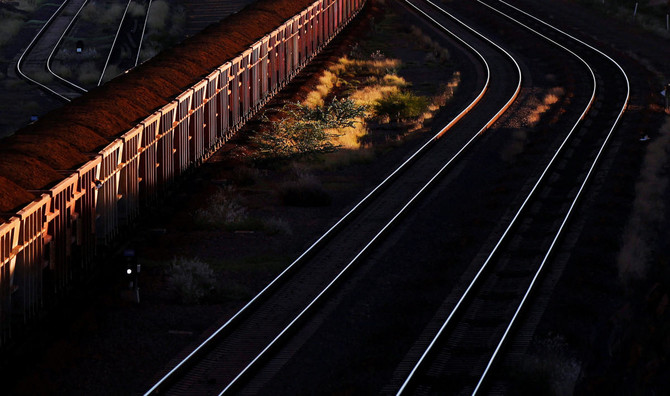
Above, a train loaded with iron ore travels toward the Rio Tinto Parker Point iron ore facility in Dampier at the Pilbarra region in Western Australia. Rio Tinto’s fourth-quarter iron ore shipments rose 3 percent to 90 million tons from the same period a year ago and 5 percent against the previous quarter. (Reuters)
Updated 16 January 2018
Follow

Rio Tinto targets modest hike in 2018 iron ore shipments

SYDNEY: Global miner Rio Tinto said on Tuesday it could ship up to an additional 10 million tons of iron ore in 2018 worth $780 million (SR2.925 billion) at today’s prices after reporting a 1 percent rise in 2017 shipments.
The slight lift in 2017 output to 330.1 million tons came as the average sales price for its ore jumped 20 percent over the year to $64.80, buoyed by strong demand from Chinese steelmakers.
The price rise helped the world’s no. 2 iron ore miner boost returns to shareholders after a bumper first-half profit. Rio is due to report its 2017 full-year profit on February 7, with forecasts centered around $8.5 billion, up 85 percent.
Rio on Tuesday also stuck to a target of 330-340 million tons of iron ore from its new Silvergrass mine, which is ramping up operations in Australia’s Pilbara.
Silvergrass yielded about 2 million tons in 2017 and at peak production should yield 10 million tons a year, according to the company.
The iron ore price stood at $78.05 per ton on Jan. 12, according to Metal Bulletin. However, uncertainty over Chinese demand has led to forecasts for prices to fall as the year progresses, which could cut Rio’s take from any additional sales.
“The business performed well in the fourth quarter, and we finished the year in line with guidance across all major products,” Chief Executive Jean-Sebastien Jacques said in a statement.
Fourth-quarter iron ore shipments rose 3 percent to 90 million tons from the same period a year ago and 5 percent against the previous quarter.
The last quarter is typically the strongest as miners boost exports ahead of the first quarter, a high cyclone-risk period in Australia.
In other commodities, Rio Tinto stuck to a 2018 target of 510,000-610,000 tons of mined copper and 225,000-265,000 tons of refined copper. Aluminum production will reach 3.5-3.7 million tons.
For 2017, aluminum production eased 1 percent and mined copper output fell 9 percent.
The mined copper decline followed a 43-day strike at Rio’s Escondida mine in Chile in the first quarter and a 22 percent drop in output from the Oyu Tolgoi open pit mine in Mongolia as sources of higher grade ore were fully depleted.
The slippage in copper output should be more than offset by better copper prices, which have climbed 25 percent in the past year, said Shaw and Parners analyst Peter O’Connor.
Separately on Tuesday, Rio Tinto subsidiary Turquoise Hill Resources said it was being asked to pay $155 million in tax arrears by Mongolia after an audit of Oyu Tolgoi’s tax payments between 2013 and 2015.
Turquoise Hill, which is 51 percent owned by Rio Tinto, said it was of the “firm view” the mine had paid all required taxes and charges. Turquoise Hill holds 66 percent of Oyu Tolgoi.


Saudi Arabia’s cultural sector is a new economic engine between Riyadh and Paris, says ambassador

Updated 25 January 2026
Follow

Saudi Arabia’s cultural sector is a new economic engine between Riyadh and Paris, says ambassador

RIYADH: Culture has become a fundamental pillar in bilateral relations between France and Saudi Arabia, according to the French Ambassador to the Kingdom, Patrick Maisonnave.

Maisonnave noted its connection to the entertainment and tourism sectors, which makes it a new engine for economic cooperation between Riyadh and Paris.

He told Al-Eqtisadiah during the opening ceremony of La Fabrique in the Jax district of Diriyah that cultural cooperation with Saudi Arabia is an important element for its attractiveness in the coming decades.

La Fabrique is a space dedicated to artistic creativity and cultural exchange, launched as part of a partnership between the Riyadh Art program and the French Institute in Riyadh. 

Running from Jan. 22 until Feb 14, the initiative will provide an open workspace that allows artists to develop and work on their ideas within a collaborative framework.

Launching La Fabrique as a space dedicated to artistic creativity

The ambassador highlighted that the transformation journey in the Kingdom under Vision 2030 has contributed to the emergence of a new generation of young artists and creators, alongside a growing desire in Saudi society to connect with culture and to embrace what is happening globally. 

He affirmed that the relationship between the two countries is “profound, even cultural par excellence,” with interest from the Saudi side in French culture, matched by increasing interest from the French public and cultural institutions unfolding in the Kingdom.

Latest estimates indicate that the culture-based economy represents about 2.3 percent of France’s gross domestic product, equivalent to more than 90 billion euros ($106.4 billion) in annual revenues, according to government data. The sector directly employs more than 600,000 people, making it one of the largest job-creating sectors in the fields of creativity, publishing, cinema, and visual arts.

Saudi Arabia benefiting from French experience in the cultural field

Maisonnave explained that France possesses established cultural institutions, while Saudi Arabia is building a strong cultural sector, which opens the door for cooperation opportunities.

This comes as an extension of the signing of 10 major cultural agreements a year ago between French and Saudi institutions, aiming to enhance cooperation and transfer French expertise and knowledge to contribute to the development of the cultural system in the Kingdom.

He added that experiences like La Fabrique provide an opportunity to meet the new generation of Saudi creators, who have expressed interest in connecting with French institutions and artists in Paris and France.

La Fabrique encompasses a space for multiple contemporary artistic practices, including performance arts, digital and interactive arts, photography, music, and cinema, while providing the public with an opportunity to witness the stages of producing artistic works and interact with the creative process.