Israel approves hundreds of new West Bank settlement homes

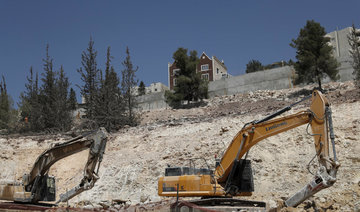
A construction site in the Israeli settlement of Givat Zeev, West Bank. Palestinians view such construction as jeopardizing their prospects for statehood. (Reuters)
Updated 11 January 2018
Follow

Israel approves hundreds of new West Bank settlement homes

JERUSALEM: Israel has given final building approval for 352 homes in settlements in the occupied West Bank, an anti-settlement movement said on Thursday — construction that Palestinians see as jeopardizing their prospects for statehood.
The Peace Now group said a meeting on Wednesday by a planning committee of Israel’s military-run Civil Administration for the West Bank also moved plans for 770 other settler homes to more advanced stages.
Settlements are one of the most heated issues in efforts to revive Israeli-Palestinian peace talks, frozen since 2014.
“I think what Israel is doing is a purposeful, well-planned process of destruction of the two-state solution and possibility of the establishment of a Palestinian state,” Mustafa Barghouti, a Palestinian lawmaker, said of the committee’s decision.
Palestinians want the West Bank for a future state, along with East Jerusalem and the Gaza Strip. Most countries consider as illegal the settlements that Israel built in the territory it captured in the 1967 Middle East war.
Israel disputes that its settlements are illegal. Its government says their future should be determined in peace talks and that the Palestinians’ refusal to recognize Israel as a Jewish state and declare an end to a decades-old conflict are the real obstacles to peace.
Some 500,000 Israelis live in the West Bank and East Jerusalem, areas that are home to more than 2.6 million Palestinians.
Hagit Ofran, a Peace Now spokeswoman, said the new round of construction approvals was “not a dramatic change” from last year’s pace, when Israel gave the go-ahead for 6,742 housing projects in the West Bank — a figure described by Peace Now as the highest since 2013.
But she noted that many of the latest housing projects were slated for settlements deep inside the West Bank, “especially in places that Israel would need to (evacuate) in case of a (peace) agreement — which means our government is trying to prevent a two-state solution.”
Barghouti linked the increased settlement activity to the 2016 election of US President Donald Trump, a Republican who has been less critical than his predecessor, Democrat Barack Obama, of Israel on the issue.
“These settlements could have been stopped by the United States,” he told Reuters.
The latest construction plans were first announced by Israeli defense minister Avigdor Lieberman earlier this week.
Asked about them, a US State Department official said on Tuesday there had been no change in policy on settlements and the Israeli government had made clear that going forward “its intent is to adopt a policy regarding settlement activity that takes the president’s concerns into consideration.”


Spain highlights importance of Gaza reconstruction

Palestinian prime minister, Mohammed Mustafa, and the Spanish foreign minister, Jose Manuel Albares. (AP)
Updated 02 January 2026
Follow

Spain highlights importance of Gaza reconstruction

  • Spain officially recognized Palestine as a state in May 2024, in a coordinated move alongside Ireland and Norway

RAMALLAH: The Palestinian prime minister, Mohammed Mustafa, and the Spanish foreign minister, Jose Manuel Albares, on Friday discussed the latest developments in the West Bank and Gaza Strip.
During their telephone conversation they emphasized the need to intensify international efforts to end the Israeli occupation and halt attacks and settler violence, and to secure the release of Palestinian funds held by Israeli authorities.
They affirmed the importance of ongoing efforts relating to plans for the reconstruction of Gaza, and Europe’s significant role in this process. Mustafa and Albares highlighted the need to unify Palestinian institutions in Gaza with those in the West Bank, with the aim of establishing a Palestinian state in line with international resolutions, including last year’s New York Declaration.
They also discussed coordination between their countries, and the strengthening of Spain’s political, diplomatic and financial support for Palestine, and Mustafa thanked Spain for its ongoing support.
Spain officially recognized Palestine as a state in May 2024, in a coordinated move alongside Ireland and Norway. Estephan Salameh, the Palestinian finance and planning minister, is set to visit Spain this month to discuss enhanced cooperation, particularly in the areas of development and reconstruction. Meanwhile, Israel continues operating in the occupied West Bank.
The Palestinian Prisoners media office said on Friday that Israel carried out numerous raids across the territory, including the major cities of Ramallah and Hebron, according to The Associated Press.
Nearly 50 people were detained, following the arrest of at least 50 other Palestinians on Thursday, most of those in the Ramallah area.
As 2026 begins, the shaky 12-week-old ceasefire between Israel and Hamas has largely ended large-scale Israeli bombardment of Gaza. 
But Palestinians are still being killed by Israeli fire, especially along the so-called Yellow Line that delineates areas under Israeli control, and the humanitarian crisis is compounded by frequent winter rains and colder temperatures.
On Friday, American actor and film producer Angelina Jolie visited the Rafah border crossing between Egypt and the Gaza Strip. 
The only crossing between the territory and a country other than Israel, it remains closed despite Palestinian requests to reopen it to people and aid.
Jolie met with members of the Red Crescent on the Egyptian side of the Rafah border crossing and then visited a hospital in the nearby city of Arish to speak with Palestinian patients on Friday, according to Egyptian officials.
Aid groups say not enough shelter materials are getting into Gaza during the truce.