Iran firm says there may be survivors from tanker crash

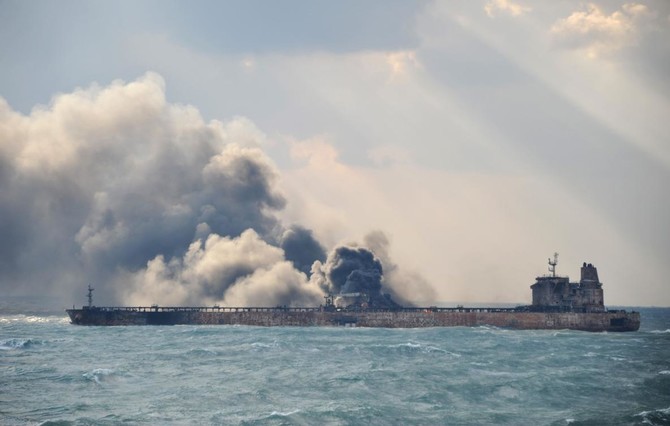
Smoke and flames coming from the burning oil tanker “Sanchi” at sea off the coast of eastern China. (AFP)
Updated 10 January 2018
Follow

Iran firm says there may be survivors from tanker crash

TEHRAN: The Iranian company whose oil tanker burst into flames after a collision in the East China Sea says there is still hope of finding survivors as 31 crew members remain missing and rescue efforts continued on Wednesday.
As the stricken Sanchin still lists after colliding with the Hong Kong-registered freighter CF Crystal late Saturday, a spokesman for National Iranian Tanker Co. told The Associated Press in Tehran that rescuers “likely” will find survivors.
“Since the vessel’s engine room is not directly affected by the fire and is about 14 meters (46 feet) under water, there is still hope,” spokesman Mohsen Bahrami said late Tuesday. “We are persistently working to put out the fire and rescue possible survivors.”
The body of one of the 32 crew members has been recovered and taken to Shanghai for identification, Bahrami said.
Mahmoud Abuli Ghasemabadi, the brother of missing Iranian sailor Ehasan Abuli Ghasemabadi, said he and other families remained hopeful for good news.
“I ask countries that are in that region and can offer any assistance to help us deal with this situation as soon as possible,” Ghasemabadi said.
The Panamanian-registered Sanchin had a crew of 30 Iranians and two Bangladeshis, Chinese state media reported. The 21 members of the Crystal’s all-Chinese crew were rescued.
What caused Saturday’s collision in the East China Sea, 257 km off the coast of Shanghai, remains unclear.
The Sanchi was carrying 136,000 metric tons (150,000 tons, or nearly 1 million barrels) of condensate, a type of ultra-light oil, according to Chinese authorities.
South Korean petrochemical company Hanwha Total Co., a 50-50 partnership between the Seoul-based Hanwha Group and French oil giant Total, said in a previous email to the AP it had contracted the Sanchi to import Iranian condensate to South Korea.
The tanker has operated under five different names since it was built in 2008, according the UN-run International Maritime Organization. The National Iranian Tanker Co. describes itself as operating the largest tanker fleet in the Middle East.
It is the second collision for a ship from the National Iranian Tanker Co. in less than a year and a half. In August 2016, one of its tankers collided with a Swiss container ship in the Singapore Strait, damaging both ships but causing no injuries or oil spill.


Thousands of Libyans gather for the funeral of Qaddafi’s son who was shot and killed this week

Updated 4 sec ago
Follow

Thousands of Libyans gather for the funeral of Qaddafi’s son who was shot and killed this week

  • As the funeral procession got underway and the crowds swelled, a small group of supporters took Seif Al-Islam’s coffin away and later performed the funeral prayers and buried him
  • Authorities said an initial investigation found that he was shot to death but did not provide further details

BANI WALID, Libya: Thousands converged on Friday in northwestern Libya for the funeral of Seif Al-Islam Qaddafi, the son and one-time heir apparent of Libya’s late leader Muammar Qaddafi, who was killed earlier this week when four masked assailants stormed into his home and fatally shot him.
Mourners carried his coffin in the town of Bani Walid, 146 kilometers (91 miles) southeast of the capital, Tripoli, as well as large photographs of both Seif Al-Islam, who was known mostly by his first name, and his father.
The crowd also waved plain green flags, Libya’s official flag from 1977 to 2011 under Qaddafi, who ruled the country for more than 40 years before being toppled in a NATO-backed popular uprising in 2011. Qaddafi was killed later that year in his hometown of Sirte as fighting in Libya escalated into a full-blown civil war.
As the funeral procession got underway and the crowds swelled, a small group of supporters took Seif Al-Islam’s coffin away and later performed the funeral prayers and buried him.
Attackers at his home
Seif Al-Islam, 53, was killed on Tuesday inside his home in the town of Zintan, 136 kilometers (85 miles) southwest of the capital, Tripoli, according to Libyan’s chief prosecutor’s office.
Authorities said an initial investigation found that he was shot to death but did not provide further details. Seif Al-Islam’s political team later released a statement saying “four masked men” had stormed his house and killed him in a “cowardly and treacherous assassination,” after disabling security cameras.
Seif Al-Islam was captured by fighters in Zintan late in 2011 while trying to flee to neighboring Niger. The fighters released him in June 2017, after one of Libya’s rival governments granted him amnesty.
“The pain of loss weighs heavily on my heart, and it intensifies because I can’t bid him farewell from within my homeland — a pain that words can’t ease,” Seif Al-Islam’s brother Mohamed Qaddafi, who lives in exile outside Libya though his current whereabouts are unknown, wrote on Facebook on Friday.
“But my solace lies in the fact that the loyal sons of the nation are fulfilling their duty and will give him a farewell befitting his stature,” the brother wrote.
Since the uprising that toppled Qaddafi, Libya plunged into chaos during which the oil-rich North African country split, with rival administrations now in the east and west, backed by various armed groups and foreign governments.
Qaddafi’s heir-apparent
Seif Al-Islam was Qaddafi’s second-born son and was seen as the reformist face of the Qaddafi regime — someone with diplomatic outreach who had worked to improve Libya’s relations with Western countries up until the 2011 uprising.
The United Nations imposed sanctions on Seif Al-Islam that included a travel ban and an assets freeze for his inflammatory public statements encouraging violence against anti-Qaddafi protesters during the 2011 uprising. The International Criminal Court later charged him with crimes against humanity related to the 2011 uprising.
In July 2021, Seif Al-Islam told the New York Times that he’s considering returning to Libya’s political scene after a decade of absence during which he observed Middle East politics and reportedly reorganized his father’s political supporters.
He condemned the country’s new leaders. “There’s no life here. Go to the gas station — there’s no diesel,″ Seif Al-Islam told the Times.
In November 2021, he announced his candidacy in the country’s presidential election in a controversial move that was met with outcry from anti-Qaddafi political forces in western and eastern Libya.
The country’s High National Elections Committee disqualified him, but the election wasn’t held over disputes between rival administrations and armed groups.