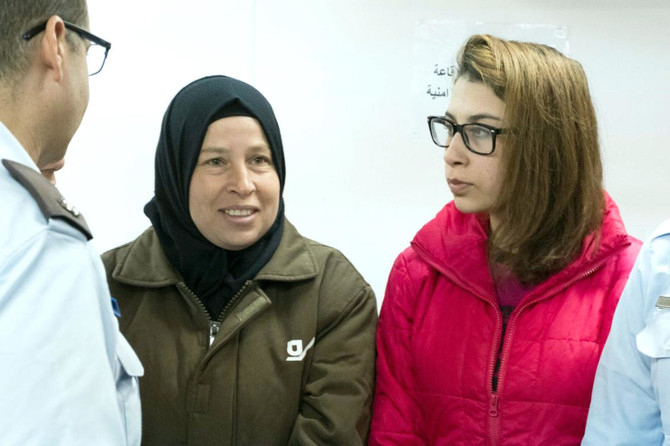
RAMALLAH: Ahed Tamimi has been in jail since Dec. 15. The 16-year-old Palestinian girl, who became internationally famous when a video of her and her cousin Nour Tamimi slapping two Israeli soldiers went viral last month, remains in Israeli custody — along with her mother Nairiman — while Nour, 20, was released early Friday after posting bail of $1,450.
“Ahed is suffering in dire conditions in Israel’s Hasharon prison,” her aunt Manal Tamimi told Arab News. Manal was released from Hasharon herself on Wednesday, having been arrested, she said, “during a peaceful rally” in Western Ramallah. She was accused of the attempted assault of a female Israeli soldier.
“Ahed’s suffering isn’t only due to poor conditions including cold and inadequate food, but also to attempts to break her spirit,” Manal continued. She cited procedures including a five-hour transfer from Hasharon to Ramla prison, after which Ahed was moved to Ofer detention center and placed in “a very cold cell” for the day. Manal said Ahed had also been placed in solitary confinement on occasion.
Manal said that while she was in custody, she was able to communicate with Ahed, Nour and Nairiman, who were in cells opposite her.
“Her mother and I tried to offer support,” Manal told Arab News. “We were worried about Ahed, because she would be on the verge of collapse when she returned after many hours travelling from one prison to another.”
However, she added, Ahed’s spirits remain high because she believes Palestinians must resist occupation, regardless of the consequences.
When Ahed learned that Nour was to be released, Manal said, Ahed gave her cousin the password to her Instagram and Facebook accounts “so she could find out how the world was reacting to her case.”
Ahed will remain in custody at least until her hearing on Monday, when the prosecution is expected to add to the 12 charges already filed against her. Ahed’s Israeli lawyer Gaby Lasky was not immediately available for comment.
Nour’s father Naji, who was released from jail Friday morning, says Israeli forces raided his house and detained his daughter at 3:30 a.m. and that most of the questions she faced were about the video in which Nour and Ahed confronted the two soldiers.
He claimed the Israeli media was inciting hatred against his family, and Ahed in particular. “They always describe the family as having ‘a long history of terrorism,’ as if they are talking about ISIS,” he said.
The Tamimi family make up a large portion of the 600-strong population of their village, Nabi Salih, in Ramallah. The village is known for its activism, including a weekly rally after Friday prayers.
“Popular resistance isn’t new (here),” Naji said. “The village has been suffering from restrictions imposed by Israel.” Illegal settlements, he said, have “swallowed” vast areas of land around the village, and there were, until recently, two Israeli military checkpoints nearby.
However, in a move which offers hope to the Tamimis, Israel recently removed one of the checkpoints, he said, “following popular and media pressure.”


![]()
A family affair: The Tamimis’ history of resistance
A family affair: The Tamimis’ history of resistance


Latest updates


Recommended


© 2026 SAUDI RESEARCH & PUBLISHING COMPANY, All Rights Reserved And subject to Terms of Use Agreement.