ODS Movement looks to popularize one-state solution for Palestine

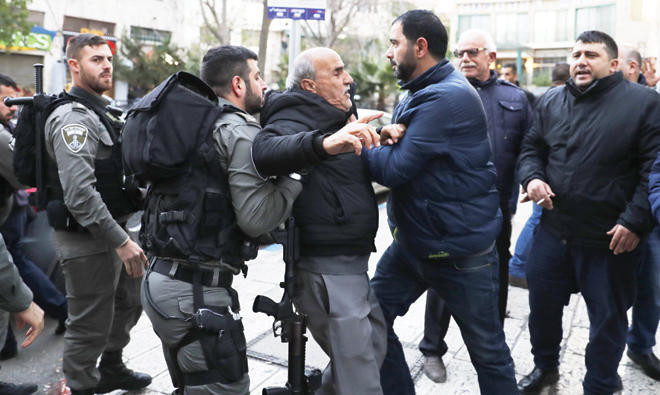
Israeli security forces restrain a Palestinian protester during a protest in Arab East Jerusalem on Saturday against the US recognition of the holy city as Israel's capital. (AFP)
Updated 31 December 2017
Follow

ODS Movement looks to popularize one-state solution for Palestine

AMMAN: The Popular Movement for One Democratic State in Historic Palestine (ODS) is stepping up efforts to increase the awareness and the popularity of its cause.
ODS spokesman Radi Jarai told Arab News that his movement wants to make the concept “much more accessible and understandable to people.”
Jarai, an active member of Palestine’s nationalist Fatah party who has spent years in Israeli prisons, said the movement is currently made up of academics and thinkers, so, “We need to make the idea understandable to the common person so that it begins to gain traction.”
The board of the movement met in Istanbul in early December and agreed on a plan to popularize its credo. “This week, we will tape a number of episodes to be broadcast on Palestine TV with the hope of triggering discussions about a democratic state,” Jarai told Arab News.
Lectures are scheduled at Bethlehem and Al-Quds universities, along with a major conference in Ramallah on March 16.
ODS was founded in March 2013 and welcomes both Jews and Palestinians as members.
“There are Israeli Jewish groups that support our goal but have chosen not to join us at the moment,” Jarai said.
Yoav Haifawi, an Israeli activist and publisher of the Free Haifa blog, told Arab News that he is a longtime supporter of the one-state concept.
“The biggest obstacle we face is that Israel is a privileged country for Jews. Therefore, as a colonial state that gives privileges through discrimination, the decolonization of Palestine cannot happen as long as Israel is strong and Palestinians are weak.”
Uri Davis, a Jewish member of Fatah, told Arab News that the Palestine Liberation Organization (PLO) is the representative of the Palestinian people.
He continued that, in his opinion, the replacement of the two-state solution with the ODS paradigm is best seen as a process, one which he suggested should begin with some type of negotiation between the PLO and Israel, supported by the global Boycott, Divestment and Sanctions Movement (BDS) and mediated by the UN.
The one-state solution, Davis said, would mean a change “from the current state of affairs into a single Palestinian sovereignty (stretching) from the Mediterranean Sea to the Jordan River under a liberal-democratic Palestinian Constitution; single Palestinian citizenship; and a single Palestinian currency, hopefully leading to a socialist democratic Federal Republic of Palestine.”
Few PLO factions have been supportive of ODS so far, but lately more have warmed to the idea, according to Jarai. But he added that the idea is still seen by many as a tactic, rather than an actual change of direction.
“Their minds are still set on the two-state solution and they use the one-state idea as a threat,” Jarai said. “That includes President (Mahmoud) Abbas who wants to change the international sponsors of the peace process, not understanding that Israel doesn’t want peace, regardless of who the sponsors are.”
In his speech at the opening session of the UN General Assembly in September, Abbas mentioned the two-state solution 13 times but warned of what would happen if this vision were to “be destroyed due to the creation of a one-state reality with two systems — apartheid — from the unchecked imposition of this occupation that is rejected by our people and the world.”
Abbas concluded by saying that if the two-state solution were to fail, “We will have no choice but to continue the struggle and demand full, equal rights for all inhabitants of historic Palestine.”


Thousands of Libyans gather for the funeral of Qaddafi’s son who was shot and killed this week

Updated 06 February 2026
Follow

Thousands of Libyans gather for the funeral of Qaddafi’s son who was shot and killed this week

  • As the funeral procession got underway and the crowds swelled, a small group of supporters took Seif Al-Islam’s coffin away and later performed the funeral prayers and buried him
  • Authorities said an initial investigation found that he was shot to death but did not provide further details

BANI WALID, Libya: Thousands converged on Friday in northwestern Libya for the funeral of Seif Al-Islam Qaddafi, the son and one-time heir apparent of Libya’s late leader Muammar Qaddafi, who was killed earlier this week when four masked assailants stormed into his home and fatally shot him.
Mourners carried his coffin in the town of Bani Walid, 146 kilometers (91 miles) southeast of the capital, Tripoli, as well as large photographs of both Seif Al-Islam, who was known mostly by his first name, and his father.
The crowd also waved plain green flags, Libya’s official flag from 1977 to 2011 under Qaddafi, who ruled the country for more than 40 years before being toppled in a NATO-backed popular uprising in 2011. Qaddafi was killed later that year in his hometown of Sirte as fighting in Libya escalated into a full-blown civil war.
As the funeral procession got underway and the crowds swelled, a small group of supporters took Seif Al-Islam’s coffin away and later performed the funeral prayers and buried him.
Attackers at his home
Seif Al-Islam, 53, was killed on Tuesday inside his home in the town of Zintan, 136 kilometers (85 miles) southwest of the capital, Tripoli, according to Libyan’s chief prosecutor’s office.
Authorities said an initial investigation found that he was shot to death but did not provide further details. Seif Al-Islam’s political team later released a statement saying “four masked men” had stormed his house and killed him in a “cowardly and treacherous assassination,” after disabling security cameras.
Seif Al-Islam was captured by fighters in Zintan late in 2011 while trying to flee to neighboring Niger. The fighters released him in June 2017, after one of Libya’s rival governments granted him amnesty.
“The pain of loss weighs heavily on my heart, and it intensifies because I can’t bid him farewell from within my homeland — a pain that words can’t ease,” Seif Al-Islam’s brother Mohamed Qaddafi, who lives in exile outside Libya though his current whereabouts are unknown, wrote on Facebook on Friday.
“But my solace lies in the fact that the loyal sons of the nation are fulfilling their duty and will give him a farewell befitting his stature,” the brother wrote.
Since the uprising that toppled Qaddafi, Libya plunged into chaos during which the oil-rich North African country split, with rival administrations now in the east and west, backed by various armed groups and foreign governments.
Qaddafi’s heir-apparent
Seif Al-Islam was Qaddafi’s second-born son and was seen as the reformist face of the Qaddafi regime — someone with diplomatic outreach who had worked to improve Libya’s relations with Western countries up until the 2011 uprising.
The United Nations imposed sanctions on Seif Al-Islam that included a travel ban and an assets freeze for his inflammatory public statements encouraging violence against anti-Qaddafi protesters during the 2011 uprising. The International Criminal Court later charged him with crimes against humanity related to the 2011 uprising.
In July 2021, Seif Al-Islam told the New York Times that he’s considering returning to Libya’s political scene after a decade of absence during which he observed Middle East politics and reportedly reorganized his father’s political supporters.
He condemned the country’s new leaders. “There’s no life here. Go to the gas station — there’s no diesel,″ Seif Al-Islam told the Times.
In November 2021, he announced his candidacy in the country’s presidential election in a controversial move that was met with outcry from anti-Qaddafi political forces in western and eastern Libya.
The country’s High National Elections Committee disqualified him, but the election wasn’t held over disputes between rival administrations and armed groups.