Suspected Russian jets kill at least 20 civilians near Syrian capital: residents

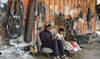
A Syrian child who was injured in shelling on the town of Misraba receives treatment at a make-shift hospital in the besieged rebel-held town of Douma, on the outskirts of the capital Damascus on early Jan. 4, 2018. At least 23 civilians were killed in the Syrian opposition redoubt of East Ghouta, near Damascus, with the majority of victims perishing in Russian air raids, a monitor said. (AFP/Hasan Mohamed)
Updated 04 January 2018
Follow

Suspected Russian jets kill at least 20 civilians near Syrian capital: residents

AMMAN: Suspected Russian jets killed at least 20 civilians and wounded dozens early on Thursday when they dropped bombs on two residential buildings in a besieged rebel enclave east of the Syrian capital, residents and a war monitor said.
They said at least four bombs flattened the two buildings in the town of Misraba, wounding more than 40 people, while at least ten people were killed in aerial strikes in nearby towns in the last rebel stronghold near the capital.
The UK-based Syrian Observatory for Human Rights, a war monitor, said 11 women and a child were among the dead in the strike in Misraba.
Video footage downloaded by activists on social media showed children and women being pulled from the rubble by rescue workers. The footage could not be independently confirmed.


Hezbollah chief accuses Israel of ignoring ceasefire agreement

Updated 57 min 34 sec ago
Follow

Hezbollah chief accuses Israel of ignoring ceasefire agreement

  • Naim Qassem says moves to disarm his group in Lebanon are an 'Israeli-American plan'
  • Lebanese military is expected to complete Hezbollah’s disarmament south of Litani River as part of ceasefire

BEIRUT: Hezbollah leader Naim Qassem on Sunday said moves to disarm the group in Lebanon are an “Israeli-American plan,” accusing Israel of failing to abide by a ceasefire agreement sealed last year.
Under heavy US pressure and fears of expanded Israeli strikes, the Lebanese military is expected to complete Hezbollah’s disarmament south of the Litani River — located about 30 kilometers (19 miles) from the border with Israel — by the end of the year.
It will then tackle disarming the Iran-backed movement in the rest of the country.
“Disarmament is an Israeli-American plan,” Qassem said.
“To demand exclusive arms control while Israel is committing aggression and America is imposing its will on Lebanon, stripping it of its power, means that you are not working in Lebanon’s interest, but rather in the interest of what Israel wants.”
Despite a November 2024 ceasefire that was supposed to end more than a year of hostilities between Israel and the Iran-backed Hezbollah group, Israel has kept up strikes on Lebanon and has maintained troops in five areas it deems strategic.
According to the agreement, Hezbollah was required to pull its forces north of the Litani River and have its military infrastructure in the vacated area dismantled.
Israel has questioned the Lebanese military’s effectiveness and has accused Hezbollah of rearming, while the group itself has rejected calls to surrender its weapons.
“The deployment of the Lebanese army south of the Litani River was required only if Israel had adhered to its commitments... to halting the aggression, withdrawing, releasing prisoners, and having reconstruction commence,” Qassem said in a televised address.
“With the Israeli enemy not implementing any of the steps of the agreement... Lebanon is no longer required to take any action on any level before the Israelis commit to what they are obligated to do.”
Lebanese army chief Rodolphe Haykal told a military meeting on Tuesday “the army is in the process of finishing the first phase of its plan.”
He said the army is carefully planning “for the subsequent phases” of disarmament.