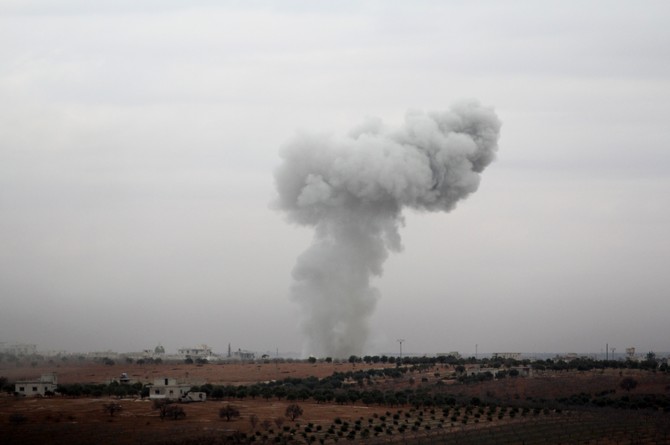
BEIRUT: At least seven civilians, including five children, were killed Tuesday by air strikes in Syria’s northwestern Idlib province, the last outside government control, a monitor said.
Government and allied forces backed by Russian warplanes have been battling jihadist fighters and rebels for over a week in an area straddling the border between Idlib and Hama provinces.
The air strikes targeted the town of Khan Subul in the center of Idlib province, the Britain-based Syrian Observatory for Human Rights said.
“There were at least seven dead, five children and two women,” the Observatory said.
“We do not know if these were air strikes by the Syrian regime or the Russians,” Observatory head Rami Abdel Rahman told AFP.
The government push on the edge of Idlib province follows two months of sporadic fighting that the United Nations says has displaced more than 60,000 people.
“Displacement sites are reportedly overwhelmed. Some services are 400 percent above their planned capacity to serve,” the United Nations Office for the Coordination of Humanitarian Affairs said.
An AFP correspondent said there were fresh clashes Tuesday.
A column of white smoke could be seen rising into the sky after a regime air strike in the town of Al-Tamana and rebels were firing artillery at government positions.
Idlib province — currently dominated by a former Al-Qaeda affiliate — was one of four “de-escalation zones” agreed to help halt fighting around the country by regime backers Russia and Iran and rebel supporter Turkey.
The war in Syria has killed more than 340,000 people and displaced millions from their homes since it began in 2011 with the brutal repression of anti-government protests.

7 civilians killed in air strikes in Syria’s Idlib
Iran security chief says Trump’s threats to hit harder are ‘empty’
- Ali Larijani: ‘Iran is not afraid of your empty threats. Even those greater than you could not eliminate the Iranian nation’
TEHRAN: Iran’s security chief Ali Larijani issued on Tuesday a veiled threat to US President Donald Trump, warning him to be careful “not to be eliminated” and saying the Islamic republic was not afraid of his “empty threats.”
“Iran is not afraid of your empty threats. Even those greater than you could not eliminate the Iranian nation,” said Larijani in a post on X.
His remarks came in response to a post by Trump threatening to hit Iran harder if it stops the oil flow through the strategic Strait of Hormuz.
“Take care of yourself not to be eliminated!” Larijani added.
In a post on Truth Social, Trump had said “if Iran does anything that stops the flow of Oil within the Strait of Hormuz, they will be hit by the United States of America TWENTY TIMES HARDER than they have been hit by us thus far.”
On February 28, the US and Israel launched strikes against Iran that killed its supreme leader Ayatollah Ali Khamenei and triggered a war that has spread across the Middle East.
Iran has responded with drone and missile strikes targeting Israel and countries across the region.
Shipping traffic through the Strait of Hormuz, through which nearly 20 percent of the world’s crude oil usually transits, has been severely disrupted.
Iranian forces have threatened to block “the export of a single liter of oil from the region” to allies of the United States and Israel as long as the war continues.
“Iran is not afraid of your empty threats. Even those greater than you could not eliminate the Iranian nation,” said Larijani in a post on X.
His remarks came in response to a post by Trump threatening to hit Iran harder if it stops the oil flow through the strategic Strait of Hormuz.
“Take care of yourself not to be eliminated!” Larijani added.
In a post on Truth Social, Trump had said “if Iran does anything that stops the flow of Oil within the Strait of Hormuz, they will be hit by the United States of America TWENTY TIMES HARDER than they have been hit by us thus far.”
On February 28, the US and Israel launched strikes against Iran that killed its supreme leader Ayatollah Ali Khamenei and triggered a war that has spread across the Middle East.
Iran has responded with drone and missile strikes targeting Israel and countries across the region.
Shipping traffic through the Strait of Hormuz, through which nearly 20 percent of the world’s crude oil usually transits, has been severely disrupted.
Iranian forces have threatened to block “the export of a single liter of oil from the region” to allies of the United States and Israel as long as the war continues.
© 2026 SAUDI RESEARCH & PUBLISHING COMPANY, All Rights Reserved And subject to Terms of Use Agreement.