ACAYUCAN, Mexico: For some, Gumaro Perez was an experienced reporter who got on well with locals and earned the nickname “the red man” for his coverage of bloody crimes in Veracruz, one of Mexico’s deadliest states for journalists and civilians alike.
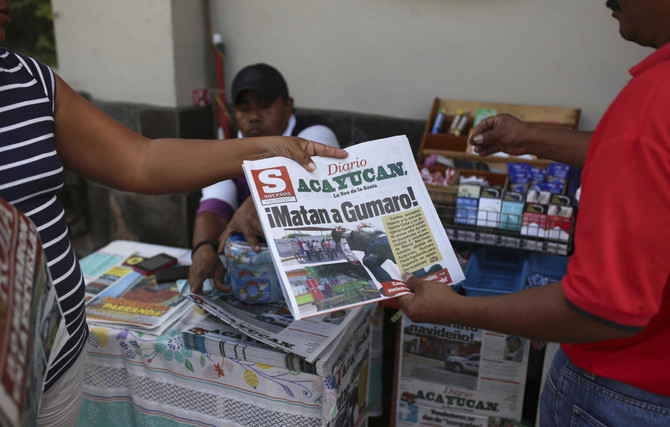
In the eyes of prosecutors, Perez was an alleged drug cartel operative who met a grisly end when he was shot dead Dec. 19 while attending a Christmas party at his 6-year-old son’s school in Acayucan, purportedly by gunmen from a rival gang.
Either way the brazen daylight killing underscored the blurred-lines nature of how journalism is practiced in much of Mexico, especially in the countryside and in areas where organized crime gangs hold sway over corrupt authorities, terrorize local populations and are largely free to harass and murder reporters with impunity.
Reporting in such places often entails writing or uploading photographs to a rudimentary website or Facebook page, or working part-time for a small local media outlet where meager salaries aren’t enough to cover expenses. Holding down a second job is essential. Some moonlight as cabbies or run small businesses. Others may work for a local government. And some, it’s widely believed — though it is said to be a small minority — go on the payroll of a cartel or a corrupt government.
In a country where at least 10 journalists have been killed this year in what observers are calling a crisis for freedom of expression, the risk is especially high for those who operate without editors, company directors or colleagues who could go to bat for them or steer them to institutions that would protect them.
“It certainly does make them more vulnerable,” said Jan-Albert Hootsen, Mexico representative for the New York-based Committee to Protect Journalists. He cited in particular the decapitation-murder nearly three years ago of Moises Sanchez, another Veracruz reporter, for motives the CPJ has confirmed were related to his work.
Sanchez “had his own little newspaper which he didn’t actually make any money with, so he doubled as a taxi driver and he financed that little newspaper with the money that he made as a taxi driver,” Hootsen said. “So he didn’t have any institutional backing. So when he started getting death threats, at that point there’s really nobody to back him up.”
Perez, 34, got his start as a journalist as a young man working for Diario de Acayucan, the local newspaper in the city of the same name. Set in the steamy lowlands of southern Veracruz, near the Gulf of Mexico, the oil-rich region is a hotly contested drug trafficking corridor that today is said to be disputed by the Zetas and Jalisco New Generation cartels.
“Back then he was a hard-working boy,” said the newspaper’s deputy director, Cecilio Perez, no relation, who later lost track of him.
Over the years, Gumaro Perez contributed stories to several local media outlets and helped found the news website La Voz del Sur.
He also began working as a driver, personal assistant and photographer for Acayucan’s mayor, although he was not on the government’s payroll and it’s not clear how he was being paid, said Jorge Morales of the official State Commission for Attention and Protection of Journalists in Veracruz.
Mayor Marco Antonio Martinez did not respond to multiple requests to be interviewed for this article.
According to several local journalists interviewed by The Associated Press, Perez also apparently had a different job: Keeping a close watch on what they were publishing about the Zetas and trying to influence their coverage or coerce their silence through intimidation.
Two reporters in Acayucan told AP, speaking on condition of anonymity due to concerns for their safety, that they and others had received threatening calls from Perez. In one, Perez allegedly warned a reporter to “take down” a story or else he would pass their number on “to you know who, so they will get in touch with you.” Perhaps innocuous elsewhere, words like “get in touch with you” carry life-or-death weight in communities where the gangs are dominant.
The reporters did not complain to authorities. “If Gumaro were still alive, I would not even be telling you,” one said.
“The journalists of Acayucan lived in terror and in constant anguish due to this guy,” said Ignacio Carvajal, a veteran reporter who covers that region of Veracruz, adding that the same pattern plays out repeatedly across a state marked by drug politics. “This is not an isolated case.”
Prosecutors said just 24 hours after the killing that Perez was linked to a cartel. They have presented no evidence, saying only that the allegation was based on data from his cellphone and visits to a jailed gang leader.
Family members denied he was a criminal.
“For me and my family, my brother is a very decent person who walks with his head held high and was admired by many,” Maribel Perez, his sister, said at his wake.
Journalist Fidel Perez, who is also not related to Gumaro Perez, said he had known the slain reporter for nearly 10 years and he showed no sign of being flush with narco-cash. He called the narco-allegations by prosecutors “very hasty, very risky.”
Early investigations have turned up no evidence that Perez was killed due to his journalistic work. The last time he is known to have published was several months ago.
Virgilio Reyes, director of the Golfo Pacifico website, said Perez’s most recent work involved crime stories in September and October, after which Perez stopped contributing because his work with the mayor kept him too busy.
In a number of other cases, authorities have quickly and publicly sought to decouple the murders of journalists from their work, leading to mistrust of the official version and a sense that authorities are engaged in victim-smearing.
So as much as Carvajal believes Perez may have been crooked, he said that prosecutors’ linking him to drug traffickers smells of an attempt to lessen the political fallout and have the murder fade from the spotlight without a proper investigation.
“Regardless of whether they are good or bad journalists, what remains at the end of the day is impunity,” Carvajal said.
Hootson warned that in the absence of proper investigations, “isolated cases could be used to criminalize and create an even more hostile environment” for a profession that is already under fire.
The 2010-2016 administration of Veracruz Gov. Javier Duarte, now imprisoned on charges of corruption and money laundering, had been considered a low point for the state in terms of journalist killings.
But despite the election last year of a new governor from a different party, things have only gotten worse, with Perez’s murder bringing the 2017 tally of journalists slain in the state to three. That comes amid a national surge in violence to highs not seen since the peak of Mexico’s war on drugs.
The beginning of Veracruz’s broader wave of violence dates back more than 10 years to when the hyper-violent Zetas cartel infiltrated politics and security forces in the state, fracturing the rule of law, Morales said. The increased criminality of today is the “metastasis” of that cancer, he said.
In the days following Perez’s killing, Acayucan appeared calm and police patrolled among the low-slung homes. Many residents were unwilling to speak about the slaying or the fear they feel every day. But those who dared said that beneath the quiet veneer, things are boiling.
“Since early this year, it is too much,” said Lilia Dominguez, who lives across the street from the school where the shooting happened. “They’re killing here, they’re killing there ...”
One of the reporters who alleged that Perez threatened him said he has no reason to believe that he will be any safer now. The gangs are still powerful and he doesn’t know whom to trust.
“His death leaves only fear,” the journalist said.


![]()
Mexico: Latest murder highlights blurred lines in journalism
Mexico: Latest murder highlights blurred lines in journalism


Latest updates


© 2026 SAUDI RESEARCH & PUBLISHING COMPANY, All Rights Reserved And subject to Terms of Use Agreement.