Myanmar court remands Reuters journalists for 2 more weeks

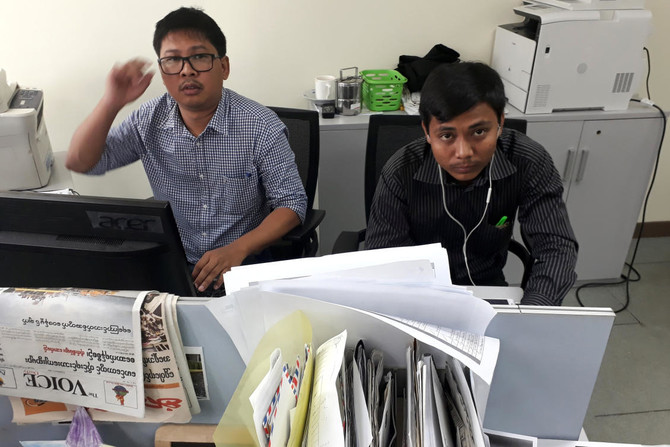
Reuters journalists Wa Lone (L) and Kyaw Soe Oo, who are based in Myanmar, pose for a picture at the Reuters office in Yangon, Myanmar December 11, 2017. (Reuters)
Updated 27 December 2017
Follow

Myanmar court remands Reuters journalists for 2 more weeks

YANGON: The detention of two Reuters journalists in Myanmar was extended for two more weeks, a court said Wednesday, in the pair’s first public appearance since their December 12 arrest under a draconian colonial-era secrecy law.
Wa Lone, 31, and Kyaw Soe Oo, 27 — Myanmar nationals who had been reporting on a military-led crackdown on Rohingya Muslims — were arrested after being invited to meet police for dinner on the outskirts of Yangon.
They face up to 14 years in jail under the Official Secrets Act for allegedly possessing documents related to the army crackdown in Rakhine state — a highly sensitive issue in Myanmar.
The UN says the army is likely guilty of ethnic cleansing and may have committed genocide against the Muslim minority, some 655,000 of whom have fled the country since the military launched a crackdown on Rohingya rebels in late August.
Myanmar denies the allegations and has tightly controlled media and UN access to the conflict area.
Myanmar officials have refused to comment on where the Reuters journalists were being detained or when they would be released.
On Wednesday, the pair appeared in public for the first time in a court on the outskirts of Yangon, where they were embraced by tearful relatives who have been denied any contact with the two men.

“They have not mistreated me,” Wa Lone told AFP inside the courthouse.
The other reporter, Kyaw Soe Oo, urged other journalists to be cautious in brief comments to AFP.
“Please tell journalist friends to be careful. It’s really scary. We didn’t do anything wrong,” he said.
Judge Ohn Myint extended their remand period until January 10, telling the court “the interrogation is still ongoing.”
The arrests have been widely condemned as the latest sign of eroding press freedoms in Myanmar, which is still shedding a 50-year legacy of brutal junta rule.
The emerging democracy is now led by former democracy activist Aung San Suu Kyi, who was swept into office in the 2015 elections.
But her civilian administration must share power with an army that retains firm control of security policy and other key levers of government.
At least 11 journalists have been arrested in Myanmar in 2017.
Saudi Arabia strengthens global ranking in 2026 Soft Power Index

Updated 20 January 2026
Follow

Saudi Arabia strengthens global ranking in 2026 Soft Power Index

  • UAE maintains 10th place, Qatar climbs 2 spots

DUBAI: Saudi Arabia climbed three positions to 17th place in this year’s Soft Power Index, released on Tuesday by marketing consultancy Brand Finance.

Other Gulf nations also performed well, with the UAE maintaining its 10th-place ranking and Qatar and Bahrain each climbing two spots to No. 20 and No. 49, respectively, marking a rebound for the region after a softer showing in 2025.

The report indicates that the performance reflects sustained investment in proactive diplomacy, economic diversification and expanded initiatives across culture, tourism and sports.

It also comes at a time when several Western powers are recording declines in their rankings, highlighting the growing influence of Gulf states.

“The UAE remains a clear regional leader, while Saudi Arabia and Qatar have strengthened their global positions through focused economic diplomacy and international engagement,” said Savio D’Souza, managing director for the Middle East and Africa, Brand Finance.

Saudi Arabia and the UAE either maintained or improved their rankings across all key pillars, including familiarity, reputation and influence.

The Kingdom recorded notable gains, with increases of 25 points in the People & Values pillar and 12 points in the Culture & Heritage pillar.

“Although perceptions across some markets remain mixed, renewed upward movement in the rankings suggests that targeted, long-term soft power strategies are beginning to pay off,” D’Souza said.

Globally, the US retained its top position despite recording the steepest overall decline in its score, followed by China in second place. Japan rose to third place, overtaking the UK, which ranked fourth, while Germany placed fifth.

Brand Finance defines “soft power” as a “nation’s ability to influence the preferences and behaviors of various actors in the international arena (states, corporations, communities, publics, etc.) through attraction and persuasion rather than coercion.” 

Each nation is assessed across 55 individual metrics, producing an overall score out of 100 and a ranking from first to 193rd.