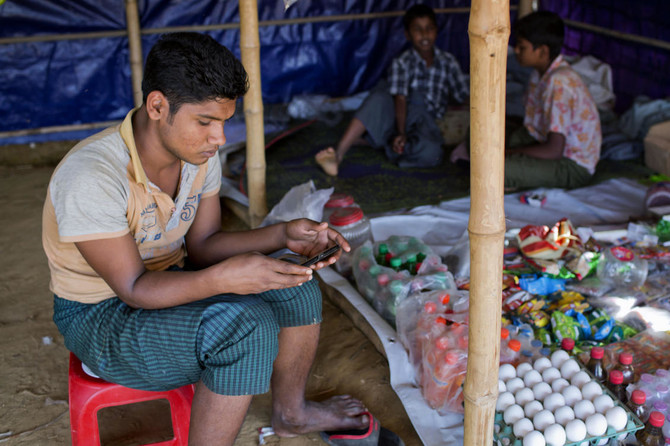
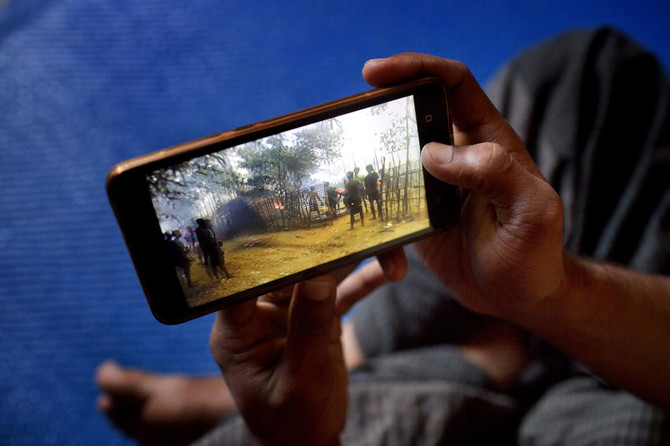
KUTUPALONG, Bangladesh: Abdul Hasan can spend hours watching old videos he shot on his cellphone.
“My heart aches for my village, my home,” the 16-year-old Rohingya refugee from Myanmar said in a camp in neighboring Bangladesh. “That’s why we have brought these memories, this video, from Myanmar.”
Since late August, hundreds of thousands of Rohingya Muslims have fled to Bangladesh to escape attacks by Myanmar security forces. But before fleeing from advancing soldiers, few Rohingya had time to grab many of their belongings. Instead, they poured across the border into Bangladesh bringing with them little more than horror stories of marauding forces and memories of terrifying treks through the forests.
Their old lives — homes, cattle, villages, everything — are gone. All they have left is their memories.
But if they’re lucky, some of those memories are stored on the cellphones many refugees managed to bring with them.
It’s the closest Hasan gets to experiencing his old life and country. One video shows him having what he calls a “coconut party.” A song hailing the bravery of a Rohingya rebel leader plays in the background as Hasan and his friends eat coconuts, and laugh as they throw them at each other.
“When I watch this video, I think of my country, Myanmar. It really breaks my heart so much,” he said.
The government of Buddhist-majority Myanmar has refused to accept Rohingya as a minority group, even though some have lived in the country for generations. Rohingya were stripped of their citizenship in 1982, denying them almost all rights and rendering them stateless.
In late August, attacks by Rohingya militants triggered a brutal and indiscriminate response by Myanmar’s military, sending more than 630,000 Rohingya fleeing to nearby Bangladesh.
Mohammad Fahid, 15, said he often finds himself looking through old photos and videos on his phone. He misses his friends. He misses school.
“I shared a lot of good times and laughter with my friends. I can’t do that here anymore,” he said. “We could go to school, now we can’t. So that is why I have kept these pictures. To remember.”
There is little work for the adults in the camps, and almost no schools for the children, who make up nearly 60 percent of the refugees. There is plenty of time to scroll through cellphones.
But not all the phone memories are happy.
Mujib Ullah is sitting with his sisters in their new home, a dark one-room shelter made from bamboo and plastic sheets. Ullah, 22, is showing a video of people in the Myanmar village of Borgiyabil frantically trying to extinguish the flames after soldiers lit their homes on fire with Molotov cocktails. The villagers used buckets of sand and water to try to put out the fires, but the homes kept burning, Ullah said.
A few hours after shooting his video, Ullah returned to his own village nearby and found his neighbors coming out of their homes. Everyone thought the soldiers had left. Suddenly gunfire rang out. Soldiers they hadn’t spotted were firing into the crowd.
“Some people were able to save themselves, others could not,” Ullah said. “My brother could not save himself. He was riddled with bullets.”


![]()
![]()
Heartbroken Rohingya refugees return home to Myanmar, even if only in videos
Heartbroken Rohingya refugees return home to Myanmar, even if only in videos

Latest updates



Recommended


© 2026 SAUDI RESEARCH & PUBLISHING COMPANY, All Rights Reserved And subject to Terms of Use Agreement.