BAGHDAD: Iraq on Sunday invited companies to submit statements of interest in building a new pipeline from the northern city of Kirkuk to Turkey’s Mediterranean port of Ceyhan.
The new 350-kilometer (220-mile) pipeline will carry up to one million barrels a day, the state-run Oil Projects Company said. A 305-kilometer (190-mile) gas pipeline to feed pumping stations, tanks and other service installations will be included in the project, it said.
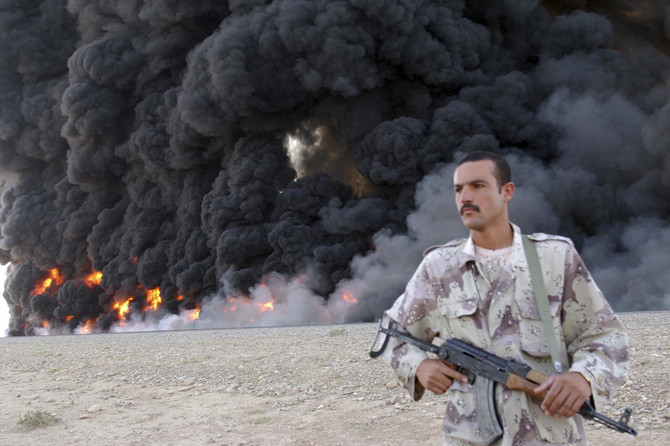
The new line will be built alongside an existing 1.6 million barrel-per-day pipeline, which runs through restive Sunni areas and has been idle since it was badly damaged by militant attacks in 2014.
Iraqi forces drove the Daesh group from the area earlier this year, but the militants are expected to continue to launch insurgent-style attacks.
Interested companies have until January 24 to submit applications for pre-qualification before receiving the final tender documents. Authorities did not provide a timeline for the project, which will be offered under a build-own-operate-transfer scheme. At least 25 percent of the project will be owned by Iraqi entities.
Iraqi forces seized the disputed city of Kirkuk from Kurdish forces in October. The Kurds, who had taken control of Kirkuk and other disputed areas when Daesh swept into Iraq three years ago, exported oil through their own pipeline to Turkey.
The fields around Kirkuk currently produce around 140,000 barrels a day, all of which goes to refineries, Oil Ministry spokesman Assem Jihad said Sunday.
Iraq has the world’s fourth-largest oil reserves. This year, it added 10 billion barrels, bringing its total reserves up to 153.1 billion barrels.
Oil and other infrastructure suffered widespread damage during the fighting against Daesh. The costs of the war, along with low oil prices, have taken a heavy toll on Iraq’s economy.

Iraq plans new Kirkuk-Ceyhan oil pipeline
Post-break return of students drives surge in education spending, SAMA data shows
RIYADH: Spending on education in Saudi Arabia increased by 141.1 percent for the week ending Jan. 24, as students returned to the classroom after the mid-year break.
This was accompanied by a 7 percent increase in spending on books and stationery, which reached SR146.17 million ($38.9 million).
According to the latest data from the Saudi Central Bank, the over POS value dropped 10.6 percent to SR12.52 billion, with transactions representing a 9.7 percent week-on-week decrease to 213.62 million.
This week saw negative changes across all the remaining sectors. Spending on bakeries and pastries saw an 18.4 percent decline to SR229.71 million, while gas stations saw an 11 percent drop. Professional and business services decreased by 11.6 percent.

Expenditure on apparel and clothing fell by 19.7 percent to SR985.94 million, followed by a 2.8 percent drop in spending on jewelry.
Spending on car rentals in the Kingdom fell by 14.7 percent, while airlines saw a 9.3 percent decrease to SR38.16 million.
Expenditure on food and beverages saw a 7.9 percent decline to SR1.88 billion, claiming the largest share of the POS. Restaurants and cafes retained the second position despite an 18.5 percent decrease to SR1.50 billion.
Geographically, Riyadh accounted for the largest share of total POS spending, but still saw a 6 percent dip to SR4.46 billion, down from SR4.74 billion the previous week. The number of transactions in the capital settled at 69.07 million, down 6.8 percent week on week.
In Jeddah, transaction values decreased by 13.6 percent to SR1.75 billion, while Dammam reported a 4.8 percent decrease to SR640.59 million.

POS data, tracked weekly by SAMA, provides an indicator of consumer spending trends and the ongoing growth of digital payments in Saudi Arabia.
The data also highlights the expanding reach of POS infrastructure, extending beyond major retail hubs to smaller cities and service sectors, supporting broader digital inclusion initiatives.
The growth of digital payment technologies aligns with the Kingdom’s Vision 2030 objectives, promoting electronic transactions and contributing to the Kingdom’s broader digital economy.