North Korea says new UN sanctions an act of war

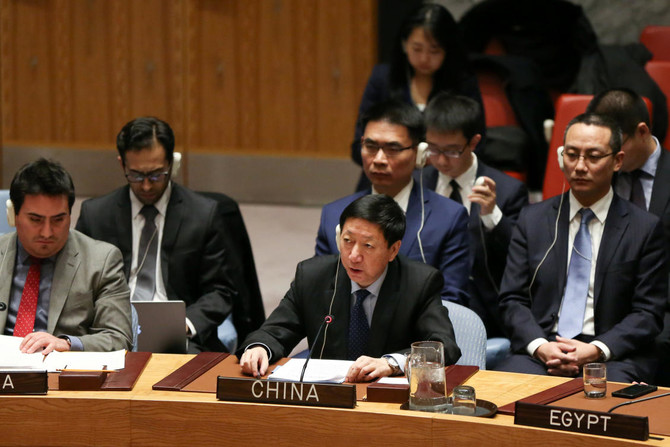
Chinese Deputy Ambassador to the United Nations Wu Haitao (C) attends the United Nations Security Council session on imposing new sanctions on North Korea, in New York, US, Dec. 22, 2017. (Reuters)
Updated 24 December 2017
Follow

North Korea says new UN sanctions an act of war

BEIJING: The latest round of United Nations sanctions against North Korea are an act of war and tantamount to a complete economic blockade against the country, North Korea’s foreign ministry said on Sunday in a statement carried by the official KCNA news agency.
“The United States, completely terrified at our accomplishment of the great historic cause of completing the state nuclear force, is getting more and more frenzied in the moves to impose the harshest-ever sanctions and pressure on our country,” the ministry said.
“We will further consolidate our self-defensive nuclear deterrence aimed at fundamentally eradicating the US nuclear threats, blackmail and hostile moves by establishing the practical balance of force with the US.”


’Without any humanity’: Eritrea human trafficker gets 20 years

Updated 5 sec ago
Follow

’Without any humanity’: Eritrea human trafficker gets 20 years

  • The court said the man had treated migrants “without any humanity” as they were transported from Eritrea to Europe via Libya
  • Gang members abused thousands of migrants before detaining them in overcrowded and dirty camps in Libya

THE HAGUE: A Dutch court on Tuesday sentenced an Eritrean man to 20 years in prison for operating a human trafficking ring in which migrants were tortured and their families extorted.
The court said the man, identified as Amanuel Walid, had treated migrants “without any humanity” as they were transported from Eritrea to Europe via Libya.
“Your only aim was to earn as much money as possible from people who were looking for a better future,” presiding judge Rene Melaard told Walid.
Gang members abused thousands of migrants before detaining them in overcrowded and dirty camps in Libya, extorting their families for large sums of money.
The court in the northern Dutch city of Zwolle heard how gang members tortured victims while on the phone to their families in the Netherlands, demanding payments to make the abuse stop.
Only once family members had transferred money were the victims put on rickety boats for the perilous trip across the Mediterranean Sea. Many drowned in the crossing.
Prosecutors had called for the maximum sentence of 20 years, accusing him of leading a criminal organization with the intent to commit human trafficking, extortion, hostage-taking, and sexual offenses.
“The court finds that the seriousness and the extent of those crimes justifies such a 20-year sentence,” said Melaard.
He noted Walid had never expressed remorse for his actions and that a psychiatric observation center had judged him mentally fit to take criminal responsibility.
Melaard said he was also imposing the maximum sentence “because of the particularly cruel, violent, and degrading treatment to which the defendant and his accomplices subjected the migrants.”
The court ruled however it had no jurisdiction over the charges of hostage-taking and sexual offenses as these alleged crimes did not take place on Dutch soil.
Walid has been in custody in the Netherlands since October 2022. There is confusion over both his name and his age. He says he has a different name and is 46, not 42.
He made no substantive comments in court, except to deny the charges. He said it is a case of mistaken identity.
But the judge dismissed this claim, saying: “The court finds that it is beyond reasonable doubt that you are the person who was active as a trafficker in Bani Walid in Libya.”
His lawyers also argued that he has already been tried in Ethiopia over largely the same allegations and therefore could not be put on trial again.
Melaard said that the sentence in the Ethiopian case had not yet been applied but that Walid could appeal if it is.

- ‘Freedom and dignity’ -

Prosecutors believe Walid was one of the “most prolific” smugglers on the route from conflict-torn regions in Africa via Libya to Europe.
Walid “deprived the victims of their freedom and dignity,” the public prosecutor argued in court.
“He held them in appalling conditions, starved them, tortured them, and denied them essential medical care,” said the prosecutor.
The Dutch investigation into the operation lasted several years and was carried out with other international bodies such as the International Criminal Court and Interpol.
Libya has struggled to recover from chaos that erupted after a NATO-backed uprising in 2011 overthrew longtime dictator Muammar Qaddafi.
Smugglers and human traffickers have taken advantage of the instability, with the country facing criticism over conditions for migrants and rights groups levelling accusations of extortion and slavery.