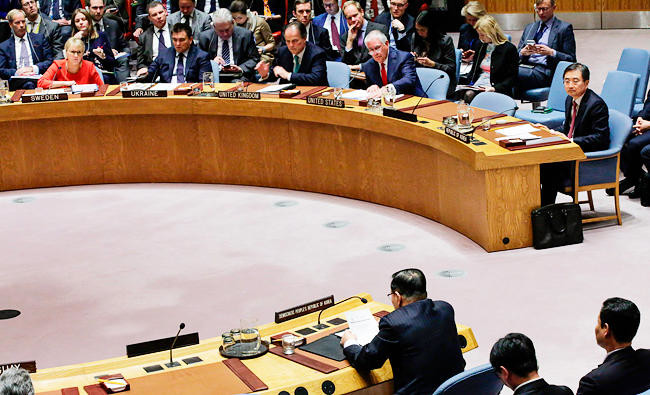
UNITED NATIONS, United States: With China’s backing, the UN Security Council on Friday slapped new sanctions on North Korea that will restrict oil supplies vital for Pyongyang’s missile and nuclear programs.
The council unanimously adopted a US-drafted resolution that also orders the repatriation of North Korean workers sent abroad to earn revenue for Kim Jong-Un’s regime.
It is the third raft of sanctions imposed on Pyongyang this year and comes as the United States and North Korea show no signs they are willing to open talks on ending the crisis on the Korean peninsula.
US President Donald Trump Friday hailed the move, saying the international community was pushing for peace with the isolated regime.
“The United Nations Security Council just voted 15-0 in favor of additional Sanctions on North Korea. The World wants Peace, not Death!” Trump tweeted.
The resolution bans the supply of nearly 75 percent of refined oil products to North Korea, puts a cap on crude deliveries and orders all North Korean nationals working abroad to be sent back by the end of 2019.
The United States put forward the draft text on Thursday following negotiations with China, Pyongyang’s ally and main supplier of oil.
Describing North Korea as “the most tragic example of evil in the modern world,” US Ambassador Nikki Haley said the new sanctions are “a reflection of the international outrage at the Kim regime’s actions.”
The resolution “sends the unambiguous message to Pyongyang that further defiance will invite further punishment and isolation,” she said.
The measures are in response to North Korea’s test of an intercontinental ballistic missile (ICBM) on November 28 that marked an advance in Pyongyang’s drive to threaten the US mainland with a nuclear strike.
Trump has threatened to “totally destroy” North Korea if it attacks the United States while North Korea insists the world must now accept that it is a nuclear power.
Last month, Trump asked Chinese President Xi Jinping to cut off oil to the North, a move that would cripple its struggling economy.
Crude oil supplies were capped at four million barrels per year and a ceiling of 500,000 barrels of refined petroleum products, including diesel and kerosene, was set for next year, down from two million barrels in a previous resolution.
If North Korea carries out another nuclear or ICBM test, “then the Security Council will take action to restrict further the export to the DPRK of petroleum,” said the resolution.
The United States had initially sought to expel within a year tens of thousands of North Koreans, most of whom are working in Russia and China, but that deadline was extended to two years after Russia objected.
To prevent North Korea from circumventing sanctions, all countries were authorized to seize, inspect and impound ships suspected of carrying illegal cargo to and from North Korea.
The measure bans sales of all industrial machinery, trucks, iron, steel and other metals to North Korea and bars exports of food, machinery, electrical equipment, earth, stone, wood and vessels produced in the reclusive state.
Addressing the council, China and Russia condemned North Korea’s behavior but made the case for urgently opening diplomatic channels to ease tensions and move toward settling the crisis.
“Sanctions are only a means,” said Chinese Deputy Ambassador Wu Haitao. “One should not expect to settle the problems through unilateral sanctions or pressure.”
“We all must, we are all duty-bound, to provide opportunities for diplomacy to function,” said Russian Deputy Ambassador Vladimir Safronkov.
A total of 15 North Korean officials, most of whom work in banking, were added to the UN sanctions blacklist along with the ministry of the people’s armed forces, which manages army logistics for the country.
An earlier list contained 19 names, later reduced to 16, but a final version listed 15 North Koreans, who will be subjected to a global visa ban and assets freeze.
Since September last year, North Korea has carried out its sixth and largest nuclear test and a series of advanced missile launches which are banned under UN resolutions.
The United States has led the drive at the Security Council to tighten sanctions aimed at piling pressure on Kim’s regime to come to the negotiating table.
French Ambassador Francois Delattre welcomed the new measures, saying “this resolution bites.”
“Maximum firmness today is our best antidote to the risk of war,” he said.
The European Union said in a statement that it too is planning to adopt tougher sanctions against North Korea early next year.

UN slaps new sanctions on North Korea
Donald Trump, once unstoppable, hits snag after snag ahead of State of the Union address
- The US president is unlikely to back down in his State of the Union address
- His boasts will have less sting on Democrats, and world leaders, who have been bulldozed by his agenda
WASHINGTON: For a year, Donald Trump has governed the United States with little standing in his way.
Now, as the president prepares for his State of the Union address on Tuesday, he’s weighed down with Supreme Court reversals on tariffs, souring public opinion on his immigration crackdown and mounting economic concerns.
Trump is unlikely to back down in his speech, a primetime American political institution where the president is invited by Congress to present his accomplishments and lay out his agenda.
But his boasts will have less sting on Democrats — and world leaders — who have up to this point been bulldozed by his agenda.
On Friday, the Supreme Court delivered a sharp rebuke of his use of tariffs, which he slapped on countries often arbitrarily via a simple order on social media in an effort to gain leverage over diplomatic matters sometimes wholly unrelated to trade.
The same day, the government data showed the US economy expanded at a 1.4 percent annual rate in the October to December period — significantly below the 2.5 percent pace that analysts had forecasted for the quarter.
Polls meanwhile show growing dissatisfaction with the cost of living as well as Trump’s crackdown on undocumented immigrants.
Cost-of-living concerns
Trump’s strategy so far on inflation has been to cede no ground.
“I’ve won affordability,” Trump said during a speech in the southeastern state of Georgia on Thursday.
But “you cannot out-message the economy. People know what they are spending,” Todd Belt, a political science professor at George Washington University, said.
“People become very resentful when being told something they know is not true,” he said — which applies to both the cost of living but also the crackdown on immigrants, which many Americans had falsely believed would focus on deporting violent criminals.
American voters have proven extremely sensitive to economic issues, which in part sunk Trump’s predecessor Joe Biden but now threaten Republicans.
As midterms approach in November, the House of Representatives and a third of the Senate will be up for grabs.
Trump has already warned that if Democrats take control they could try to impeach him.
Backing down?
Even the normally bombastic Trump has been cowed in recent days, including when a racist video of Barack Obama — the country’s first Black president — was posted onto his Truth Social account.
The White House tried to brush off the issue before claiming that an unnamed aide posted it, as even loyal members of Congress broke ranks to criticize the president.
After federal immigration agents shot and killed two US citizens during their wide-sweeping operations in Minneapolis, the administration announced it was scaling back the deployment in the city, which was the scene of mass protests.
On the international scene, a US-Denmark-Greenland working group has been established to discuss Washington’s security concerns in the Arctic, but Trump has had to dial back his threats to seize Greenland.
He has imposed an across-the-board 10 percent tariff on imports into the United States after the Supreme Court rebuffed his previous tariffs Friday — but that still means some nations are now trading at reduced rates than they had agreed to under his previous levies.
The administration has vowed to find other ways to implement tariffs as it decried the court’s “lawlessness.”
In the meantime, challenges to Trump’s policies are slowly winding their way through the courts.
But while Trump has been chastened, the House and the Senate still remain in Republican control — for now. And Trump himself will be in the White House until 2029.
Now, as the president prepares for his State of the Union address on Tuesday, he’s weighed down with Supreme Court reversals on tariffs, souring public opinion on his immigration crackdown and mounting economic concerns.
Trump is unlikely to back down in his speech, a primetime American political institution where the president is invited by Congress to present his accomplishments and lay out his agenda.
But his boasts will have less sting on Democrats — and world leaders — who have up to this point been bulldozed by his agenda.
On Friday, the Supreme Court delivered a sharp rebuke of his use of tariffs, which he slapped on countries often arbitrarily via a simple order on social media in an effort to gain leverage over diplomatic matters sometimes wholly unrelated to trade.
The same day, the government data showed the US economy expanded at a 1.4 percent annual rate in the October to December period — significantly below the 2.5 percent pace that analysts had forecasted for the quarter.
Polls meanwhile show growing dissatisfaction with the cost of living as well as Trump’s crackdown on undocumented immigrants.
Cost-of-living concerns
Trump’s strategy so far on inflation has been to cede no ground.
“I’ve won affordability,” Trump said during a speech in the southeastern state of Georgia on Thursday.
But “you cannot out-message the economy. People know what they are spending,” Todd Belt, a political science professor at George Washington University, said.
“People become very resentful when being told something they know is not true,” he said — which applies to both the cost of living but also the crackdown on immigrants, which many Americans had falsely believed would focus on deporting violent criminals.
American voters have proven extremely sensitive to economic issues, which in part sunk Trump’s predecessor Joe Biden but now threaten Republicans.
As midterms approach in November, the House of Representatives and a third of the Senate will be up for grabs.
Trump has already warned that if Democrats take control they could try to impeach him.
Backing down?
Even the normally bombastic Trump has been cowed in recent days, including when a racist video of Barack Obama — the country’s first Black president — was posted onto his Truth Social account.
The White House tried to brush off the issue before claiming that an unnamed aide posted it, as even loyal members of Congress broke ranks to criticize the president.
After federal immigration agents shot and killed two US citizens during their wide-sweeping operations in Minneapolis, the administration announced it was scaling back the deployment in the city, which was the scene of mass protests.
On the international scene, a US-Denmark-Greenland working group has been established to discuss Washington’s security concerns in the Arctic, but Trump has had to dial back his threats to seize Greenland.
He has imposed an across-the-board 10 percent tariff on imports into the United States after the Supreme Court rebuffed his previous tariffs Friday — but that still means some nations are now trading at reduced rates than they had agreed to under his previous levies.
The administration has vowed to find other ways to implement tariffs as it decried the court’s “lawlessness.”
In the meantime, challenges to Trump’s policies are slowly winding their way through the courts.
But while Trump has been chastened, the House and the Senate still remain in Republican control — for now. And Trump himself will be in the White House until 2029.
© 2026 SAUDI RESEARCH & PUBLISHING COMPANY, All Rights Reserved And subject to Terms of Use Agreement.