ISLAMABAD: Pakistan’s Supreme Court on Friday unanimously rejected the appeal to reopen the 17-year old corruption case against ousted Premier Nawaz Sharif and his family members.
In an appeal, the National Accountability Bureau (NAB ) sought to re-open the case commonly known as the Hudaibiya Paper Mills.
The country’s anti-graft body, NAB, alleges that the Sharif family used the company in the 1990s to launder about $10 million out of Pakistan; Sharif and his family members deny the allegation.
The court order has brought some relief for Nawaz Sharif and his younger brother Shahbaz Sharif who was also accused in the case. The Supreme Court disqualified Nawaz Sharif from office in July this year due to concealment of financial assets and that forced him to step down.
Pakistan has been in political turmoil since Nawaz Sharif’s judicial ouster, which was largely flayed by the ruling Pakistan Muslim League-Nawaz (PML-N) party members who called the ouster a conspiracy against a democratically elected government.
National Assembly Speaker Ayaz Sadiq is the latest member of the political corps and senior government officials to speak of an alleged conspiracy to derail democracy in Pakistan. He expressed his fear that the current assemblies may not be able to complete their full terms.
In an interview this week, Sadiq said he has “enough information to believe that a conspiracy was being hatched” to “disrupt the (democratic) system.” This was quoted on a local television channel and he added that the recent sit-in protests by far-right activists in different cities were also part of this “greater plan.”
According to the media, Sadiq also hinted at the involvement of external forces in political maneuvering to destabilize the government and stressed that the US would eventually question political stability in Pakistan if such “experiments went unabated.” His statements have caused great concern, not only among politicians but among the general public as well.
The government is already facing difficulty in getting the constitutional amendment passed by the Upper House, Senate, which is required for delimitation of constituencies after the recent population census — a prerequisite for holding next year’s elections on schedule. Any delay in elections would essentially mean an interim setup taking over until constitutional requisites were fulfilled.
Prime Minister Shahid Khaqan Abbasi, however, said he was optimistic that the assemblies would complete their term.
After a meeting with Nawaz Sharif in London on Thursday, Abbasi confidently said: “Our government will have smooth sailing and an interim government will be formed in June.”
As the opposition party Pakistan Tehrik-e-Insaf (PTI) demands snap elections alleging governmental incompetence and corruption, religious groups oppose the government over an amendment which the government calls a clerical error. While opposition parties are forging different alliances to add to the mounting pressure on the government, Pakistan appears unsure of its political course.


![]()
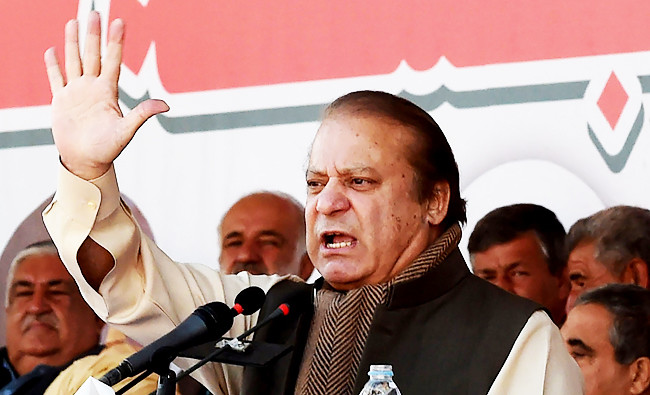
Nawaz Sharif vindicated as Supreme Court refuses to reopen Hudaibiya Paper Mills case
Nawaz Sharif vindicated as Supreme Court refuses to reopen Hudaibiya Paper Mills case
Latest updates


© 2026 SAUDI RESEARCH & PUBLISHING COMPANY, All Rights Reserved And subject to Terms of Use Agreement.