Cinemas to re-open in Saudi Arabia as of 2018, Ministry of Information confirms

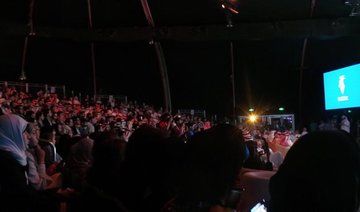
Saudi Arabia has announced that cinemas will be allowed in the country. (Shutterstock)
Updated 11 December 2017
Follow

Cinemas to re-open in Saudi Arabia as of 2018, Ministry of Information confirms

JEDDAH: Saudi Arabia’s Ministry of Culture and Information has announced that commercial cinemas will be allowed to operate in the Kingdom as of early 2018.
The announcement marks the first time in 35 years that cinema theaters will be allowed to operate in the country.
Meanwhile, the Board of the General Commission for Audiovisual Media (GCAM), which is chaired by the Minister of Culture and Information Awwad Alawwad, passed a resolution on Monday allowing the authority to grant licenses to cinemas.
In a released statement, Alawwad said: “As the industry regulator, the General Commission for Audiovisual Media has started the process for licensing cinemas in the Kingdom. We expect the first cinemas to open in March 2018.”
The announcement comes as part of the Vision 2030 social and economic reform program in the Kingdom and follows the announcement that women in the Kingdom will be allowed to drive come June 2018.
The move marks the first time that cinemas have been licensed in the country since the early 1980s.
“This marks a watershed moment in the development of the cultural economy in the Kingdom,” Alawwad added in the statement.
“Opening cinemas will act as a catalyst for economic growth and diversification; by developing the broader cultural sector we will create new employment and training opportunities, as well as enriching the Kingdom’s entertainment options.”
According to authorities, Vision 2030 aims to increase Saudi household spending on cultural and entertainment activities from 2.9 percent currently to six percent by 2030.
The announcement opens up a domestic market of more than 32 million people and it is forecast that, by 2030, Saudi Arabia will be home to more than 300 cinemas, according to the Board of the General Commission for Audiovisual Media.


300,000 Saudis quit smoking in 2025 as health push gains momentum 

Updated 07 January 2026
Follow

300,000 Saudis quit smoking in 2025 as health push gains momentum 

  • Nicotine pouch manufacturer says it wants to help 1m people quit by 2028 
  • Trend in line with Vision 2030 goals to reduce preventable health risks

ALKHOBAR: New research shows that 300,000 people in Saudi Arabia quit smoking last year, reflecting growing support for the nation’s Vision 2030 goals to improve quality of life and reduce preventable health risks.

According to nicotine alternatives company Badael, the number of people known to have quit rose from 400,000 in January 2025 to 700,000 by the year’s end.

Of the total, 200,000 people went on to cut out nicotine entirely, including the use of pouches, the company said.

International studies support this trend. The WHO’s Global Report on Trends in Prevalence of Tobacco Use notes that many smokers quit in stages, often using alternatives before fully ending their nicotine dependence. The WHO Framework Convention on Tobacco Control similarly highlights harm reduction as a pathway to complete cessation when used responsibly.

For many Saudis, the decision to quit was driven by personal health concerns.

Ahmed Al-Omari, 32, said he gave up after smoking for more than a decade.

“I started noticing how much smoking was affecting my energy and breathing,” he said.

“Once cigarettes were no longer part of my daily routine, I didn’t want to rely on nicotine either.”

Research published in the Cochrane Database of Systematic Reviews shows that cessation is more successful when driven by internal motivation and lifestyle goals rather than fear-based messaging alone, a trend health specialists say is increasingly visible among Saudis.

Mariam Al-Dossary, 27, said she stopped smoking as part of a broader effort to improve her health.

“It reached a point where smoking didn’t fit the life I wanted anymore,” she said.

“Once I made that decision, sticking to it became easier.”

Studies from Harvard T.H. Chan School of Public Health have found that health behavior changes linked to improved sleep, fitness and energy levels are more likely to be sustained over time, reinforcing the importance of quality of life motivations in smoking cessation.

Young Saudis are also quitting earlier than in previous generations.

Mohammed Al-Shahri, 22, said he decided to give up smoking while he was at university.

“I didn’t want smoking to be something I carried into my future,” he said.

“A lot of people my age are thinking differently about it now.”

Badael, which develops and manufactures the nicotine pouch product DZRT, said its focus was on providing alternatives for adult smokers seeking to move away from combustible tobacco. It said its products were intended for harm reduction, not long-term dependence.

The fact 200,000 former smokers later quit nicotine entirely highlighted the importance of supporting sustained behavioral change beyond stubbing out cigarettes, the company said.

It said it wanted to help 1 million people in Saudi Arabia quit smoking by 2028.

By combining public awareness, regulatory measures and accessible cessation pathways, the Kingdom appears to be moving toward a future where smoking is no longer the norm.