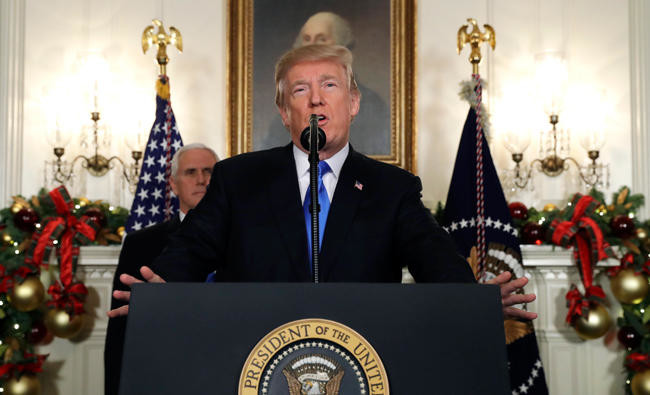
WASHINGTON: President Donald Trump shattered decades of unwavering US neutrality on Jerusalem Wednesday, declaring the sorely divided holy city as Israel’s capital and sparking frustrated Palestinians to cry out that he had destroyed already-fragile Mideast hopes for peace.
Defying dire, worldwide warnings, Trump insisted that after repeated peace failures it was past time for a new approach, starting with what he said was his decision merely based on reality to recognize Jerusalem as the seat of Israel’s government. He also said the United States would move its embassy from Tel Aviv to Jerusalem, though he set no timetable.
“We cannot solve our problems by making the same failed assumptions and repeating the same failed strategies of the past,” Trump said, brushing aside the appeals for caution from around the world.
Harsh objections came from a wide array of presidents and prime ministers. From the Middle East to Europe and beyond, leaders cautioned Trump that any sudden change on an issue as sensitive as Jerusalem not only risks blowing up the new Arab-Israeli peace initiative led by Trump’s son-in-law, Jared Kushner, but could lead to new violence in the region.
No government beyond Israel spoke up in praise of Trump or suggested it would follow his lead.
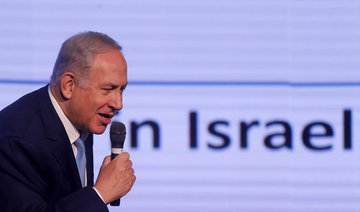
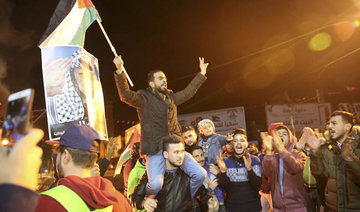
Israelis and Palestinians reacted in starkly different terms. Prime Minister Benjamin Netanyahu hailed Trump’s announcement as an “important step toward peace,” and Israeli opposition leaders echoed his praise. But Palestinian President Mahmoud Abbas said Trump’s shift serves extremist groups that want religious war and signals US withdrawal from being a peace mediator. Protesters in Gaza burned American and Israeli flags.
Trump’s declaration of Jerusalem as Israel’s capital is a powerfully symbolic statement about a city that houses many of the world’s holiest sites. Trump cited several: the Western Wall that surrounded the Jews’ ancient Temple, the Stations of the Cross that depict Jesus along his crucifixion path, the Al-Asqa Mosque where Muslims say their Prophet Muhammad ascended to heaven.
And there are major ramifications over who should control the territory. The United States has never endorsed the Jewish state’s claim of sovereignty over any part of Jerusalem and has seen the city’s future as indelibly linked to the “deal of the century” between Israel and the Palestinians that Trump believes he can reach. Beyond Kushner, Trump has dispatched other top emissaries to the region in recent months in hopes of advancing new negotiations.
Trump said he wasn’t delivering any verdict about where an Israeli-Palestinian border should lie. Instead, he described his Jerusalem declaration as recognizing the reality that most of Israel’s government already operates from the city, and he suggested the US ally should be rewarded for creating a successful democracy where “people of all faiths are free to live and worship.”
“Today we finally acknowledge the obvious,” he said, emphasizing that he wouldn’t follow past presidents who tiptoed around Jerusalem out of diplomatic caution.
US embassies and consulates around the world were put on high alert. Across the Middle East and Europe, they issued warnings to Americans to watch out for violent protests. In Jordan, home to a large Palestinian population, the US said it would close its embassy to the public on Thursday and urged children of diplomats there to stay home from school.
There was little in Trump’s statement to encourage the Palestinians. Although he recited the longstanding US position that Jerusalem’s borders must still be worked out through negotiation, he made no recognition of the Palestinian claims to east Jerusalem.
For the first time, Trump did appear to endorse the concept of an independent Palestine existing alongside Israel. Yet even that idea appeared conditional, as he said he’d promote the “two-state solution” if both sides agreed. Netanyahu’s government is dominated by hard-liners who oppose Palestinian independence.
Trump made no reference to signing a waiver that officially delays any move of the US Embassy from Tel Aviv to Jerusalem, but multiple officials confirmed he signed the waiver Wednesday. It means there will be no embassy move for at least another six months. Establishing a Jerusalem embassy was a major campaign promise of Trump’s and one that officials said he focused on in discussions with top advisers in recent weeks.
On Wednesday he focused on his directive to the State Department to begin a process of moving the embassy as required by US law, however many years that might take. After his speech, he signed a proclamation to that effect.
In Germany, Secretary of State Rex Tillerson said work will begin immediately to identify a site.
A non-governmental expert on the Middle East who consults regularly with the White House said the Trump administration had opted against an earlier plan of converting the existing US Consulate in Jerusalem to an embassy. Instead, it’s looking to construct an entirely new facility, said the individual, who wasn’t authorized to disclose private conversations with US officials and requested anonymity.
In making his decision, Trump overruled more cautious counsel from Tillerson and Defense Secretary James Mattis, who voiced concern about endangering US diplomats and troops in Muslim countries, according to officials briefed on internal administration deliberations. Those officials were not authorized to publicly discuss the matter and spoke on condition of anonymity.
“There will of course be disagreement and dissent regarding this announcement — but we are confident that ultimately, as we work through these disagreements, we will arrive at a place of greater understanding and cooperation,” Trump said. He said he intends “to do everything in my power to help forge” a peace agreement.