Militias say political opponents are ‘safe’ as fighting halts in Sanaa

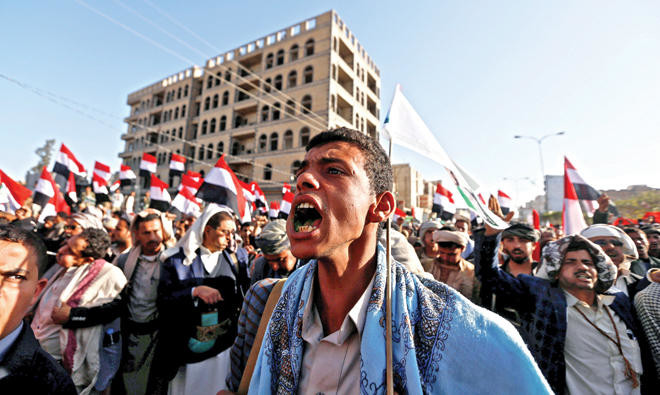
Houthi followers rally in Sanaa on Tuesday. (Reuters)
Updated 05 December 2017
Follow

Militias say political opponents are ‘safe’ as fighting halts in Sanaa

SANAA/GENEVA: Yemen’s Houthi militias rallied their supporters in the capital Tuesday, pledging that backers of former President Ali Abdullah Saleh were safe despite his death at the hands of the insurgents.
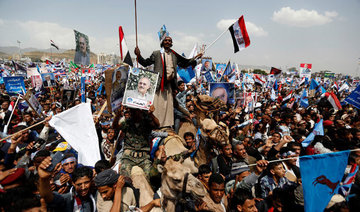
Thousands of Yemenis gathered near Sanaa International Airport shouting “Sanaa is free and the state still stands!” and “Yemenis are one!,” as militia chiefs addressed the crowd, many of whom waved the national flag.
Mohammed Ali Al-Houthi, who heads the terrorists’ revolutionary council, told the crowd the Houthis had been left with no choice but to “confront” their former ally but were now “ensuring the safety” of members of his General People’s Congress party.
“They are being treated in hospitals and no one is looking to eliminate them,” Houthi said.
Tuesday’s rally struck a decidedly conciliatory tone after days of intense clashes between the Houthis and Saleh supporters left residents fearing their neighborhoods had become a new front in the Yemen war.
Sanaa was quiet on Tuesday after five days of fighting, and UN and Red Cross flights have landed at the airport, the UN said on Tuesday.
Street battles in the capital had stopped despite 25 airstrikes overnight, UN humanitarian coordinator in Yemen Jamie McGoldrick said.
The funeral of Saleh was expected later on Tuesday.
His family’s allies have battled the Houthis since last week, a dramatic turn in a conflict that had been largely stalemated for much of the past three years.
The UN says a food shortage caused by warring parties blocking supplies has created the world’s worst humanitarian crisis. Millions of people could die in one of the worst famines of modern times.
“People are now emerging from their houses after five days being locked down basically as prisoners,” McGoldrick told a regular UN briefing, speaking by phone from Sanaa.
“They are now seeking safety, moving their families in case things erupt again and at the same time seeking medical treatment and trying to pacify very terrified kids who have endured five days of relentless shelling, shooting and ground fire and airstrikes.”
The airstrikes overnight struck government buildings, palaces and bridges, and people were now bracing themselves in case of more fighting or airstrikes, McGoldrick said, describing the situation as “very uncertain times.”
McGoldrick had no details of Saleh’s funeral later on Tuesday and did not know if it would coincide or clash with an event planned by the Houthis to celebrate his killing. He said there had been a report that there would be a ceremony around the main mosque, and the UN mission should avoid the area because of traffic.
The International Committee of the Red Cross (ICRC) said that as many as 234 people have been killed in Sanaa street fighting this month between the Houthis and Saleh supporters.
The ICRC said on Tuesday that another 400 people have been wounded in the clashes, which first erupted last week.
It’s not clear how many civilians are among the dead.


Philanthropy can unlock investment and drive global impact, says UAE’s Badr Jafar

Updated 6 sec ago
Follow

Philanthropy can unlock investment and drive global impact, says UAE’s Badr Jafar

DAVOS: Philanthropy has the power not only to do great good, but to do so in a way that stimulates additional capital investment from business and government sources, Emirati businessman Badr Jafar told Arab News on the sidelines at the World Economic Forum in Davos.

Jafar knows a thing or two about the subject. In addition to his roles as CEO of Crescent Enterprises, a multifaceted business operating across nine sectors in 15 countries, and chairman of Gulftainer, the largest privately owned container-port operator in the world, he is special envoy for business and philanthropy for the UAE, holds multiple advisory positions in the humanitarian and development sectors and co-founded the Arab World Social Entrepreneurship Program.

“The term philanthropy itself conjures up this image of the sort of billionaire donor who has lots of money to give away, and I don’t like that,” he said.

It is problematic, Jafar said, because far from simply flinging money around in the hope that some of it sticks, many philanthropists operate in a far more sophisticated way.

“Capital today is a continuum, and impact is also a continuum,” he said.

“And the sooner we start to see the benefits of alignment of capital across government, business and philanthropy, the sooner we can start to reap the rewards that come with the multiplier effect that’s generated when these pools of capital work better together.”

Philanthropy, he said, is “the forgotten child of the capital system, regarded in some parts of the world as a peripheral player, and in other parts regarded with a high degree of suspicion.”

In fact, in its best form philanthropy can act as a catalyst: “Philanthropic capital, often referred to as catalytic capital, can help to de-risk and crowd in other sources of capital, particularly from the business sector. There are many examples from around the world where donated capital without any intended financial return goes in to unlock opportunities for businesses, including in tech.”

Emirati businessman Badr Jafar. (Supplied)

He also feels the sheer scale of philanthropic capital is seriously under-appreciated.

“Take the US example. The recent reductions in USAID was a shock to the system. But to put things into perspective, at its peak in about 2023 USAID was less than $50 billion a year. Now that’s a significant amount of money, but private philanthropy alone in the US in that same year — and to clarify, this is excluding corporate philanthropy — was well north of $600 billion.

“Now I’m not suggesting that private philanthropy is a substitute for official development assistance — aid from government, and the nature of aid from government, is extremely important, particularly in certain settings, including humanitarian.

“But today global philanthropy is pushing $2 trillion a year, more than three times the global humanitarian and development aid budgets, and that’s a lot of money.”

Jafar is the author of “The Business of Philanthropy: Perspectives and Insights from Global Thought Leaders on How to Change the World,” a collection of discussions with 50 of the world’s most active philanthropists, including Microsoft founder Bill Gates, the Bulgarian economist and managing director of the International Monetary Fund, Kristalina Georgieva, and Razan Al-Mubarak, head of the Environment Agency Abu Dhabi and president of the International Union for Conservation of Nature.

The title of the book, he said “was purposefully provocative, getting people to think about what the business world has to learn from philanthropy and what philanthropists have to learn from the business world.”

Through the examples, insights and experiences of his high-profile interviewees, he makes the case for what he calls “strategic philanthropy,” in the hope that others may be inspired to follow in their footsteps.

“The need for strategic philanthropy in the world today,” he writes, “is greater than ever. The geological fractures that constitute the headlines every day — regional conflicts, political extremism, and the resulting refugee and humanitarian crises — are compounded by environmental challenges.

“Public- and private-sector leaders in all countries are grappling with these issues daily. More than ever, strategic philanthropists across the world have an opportunity to step up to help meet those challenges.”

Jafar grew up in Sharjah, in a family “with a strong belief in giving back to the community.” The book is dedicated to his mother and father, “who taught me everything I know and are still working on teaching me everything they know.”

All royalties from the sale of Badr Jafar’s book are donated to the International Rescue Committee, in support of children affected by armed combat.