

Trump hits out at UK’s May over criticism of sharing far right videos

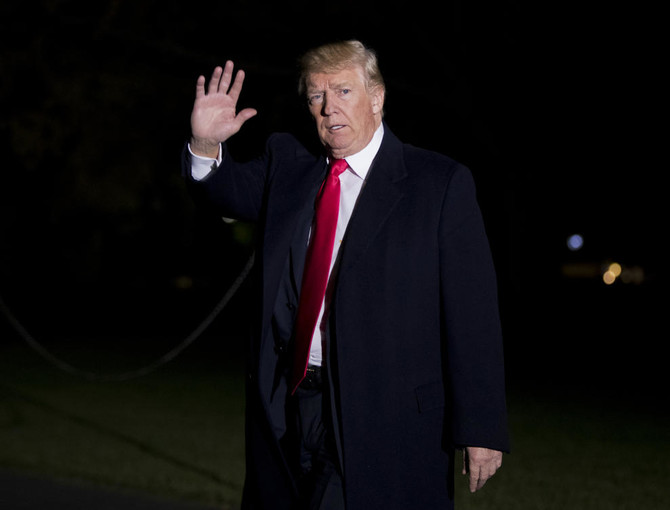
President Donald Trump waves as he walks on the South Lawn upon his return to the White House in Washington from a trip to Missouri on Wednesday, Nov. 29, 2017. (AP Photo/Manuel Balce Ceneta)
Updated 30 November 2017
Follow

Trump hits out at UK’s May over criticism of sharing far right videos

LONDON/WASHINGTON: US President Donald Trump rebuked British Prime Minister Theresa May after Britain criticized him for retweeting anti-Islam videos originally posted by a leader of a far-right British fringe party.
“Theresa @theresamay, don’t focus on me, focus on the destructive Radical Islamic Terrorism that is taking place within the United Kingdom. We are doing just fine,” Trump tweeted.
Trump initially tagged the tweet to a Twitter handle that is not Theresa May’s, though he later retweeted to the British leader’s account.

He had sparked a storm of criticism on both sides of the Atlantic by sharing anti-Muslim videos posted by Jayda Fransen, deputy leader of anti-immigration fringe group Britain First, who was convicted this month of abusing a Muslim woman.
The videos purported to show a group of people who were Muslims beating a teenage boy to death, battering a boy on crutches and destroying a Christian statue. Reuters was unable to verify the videos.
“It is wrong for the president to have done this,” a spokesman for May said on Wednesday.
British lawmakers demanded Trump make an apology and US Muslim groups said it was incendiary and reckless.
The White House defended the retweets by the Republican president, who during the 2016 US election campaign called for “a total and complete shutdown of Muslims entering the United States,” saying that he was raising security issues.
“I’m delighted,” Fransen, who has 53,000 Twitter followers, told Reuters. She said Trump’s retweets showed the president shared her aim of raising awareness of “issues such as Islam.”
The White House repeatedly refused to be drawn into the content of the videos or whether Trump was aware of the source of the tweets.
“It’s about ensuring that individuals who come into the United States don’t pose a public safety or terrorism threat,” White House spokesman Raj Shah told reporters aboard Air Force One.

Inside Chernobyl, Ukraine scrambles to repair radiation shield

Updated 2 sec ago
Follow

Inside Chernobyl, Ukraine scrambles to repair radiation shield

CHERNOBYL NUCLEAR POWER PLANT: Inside an abandoned control room at Ukraine’s Chernobyl nuclear power plant, a worker in an orange hardhat gazed at a grey wall of seemingly endless dials, screens and gauges that were supposed to prevent disaster.
The 1986 meltdown at the site was the world’s worst ever nuclear incident. Since Russia invaded in 2022, Kyiv fears another disaster could be just a matter of time.
In February, a Russian drone hit and left a large hole in the New Safe Confinement (NSC), the outer of two radiation shells covering the remnants of the nuclear power plant.
It functions as a modern high-tech replacement for an inner steel-and-concrete structure — known as the Sarcophagus, a defensive layer built hastily after the 1986 incident.
Ten months later, repair work is still ongoing, and it could take another three to four years before the outer dome regains its primary safety functions, plant director Sergiy Tarakanov told AFP in an interview from Kyiv.
“It does not perform the function of retaining radioactive substances inside,” Tarakanov said, echoing concerns raised by the International Atomic Energy Agency.
The strike had also left it unclear if the shell would last the 100 years it was designed to.
The gaping crater in the structure, which AFP journalists saw this summer, has been covered over with a protective screen, but 300 smaller holes made by firefighters when battling the blaze still need to be filled in.
Scaffolding engulfs the inside of the giant multi-billion-dollar structure, rising all the way up to the 100-meter-high ceiling.
Charred debris from the drone strike that hit the NSC still lay on the floor of the plant, AFP journalists saw on a visit to the site in December.

- ‘Main threat’ -

Russia’s army captured the plant on the first day of its 2022 invasion, before withdrawing a few weeks later.
Ukraine has repeatedly accused Moscow of targeting Chernobyl and its other nuclear power plants, saying Moscow’s strikes risk triggering a potentially catastrophic disaster.
Ukraine regularly reduces power at its nuclear plants following Russian strikes on its energy grid.
In October, a Russian strike on a substation near Chernobyl cut power flowing to the confinement structure.
Tarakanov told AFP that radiation levels at the site had remained “stable and within normal limits.”
Inside a modern control room, engineer Ivan Tykhonenko was keeping track of 19 sensors and detection units, constantly monitoring the state of the site.
Part of the 190 tons of uranium that were on site in 1986 “melted, sank down into the reactor unit, the sub-reactor room, and still exists,” he told AFP.
Worries over the fate of the site — and what could happen — run high.
Another Russian hit — or even a powerful nearby strike — could see the inner radiation shell collapse, director Tarakanov told AFP.
“If a missile or drone hits it directly, or even falls somewhere nearby ... it will cause a mini-earthquake in the area,” he said.
“No one can guarantee that the shelter facility will remain standing after that. That is the main threat,” he added.