Trump criticized in Britain and US for sharing anti-Muslim videos

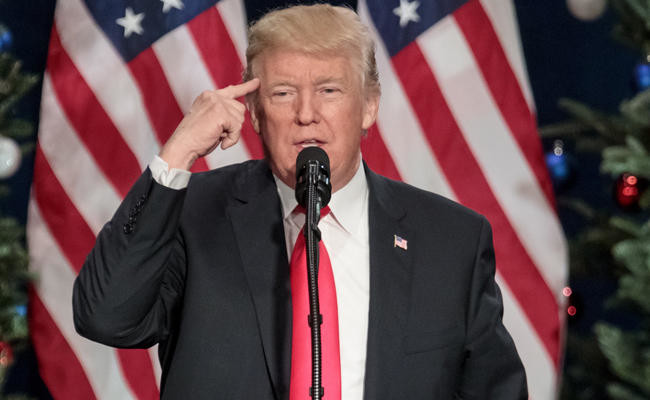
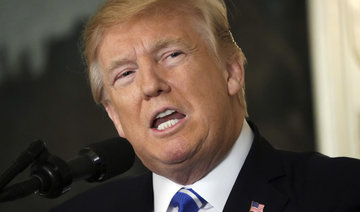
US President Donald Trump speaks about tax reform at the St. Charles Convention Center on November 29, 2017 in St. Charles, Missouri. (Whitney Curtis/Getty Images/AFP)
Updated 30 November 2017
Follow

Trump criticized in Britain and US for sharing anti-Muslim videos

WASHINGTON/LONDON: President Donald Trump on Wednesday shared anti-Muslim videos posted on Twitter by a far-right British party leader, drawing condemnation from Britain, US Muslim groups and some members of Congress.
The White House defended the retweets by the Republican president, who during the 2016 US election campaign called for “a total and complete shutdown of Muslims entering the United States,” saying that he was raising security issues.
As president, Trump has issued executive orders banning entry to some citizens of several Muslim-majority countries, although courts have partially blocked the measures from taking effect.
“Look, I’m not talking about the nature of the video,” White House spokeswoman Sarah Sanders told reporters. “The threat is real and that’s what the president is talking about is the need for national security, the need for military spending, and those are very real things. There’s nothing fake about that.”
Jayda Fransen, deputy leader of anti-immigration Britain First, posted the videos which she said showed a group of people who were Muslims beating a teenage boy to death, battering a boy on crutches and destroying a Christian statue. Fransen was convicted earlier this month of abusing a Muslim woman and was ordered to pay a fine and legal costs.
Some British lawmakers demanded an apology from Trump for sharing the videos with his nearly 44 million Twitter followers and US Muslim groups said he had been incendiary and reckless.
“It is wrong for the president to have done this,” the spokesman for British Prime Minister Theresa May said.
“Britain First seeks to divide communities through their use of hateful narratives which peddle lies and stoke tensions. They cause anxiety to law-abiding people,” the spokesman said.
Trump fired back at May over her criticism.
“Theresa @theresamay, don’t focus on me, focus on the destructive Radical Islamic Terrorism that is taking place within the United Kingdom. We are doing just fine,” Trump tweeted, using an incorrect Twitter handle for May. He later issued a tweet with her correct handle, “@Theresa_May.”
Reuters was unable to immediately verify the videos and Fransen herself said they had come from various online sources which had been posted on her social media pages.
“I’m delighted,” Fransen, who has 53,000 Twitter followers, told Reuters. She said Trump’s retweets showed the president shared her aim of raising awareness of “issues such as Islam.”
The White House repeatedly refused to be drawn into the content of the videos or whether Trump was aware of the source of the tweets.
“It’s about ensuring that individuals who come into the United States don’t pose a public safety or terrorism threat,” White House spokesman Raj Shah told reporters aboard Air Force One.
Fransen thanked Trump and said, “The important message here is Donald Trump has been made aware of the persecution and prosecution of a political leader in Britain for giving what has been said by police to be an anti-Islamic speech.”

ANTI-IMMIGRATION
One of the videos that Trump retweeted first circulated on social and Egyptian state media in 2013, showing what appeared to be supporters of now-ousted Islamist President Mohammed Mursi throwing two youths from a concrete tower onto a roof.
In reference to another video that was titled “Muslim migrant beats up Dutch boy on crutches!,” the Netherlands embassy in the United States tweeted back at Trump saying:
“@realDonaldTrump Facts do matter. The perpetrator of the violent act in this video was born and raised in the Netherlands. He received and completed his sentence under Dutch law.”
Trump’s promotion of the videos contrasts with the way he often criticizes mainstream US media, lambasting some outlets for “fake news” when they air segments he regards as being against him.
“What we saw today is one of many videos that is circulating on anti-Muslim hate websites,” said Ilhan Cagri with the US-based Muslim Public Affairs Council.
“It is years-old and simply aims to breed fear for Muslims and Islam and breed violence. It has nothing to do with the practice of Islam itself,” Cagri said.
The Anti-Defamation League said the retweets would only encourage “extremists and anti-Muslim bigots in the United States and abroad who exploit the propaganda value.”
“Such content is the engine that fuels extremist movements and will embolden bigots in the US who already believe the president is a fellow traveler,” the ADL said in a statement.
Democrats in Congress and at least one Republican lawmaker were also critical of Trump.
“The violence depicted in these videos is horrific, but it is abhorrent that President Trump would choose to deliberately fan the flames of hatred and religious bigotry,” Democratic US Senator Jack Reed said in a statement.
Republican Senator John McCain, a frequent critic of Trump, said he was “surprised” that Trump had chosen to retweet those videos. “What do I think about it? Obviously, surprised. Surprised,” he told Reuters as he left a meeting with Jordanian King Abdullah at the US Senate.
Britain First is a peripheral political party which wants to end all immigration and bring in a comprehensive ban on Islam, with anyone found to be promoting the religion’s ideology to be deported or imprisoned.
The group, which rarely garners any media attention but attracts a few hundred protesters to its regular street demonstrations, states on its website it is a “loyalist movement.” Critics say it is simply racist.
Last week, Fransen was charged by the police in Northern Ireland with using threatening, abusive or insulting words in a speech at a rally in Belfast in August.
Along with the group’s leader, she was also charged in September with causing religiously aggravated harassment over the distribution of leaflets and posting online videos during a court trial involving a number of Muslim men accused and later convicted of rape.
Politicians in Britain condemned Trump, with Jeremy Corbyn, leader of the opposition Labour Party, describing his tweets as “abhorrent, dangerous and a threat to our society.”
In contrast, David Duke, a former Ku Klux Klan leader who has run for political office in Louisiana, praised Trump. “He’s condemned for showing us what the fake news media won’t,” Duke wrote on Twitter. “Thank God for Trump! That’s why we love him!”
From the Balkans to Southeast Asia: High-stakes elections test fragile stabilities across three continents

Updated 6 sec ago
Follow

From the Balkans to Southeast Asia: High-stakes elections test fragile stabilities across three continents

  • Myanmar junta stages election after five years of civil war
  • Central African Republic votes, Russia ally Touadera seeks third term
  • Guinea votes in presidential election expected to cement Doumbouya’s rule
  • Kosovo votes in bid to end year-long political impasse

YANGON/BANGUI/CONAKRY/PRISTINA: Four nations across three continents — Myanmar, Central African Republic, Guinea, and Kosovo — have officially opened polls Sunday in a pivotal day for global democracy and shifting political tides.

While the contexts range from the desperate search for an end to civil war in Southeast Asia to breaking parliamentary deadlocks in the Balkans, each vote carries profound implications for regional stability and the future of civilian rule.

Heavily restricted polls

Myanmar’s ruling junta is touting the exercise as a return to democracy five years after it ousted the last elected government, triggering civil war.

But early voters at a downtown station near the gleaming Sule Pagoda — the site of huge pro-democracy protests after the coup — were outnumbered by journalists and polling staff, a far cry from the snaking queues of voters formed outside polling stations in the last election in 2020.

The military declared that election void, ousted civilian leader Aung San Suu Kyi and seized power in 2021. Suu Kyi remains jailed, while her hugely popular party has been dissolved and was not taking part.
Campaigners, Western diplomats and the UN’s rights chief have all condemned the phased month-long vote, citing a ballot stacked with military allies and a stark crackdown on dissent.

Voters line up to cast their ballots at a polling station, with Sule Pagoda in background, on Dec. 28, 2025, in Yangon, Myanmar. (AP)

The pro-military Union Solidarity and Development Party is widely expected to emerge as the largest one, in what critics say would be a rebranding of martial rule.
The Southeast Asian nation of around 50 million is riven by civil war and there will be no voting in rebel-held areas.
In junta-controlled territory, the first of three rounds started at 6:00 a.m. (2330 GMT Saturday), including in constituencies in the cities of Yangon, Mandalay and the capital Naypyidaw.
The run-up saw none of the feverish public rallies that Suu Kyi once commanded, and the junta has waged a withering pre-vote offensive to claw back territory.
“It is impossible for this election to be free and fair,” said Moe Moe Myint, who has spent the past two months “on the run” from junta air strikes.

The military ruled Myanmar for most of its post-independence history before a 10-year interlude saw a civilian government take the reins in a burst of optimism and reform.
But after Suu Kyi’s National League for Democracy party trounced pro-military opponents in the 2020 elections, Min Aung Hlaing snatched power in a coup, alleging widespread voter fraud.
The Asian Network for Free Elections says 90 percent of the seats in the last elections went to organizations that will not appear on Sunday’s ballots.
New electronic voting machines will not allow write-in candidates or spoiled ballots.

The junta is pursuing prosecutions against more than 200 people for violating draconian legislation forbidding “disruption” of the poll, including protest or criticism.
“These elections are clearly taking place in an environment of violence and repression,” UN rights chief Volker Turk said this week.
The second round of polling will take place in two weeks before the third and final round on January 25, but the junta has conceded elections cannot happen in almost one in five lower house constituencies.

Touadera victory would likely advance Russian interests

In the Central African Republic, President Faustin-Archange Touadera is seeking a third term as the chronically unstable country holds ​national elections, touting security gains made with the help of Russian mercenaries and Rwandan soldiers.
The 68-year-old mathematician oversaw a constitutional referendum in 2023 that scrapped the presidential term limit, drawing an outcry from his critics who accused him of seeking to rule for life.
A Touadera victory — the expected outcome — would likely further the interests of Russia, which has traded security assistance for access to resources including gold and diamonds. Touadera is also offering access to the country’s lithium and uranium reserves to anyone interested.

Supporters of Central African Republic's President and presidential candidate for the United Hearts Movement (MCU) Faustin Archange Touadera gather during his final rally in Bangui on December 26, 2025 ahead of CAR's presidential election on December 28, 2025. (AFP)

The opposition field ‌of six candidates ‌is led by two former prime ministers, Anicet-Georges Dologuele ‌and ⁠Henri-Marie Dondra, ​both of ‌whom survived attempts by Touadera’s supporters to have them disqualified for allegedly holding foreign citizenship.
Though both men remain on the ballot, Touadera is still seen as the favorite given his control over state institutions and superior financial resources, analysts say.
The challenges to the candidacies of Dologuele and Dondra “aligned with an apparent pattern of administrative manoeuvring that has disproportionately impeded opposition politicians while favoring the ruling United Hearts Party,” Human Rights Watch said last month.
“Their late admission ⁠to the race raises questions about whether voters have been given a genuine choice.”

In ‌2018, CAR became the first country in West and ‍Central Africa to bring in Russia’s Wagner ‍mercenaries, a step since also taken by Mali, Burkina Faso and Niger.
Two years ‍later Rwanda deployed troops to shore up Touadera’s government as rebel groups threatened the capital and tried to disrupt the 2020 elections, ultimately preventing voting at 800 polling stations across the country, or 14 percent of the total.
The country is more secure now after Touadera signed several peace deals with ​rebel groups this year.
But those gains remain fragile: Rebels have not fully disarmed, reintegration is incomplete, and incursions by combatants from neighboring Sudan fuel ⁠insecurity in the east. Beyond the presidential contest, the elections on Sunday cover legislative, regional and municipal positions.
Provisional results are expected by January 5.
If no candidate gets more than 50 percent of the vote, a presidential runoff will take place on February 15, while legislative runoffs will take place on April 5.
Pangea-Risk, a consultancy, wrote in a note to clients that the risk of unrest after the election was high as opponents were likely to challenge Touadera’s expected victory.
A smooth voting process could reinforce Touadera’s claim that stability is returning, which was buttressed last year with the UN Security Council’s lifting of an arms embargo and the lifting of a separate embargo on diamond exports.
In November, the UN Security ‌Council extended the mandate of its peacekeeping mission. The US opposed the decision, calling for a shorter extension and a handover of security to Bangui.

Guinea's transition to civilian rule

In Guinea, the election is widely expected to hand Mamady Doumbouya, who seized power in ​a 2021 coup, a seven-year mandate, completing the West African nation’s transition back to civilian rule.
The former special forces commander, believed to be in his early 40s, faces eight other candidates in a fragmented field with no strong challenger. Ousted president Alpha Conde and longtime opposition leader Cellou Dalein Diallo remain in exile.
Guinea holds the world’s largest bauxite reserves and the richest untapped iron ore deposit at Simandou, officially launched last month after years of delay.

Officials of the General Directorate of Elections organize electoral materials at Dixinn’s city hall in Conakry, on December 27, 2025, on the eve on Guinea’s presidential election. (AFP)

Doumbouya has claimed credit for pushing the project ‌forward and ensuring Guinea ‌benefits from its output.
His government this year also ‌revoked ⁠EGA ​subsidiary Guinea Alumina ‌Corporation’s license after a refinery dispute, transferring its assets to a state-owned firm.
The turn toward resource nationalism — echoed in Mali, Burkina Faso and Niger — has boosted his popularity, as has his youth in a country where the median age is about 19.
“For us young people, Doumbouya represents the opportunity to send the old political class into retirement,” said Mohamed Kaba, a mechanic in Conakry. “There is a lot of corruption right now, but I hope ⁠these things will be sorted out.”

If elected, Doumbouya “will likely utilize his position ‌to further entrench his power and that of the military ‍over Guinea,” said Benedict Manzin, lead Middle ‍East and Africa analyst at risk consultancy Sibylline.
“In particular he is likely to ‍position his allies and associates to benefit from the expected economic boom associated with the launch of production” at Simandou, Manzin added.
A transition charter adopted after the coup barred junta members from contesting elections. But in September, Guineans overwhelmingly backed a new constitution removing that clause, extending presidential ​terms to seven years and creating a Senate.

Political debate ⁠has been muted under Doumbouya. Civil society groups accuse his government of banning protests, curbing press freedom and restricting opposition activity.
The campaign period “has been severely restricted, marked by intimidation of opposition actors, apparently politically motivated enforced disappearances, and constraints on media freedom,” UN rights chief Volker Turk said Friday. These conditions “risk undermining the credibility of the electoral process,” he added.
The government did not respond to a request for comment.
Doumbouya kept a low profile during the campaign, leaving surrogates to make his case.
At a closing rally on Thursday in Conakry, he skipped a speech although he danced with his wife while Congolese star Koffi Olomide performed.
He wore a white baseball cap and track jacket emblazoned with the name of his ‌movement: “Generation for Modernity and Development.”
About 6.7 million people are registered to vote, with provisional results expected within 48 to 72 hours of polls closing.

Acting Prime Minister of Kosovo and Levizja Vetevendosje (Movement for Self-Determination) party leader Albin Kurti speaks to his supporters during the last election campaign rally in Pristina, Kosovo December 27, 2025. (Reuters)

Kosovo's political crisis 
In Kosovo, Prime Minister Albin Kurti’s party seeks a majority to end a year-long political deadlock that has paralyzed parliament and delayed international funding.
The vote is the second this year in Europe’s youngest nation after Kurti’s Vetevendosje party fell short of a majority in February. Months of failed coalition talks prompted President Vjosa Osmani to dissolve parliament in November and call an early election.
Failure to form a government and reopen ‌parliament would prolong the ‌crisis at a critical time: lawmakers must ‌elect ⁠a new ​president ‌in April and ratify 1 billion euros ($1.2 billion) in loan agreements from the European Union and World Bank that expire in the coming months.
The Balkan country’s opposition parties have refused to govern with Kurti, criticizing his handling of ties with Western allies and his approach to Kosovo’s ethnically divided north, where a Serb minority lives. Kurti blames the opposition for the impasse.
To woo voters, ⁠Kurti has pledged an additional month of salary per year for public sector workers, one ‌billion euros per year in capital investment and ‍a new prosecution unit to ‍fight organized crime. Opposition parties have also focused on improving living standards.
Opinion ‍polls are not published in Kosovo, leaving the outcome uncertain. Many voters say they are disillusioned.
“There wouldn’t be great joy if Kurti wins, nor would there be if the opposition wins. This country needs drastic changes, and I don’t see ​that change coming,” said Edi Krasiqi, a doctor.
Kosovo declared independence from Serbia in 2008 with US backing, including a 1999 NATO bombing campaign against Serbian forces trying to crush an uprising by the 90 percent ethnic Albanian majority.
Despite international support, the country of 1.6 million has struggled with poverty, instability and organized crime. Kurti’s tenure, which began in 2021, was the first time a Pristina government completed a full term.
Tensions with Serbia flared in 2023, prompting the EU to impose sanctions on Kosovo. The bloc said this month it would lift them after ethnic Serb mayors were elected ‌in northern municipalities, but the measures likely cost Kosovo hundreds of millions of euros.