

Egypt’s El-Sisi repeats order to restore security in Sinai with 'all brute force'

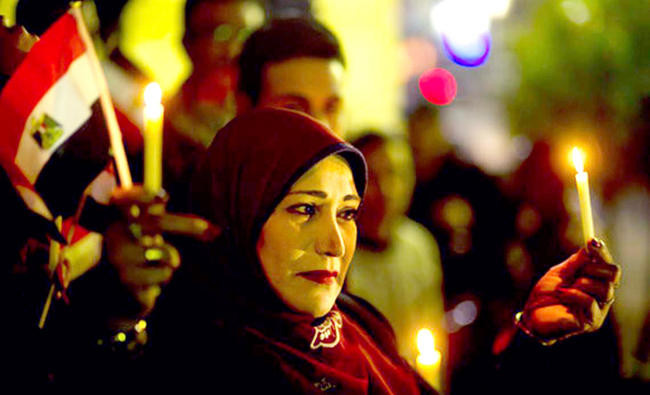
A woman holds candles and a national flag during a candlelight vigil for victims of a Friday mosque attack at the Journalists Syndicate, in Cairo, Egypt, on Monday. (AP)
Updated 30 November 2017
Follow

Egypt’s El-Sisi repeats order to restore security in Sinai with 'all brute force'

CAIRO: Egyptian President Abdel Fattah El-Sisi has given the army and the Interior Ministry three months to restore security in the Sinai Peninsula with freedom to use “all brute force.”

This comes a week after 311 Egyptian worshippers were killed and 128 others injured in a terrorist attack on a mosque in North Sinai during Friday prayers; it was the deadliest terror attack in Egypt’s modern history.

El-Sisi has promised massive development for the Bir Al-Abd area in North Sinai where the attack took place. “We will make Bir Al-Abd a city that is referred to as a model of prosperity and development; we can never allow anyone to do such a thing again to our people,” El-Sisi said on Wednesday morning.

El-Sisi issued his orders in public, addressing the Army Chief of Staff, Mohamed Farid Hegazy, who led the military salute to the president.

The Egyptian president repeated the phrase “brute force” in what appeared to be a response to criticism in a number of foreign newspapers and on social networking sites after the phrase was used last Friday to describe the response to any future terrorist acts.

The uproar prompted presidential spokesman Bassam Radhi to explain that what El-Sisi meant by “brute force” was “the ferocious force that mercilessly oppresses the aggressor, pursues the terrorists, and kills them all.”

Radhi said on Saturday that the incident underscored the despair of the forces of extremism and revealed their ugly face. “The more their strength weakens, the more they want to inflict greater losses because they have been completely routed.”

He stressed that Egypt would avenge the victims of the mosque attack and that the perpetrators of the atrocity would not escape punishment.

No group has claimed responsibility for the Al-Rawdah mosque attack in Bir Al-Abd. The Egyptian public prosecutor’s office, however, said that armed men carrying flags of Daesh opened fire on worshippers inside the mosque and on those who tried to escape after an explosive device was detonated.

Retired Egyptian Air Force Gen. Hesham Al-Halabi, who is now an adviser at Nasser Military Academy, told Arab News that the use of the term “brute force” after terrorist operations against civilian targets confirms that the Egyptian state will not tolerate any groups or terrorist plots that target civilians.

“There are increasing indications that terrorist organizations are directing the bulk of their operations in the current and short term against civilians and civilian institutions in order to push the people of North Sinai to leave their homes and evacuate the area,” Al-Halabi said.

The military expert explained that “brute force” meant the use of maximum force to destroy the terrorist threat completely.

In his speech, El-Sisi stressed that Egypt has been facing a full-fledged war over the past years, waged by what he called “some bodies” to “prevent the progress and prosperity of the state.”

The Egyptian president slammed the ideology of the terrorists: “By what logic can anyone justify the killing of children and the elderly and depriving them of their right to life?” He also asked: “How can those who claim to belong to the religion of Islam, which calls for tolerance, spread destruction on the earth?“

Al-Halabi said: “This increasing shift to targeting civilians comes with the opening of four huge tunnels in June 2018 which will link Sinai with the valley and the delta in an unprecedented way since the Suez Canal was dug.”

“The forces that support terrorism in Egypt want to limit the chances of a huge human shift in the direction of Sinai after the opening of tunnels and the state’s determination to develop the region,” he said.

Al-Halabi explained: “After the failure of the implementation of the Greater Gaza Project in Sinai during the rule of the Muslim Brotherhood in Egypt, that caused some regional and international forces in support of this project to use terrorism as an alternative to exacerbate the situation in North Sinai.”

“The president’s orders to both the army and the police to restore security in the Sinai means that counterterrorism operations in Sinai in the next phase will be mostly joint operations with the primary objective of protecting civilians,” he said.

Al-Halabi said that the restoration of security and stability in the Sinai was not a complete elimination of the terrorist threat, and that any large-scale organized terrorist attacks threatened the security of the population.

“Terrorism cannot be completely prevented anywhere in the world, especially when the regional environment is ready to spread terrorism with the support of some countries in the region,” Al-Halabi said.

Egypt’s state news agency, MENA, reported on Wednesday that Cairo had requested an emergency meeting of the Arab League on Dec. 5 to discuss “ways to strengthen the Arab system to combat terrorism” following the Al-Rawdah mosque attack.

 

Kushner’s vision for rebuilding Gaza faces major obstacles

Updated 3 sec ago
Follow

Kushner’s vision for rebuilding Gaza faces major obstacles

JERUSALEM: Modern cities with sleek high-rises, a pristine coastline that attracts tourists and a state-of-the-art port that jut into the Mediterranean. This is what Jared Kushner, President Donald Trump’s son-in-law and Middle East adviser, says Gaza could become, according to a presentation he gave at an economic forum in Davos, Switzerland.
In his 10-minute speech on Thursday, Kushner claimed it would be possible — if there’s security — to quickly rebuild Gaza’s cities, which are now in ruins after more than two years of war between Israel and Hamas.
“In the Middle East, they build cities like this ... in three years,” said Kushner, who helped broker the ceasefire in place since October. “And so stuff like this is very doable, if we make it happen.”
That timeline is at odds with what the United Nations and Palestinians expect will be a very long process to rehabilitate Gaza. Across the territory of roughly 2 million people, former apartment blocks are hills of rubble, unexploded ordnance lurks beneath the wreckage, disease spreads because of sewage-tainted water and city streets look like dirt canyons.
The United Nations Office for Project Services says Gaza has more than 60 million tons of rubble, enough to fill nearly 3,000 container ships. That will take over seven years to clear, they say, and then additional time is needed for demining.
Kushner spoke as Trump and an assortment of world leaders gathered to ratify the charter of the Board of Peace, the body that will oversee the ceasefire and reconstruction process.
Here are key takeaways from the presentation, and some questions raised by it:
Reconstruction hinges on security
Kushner said his reconstruction plan would only work if Gaza has “security” — a big “if.”
It remains uncertain whether Hamas will disarm, and Israeli troops fire upon Palestinians in Gaza on a near-daily basis.
Officials from the militant group say they have the right to resist Israeli occupation. But they have said they would consider “freezing” their weapons as part of a process to achieve Palestinian statehood.
Since the latest ceasefire took effect Oct. 10, Israeli troops have killed at least 470 Palestinians in Gaza, including young children and women, according to the territory’s Health Ministry. Israel says it has opened fire in response to violations of the ceasefire, but dozens of civilians have been among the dead.
In the face of these challenges, the Board of Peace has been working with Israel on “de-escalation,” Kushner said, and is turning its attention to the demilitarization of Hamas — a process that would be managed by the US-backed Palestinian committee overseeing Gaza.
It’s far from certain that Hamas will yield to the committee, which goes by the acronym NCAG and is envisioned eventually handing over control of Gaza to a reformed Palestinian Authority. Hamas says it will dissolve the government to make way, but has been vague about what will happen to its forces or weapons. Hamas seized control of Gaza in 2007 from the Palestinian Authority.
Another factor that could complicate disarmament: the existence of competing armed groups in Gaza, which Kushner’s presentation said would either be dismantled or “integrated into NCAG.” During the war, Israel has supported armed groups and gangs of Palestinians in Gaza in what it says is a move to counter Hamas.
Without security, Kushner said, there would be no way to draw investors to Gaza and or stimulate job growth. The latest joint estimate from the UN, the European Union and the World Bank is that rebuilding Gaza will cost $70 billion.
Reconstruction would not begin in areas that are not fully disarmed, one of Kushner’s slides said.
Kushner’s plan avoids mention of what Palestinians do in meantime
When unveiling his plan for Gaza’s reconstruction, Kushner did not say how demining would be handled or where Gaza’s residents would live as their areas are being rebuilt. At the moment, most families are sheltering in a stretch of land that includes parts of Gaza City and most of Gaza’s coastline.
In Kushner’s vision of a future Gaza, there would be new roads and a new airport — the old one was destroyed by Israel more than 20 years ago — plus a new port, and an area along the coastline designated for “tourism” that is currently where most Palestinians live. The plan calls for eight “residential areas” interspersed with parks, agricultural land and sports facilities.
Also highlighted by Kushner were areas for “advanced manufacturing,” “data centers,” and an “industrial complex,” though it is not clear what industries they would support.
Kushner said construction would first focus on building “workforce housing” in Rafah, a southern city that was decimated during the war and is currently controlled by Israeli troops. He said rubble-clearing and demolition were already underway there.
Kushner did not address whether demining would occur. The United Nations says unexploded shells and missiles are everywhere in Gaza, posing a threat to people searching through rubble to find their relatives, belongings, and kindling.
Rights groups say rubble clearance and demining activities have not begun in earnest in the zone where most Palestinians live because Israel has prevented the entry of heavy machinery.
After Rafah will come the reconstruction of Gaza City, Kushner said, or “New Gaza,” as his slide calls it. The new city could be a place where people will “have great employment,” he said.
Will Israel ever agree to this?
Nomi Bar-Yaacov, an international lawyer and expert in conflict resolution, described the board’s initial concept for redeveloping Gaza as “totally unrealistic” and an indication Trump views it from a real estate developer’s perspective, not a peacemaker’s.
A project with so many high-rise buildings would never be acceptable to Israel because each would provide a clear view of its military bases near the border, said Bar-Yaacov, who is an associate fellow at the Geneva Center for Security Policy.
What’s more, Kushner’s presentation said the NCAG would eventually hand off oversight of Gaza to the Palestinian Authority after it makes reforms. But Prime Minister Benjamin Netanyahu has adamantly opposed any proposal for postwar Gaza that involves the Palestinian Authority. And even in the West Bank, where it governs, the Palestinian Authority is widely unpopular because of corruption and perceived collaboration with Israel.