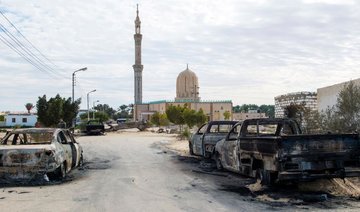
CAIRO: The Egyptian Federation for Construction and Building Contractors will announce a new initiative on Wednesday to develop Egypt’s North Sinai region, promising to rebuild Al-Rawda village, the location of Friday’s mosque attack which left 300 dead.
The federation has reportedly invited Egypt’s top 50 construction companies to contribute to development projects in the region under the slogan “Development and Construction Against Terrorism,” a local news report said.
Federation Chairman Hassan Abdel Aziz told the Youm7 newspaper that some companies had already announced their intention to reconstruct some houses in the village and rebuild the attacked mosque.
Hisham Yousry, the federation’s secretary-general, was quoted as saying that the federation aims to support the army, police and people of North Sinai to counter terrorism with real development.
North Sinai has long been seen as a region that successive governments have neglected; a lack of services and poor education and employment opportunities mean the region could potentially become a new gathering point for extremists, following the fall of Daesh in Syria and Iraq, analysts told Arab News.
“The sustained insurgency in the area began with the downfall of former President Hosni Mubarak in 2011,” Justin Dargin, Middle East expert at the University of Oxford, told Arab News. “The diminished security environment was compounded by the chaotic aftermath of the Egyptian revolution that allowed all manner of groups to operate with near impunity.”
There is a long history of banditry and smuggling in the Sinai region, Dargin added.
“The security stipulations in the Egypt-Israel peace treaty of 1979 led to a weak security presence in the region which allowed weapons and drug smuggling to flourish,” he explained. “The area, due to sparse resources and general government neglect, provided a fertile ground for militant ideologies to take root and grow.”
Dargin claimed that the region’s current militancy began with Bedouin tribesmen disillusioned with the central government.
“The grievances of the Bedouin melded with the general upswing in Islamism which spread across the region during the Arab Spring. Additionally, the situation in Sinai became more combustible due to the influx of foreign fighters and the forging of an operational collaboration between jihadist groups in Sinai and Gaza-based groups.”
The government’s apparent plan to make development a centerpiece of the fight against terrorism in the region “can make a difference,” one analyst said.
“Economic and human development can change the tide of violent extremism when connected with education and other programs. Poverty and unemployment breed frustration and anger,” Paul Sullivan, a Middle East expert at Georgetown University, told Arab News. “Giving the youth of the Sinai hope for their futures with a developing region can make a difference.”
However, he warned, “This takes time. One cannot just build new basketball courts and work places and expect immediate miracles.
“The region should have been a focus of human and economic development for decades,” he continued. “This is, sadly, yet another example of what is found globally. Development aid comes late in the process.”
Said Sadek, a political sociology professor in Cairo, is skeptical about whether development projects can succeed in North Sinai, given the current environment there.
“North Sinai is in dire need of development, but I have doubts about whether this can be achieved if the security situation is not stable,” Sadek told Arab News. “How can this be done during a time of war? How can you establish projects if even soldiers cannot protect themselves in this volatile region?”
And even if the security situation improves, Sadek added, there will be another challenge, rooted in Sinai’s long tradition of smuggling weapons and other items across the border to the Gaza Strip.
“Development projects will take years to show results,” he said. “And given that smuggling has been thriving in the region for years, it will be challenging to convince the people of Sinai to opt for regular jobs that would offer less money.”


![]()
North Sinai development plan to combat terrorism
North Sinai development plan to combat terrorism


Latest updates




© 2026 SAUDI RESEARCH & PUBLISHING COMPANY, All Rights Reserved And subject to Terms of Use Agreement.