Palestinian reconciliation talks in Cairo fail

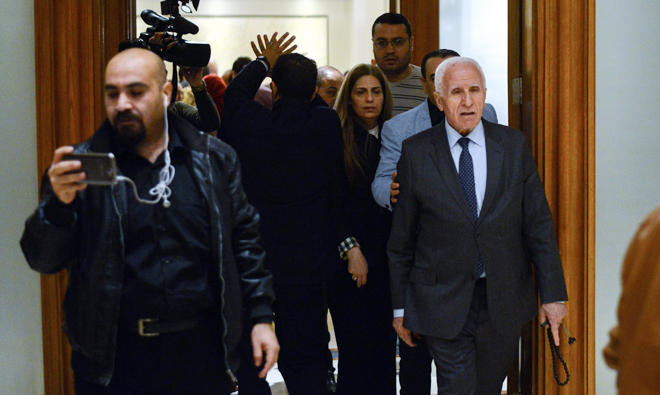
Azzam al-Ahmad (R), head of Fatah's Central Committee and delegation heads to speak at a press conference at the end of two days of closed-door talks attended by representatives of 13 leading political parties held in the Egyptian capital Cairo on November 22, 2017. (AFP)
Updated 24 November 2017
Follow

Palestinian reconciliation talks in Cairo fail

GAZA CITY: Talks between Palestinian factions in Cairo ended Wednesday evening without a breakthrough in reconciliation efforts.
Despite the announcement of elections for the presidency, the Legislative Council and the National Council of the Palestine Liberation Organization (PLO) by the end of 2018, the general mood was one of disappointment.
The head of the Fatah delegation, Azzam Al-Ahmad, said reconciliation cannot be advanced without enabling the Palestinian Authority (PA) to work freely in the Gaza Strip.
“The arrival of ministers at their headquarters in Gaza doesn’t mean everything was fine,” he told Arab News.
“They can’t issue decisions to staff working in Gaza. There’s no security to protect border crossings handed to the PA. The judicial sector is still unresolved,” he added.
“There’s still a parallel government in Gaza, and the PA doesn’t accept this. Solving Gaza’s problems, including electricity, water and trash collection, needs a ministry to govern.”
Aed Yaghi, head of the Palestinian Initiative movement who participated in the talks in Cairo, told Arab News that they “didn’t produce practical and clear results to end divisions.”
He added: “The concept of empowering the government hasn’t been defined... the issue of security hasn’t been addressed, and there has been no agreement on lifting PA sanctions imposed on Gaza.”
Salah Al-Bardawil, a Hamas leader, said the talks produced “no mechanisms of implementation.”
He added: “We haven’t been allowed to discuss the issue of the Rafah crossing, and the Palestinian people will (continue to) suffer... This is our destiny.”
An Egyptian security delegation will arrive in Gaza within two days to help the PA assume its governance of the territory, a source who participated in the talks told Arab News on condition of anonymity.
Hamas and Fatah are expected to meet in Cairo again in early December to assess the handover of government responsibilities, as agreed on Oct. 12.
According to AFP, the factions called on the electoral commission to prepare for presidential and legislative elections to be held by the end of next year at the latest.
They asked Palestinian President Mahmoud Abbas to set a date for the polls after consulting with all sides.
The statement said the reconciliation deal between Hamas and Fatah was a “realistic start to end divisions.”
UN special coordinator for the Middle East peace process, Nickolay Mladenov, told the UN Security Council on Monday that, despite the challenges, the reconciliation “must not be allowed to fail”.
“If it does, it will most likely result in another devastating conflict,” he was quoted as saying by AFP.


 

Lebanon PM says IMF wants rescue plan changes as crisis deepens

Updated 4 sec ago
Follow

Lebanon PM says IMF wants rescue plan changes as crisis deepens

  • “We want to engage with the IMF. We want to improve. This is a draft law,” Salam said
  • “They wanted the hierarchy of claims to be clearer. The talks are all positive”

DAVOS, Switzerland: The International Monetary Fund has demanded amendments to a draft rescue law aimed at hauling Lebanon out of its worst financial crisis on record and giving depositors access to savings frozen for six years, Prime Minister Nawaf Salam said.
The “financial gap” law is part of a series of reform measures required by the IMF in order to access its funding and aims to allocate the losses from Lebanon’s 2019 crash between the state, the central bank, commercial banks and depositors.
Salam told Reuters the IMF wants clearer provisions in the hierarchy of claims, which is a core element of the draft legislation designed to determine how losses are allocated.
“We want to engage with the IMF. We want to improve. This is a draft law,” Salam said in an interview at the World Economic Forum annual meeting in ⁠the Swiss mountain resort of Davos.
“They wanted the hierarchy of claims to be clearer. The talks are all positive,” Salam added.
In 2022, the government put losses from the financial crisis at about $70 billion, a figure that analysts and economists forecast is now likely to be higher.
Salam stressed that Lebanon is still pushing for a long-delayed IMF program, but warned the clock is ticking as the country has already been placed on a financial ‘grey list’ and risks falling onto the ‘blacklist’ if reforms stall further.
“We want an IMF program and we want to continue our discussions until we get there,” he said, adding: “International pressure is real ... The longer we delay, the more people’s money will evaporate.”
The draft law, which was passed by Salam’s government in December, is under parliamentary review. It aims to give depositors a guaranteed path to recovering their funds, restart bank lending, and end a financial crisis that has left nearly a million accounts frozen and confidence in the system shattered.
The roadmap would repay depositors up to $100,000 over four years, starting with smaller accounts, while launching forensic audits to determine losses and responsibility.
Lebanon’s Finance Minister Yassine Jaber, who is driving the reform push with Salam, told Reuters it was ⁠essential to salvage a hollowed-out banking system, and to stop the country from sliding deeper into its cash-only, paralyzed economy.
The aim, Jaber said, is to give depositors clarity after years of uncertainty and to end a system that has crippled Lebanon’s international standing.
He framed the law as part of a broader reckoning: the first time a Lebanese government has confronted a combined collapse of the banking sector, the central bank and the state treasury.
Financial reforms have been repeatedly derailed by political and private vested interests over the last six years and Jaber said the responsibility now lies with lawmakers.
Failure to act, he said, would leave Lebanon trapped in “a deep, dark tunnel” with no way back to a functioning system.
“Lebanon has become a cash economy, and the real question is whether we want to stay on the grey list, or sleepwalk into a blacklist,” Jaber added.