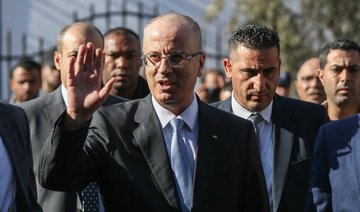
GAZA CITY: A new round of Palestinian reconciliation talks experienced its first sign of trouble on Tuesday as the Hamas militant group said it would not give up its vast weapons arsenal, putting it at odds with both the rival Fatah movement and Israel.
The tough comments by the Hamas supreme leader, Ismail Haniyeh, provided a reminder of the long road that lies ahead after this week’s launch of talks with President Mahmoud Abbas’ Fatah movement, according to The Associated Press.
The Palestinian government on Tuesday held its weekly Cabinet meeting in Gaza for the first time in three years. Abbas’ Prime Minister Rami Hamdallah arrived in Hamas-controlled Gaza earlier on Monday as a practical step in the Palestinian national reconciliation agreement that was achieved through Egyptian mediation.
In a speech before the beginning of the meeting, Hamdallah said that the Fatah delegation came to Gaza to address administrative issues. “I urge everybody to unite and support the Palestinian leadership, and to prioritize the public interest over the factional one,” he said.
“We appreciate the important job Egypt did to grant the achievement of the reconciliation.”
Head of the Egyptian intelligence Khaled Fawzy traveled to Gaza to meet the Palestinian government, following a meeting in Ramallah with Abbas. Fawzy is the highest ranking Egyptian official to visit Gaza since 2007.
“I’m convinced that you are able to implement your promises for the benefit of your people,” he said. “I’m waiting for you in Cairo, your home, and you will do it and succeed. History will register that you have unified your people.”
In a televised speech, Egyptian President Abdel Fattah El-Sisi stressed that Egypt seeks to fulfill the demands of the Palestinian people, and that disagreements must be resolved with the cooperation of all Arab countries.
Hamas congratulated the Palestinian people on the development, saying, “We, as the Hamas movement, are looking to flip the chapter of division, and to open a new chapter full of tolerance.”
In a TV interview, Hamas leader Ismail Haniyeh said his group would never give up its armed struggle against Israel.
“As long as there is occupation on the ground, our people have the right to possess weapons and resist the occupation with all forms of resistance,” he told a private TV channel.
In a gesture to Abbas, he said Hamas will not go back to war against Israel unilaterally. “We are ready to negotiate with the Palestinian factions and Fatah on unifying the decision of peace and war,” he said.
Such concessions are unlikely to satisfy Abbas, who issued his own tough statement late Monday saying that “everything must be in the hands of the Palestinian Authority.”
He said he would not agree to reproduce the “Hezbollah model” of Lebanon, where the armed militant group acts freely under the watch of a weak central government.
Israeli Prime Minister Benjamin Netanyahu, meanwhile, said his government will not accept a reconciliation deal between rival Palestinian factions that puts Israel at risk.
He said any deal must include recognizing Israel, disbanding Hamas’ military wing and cutting ties with Hamas’ patron Iran.
While previous reconciliation attempts have failed, years of international isolation and steadily worsening conditions in Gaza have pushed Hamas toward compromise.
The real work begins next week in Cairo, where Egyptian mediators will host talks between the Palestinian rivals. There is no set time frame for the negotiations.

First rifts emerge in Palestinian reconciliation talks
As Iran conflict spills over, Iraq’s Kurds say ‘this war is not mine’
- The Kurds, an ethnic minority with a distinct culture and language, are rooted in the mountainous region spread across Turkiye, Syria, Iraq and Iran
- “This isn’t my war,” said 58-year-old Satar Barsirini
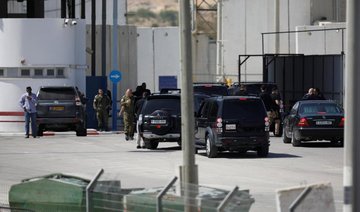
SORAN, Iraq: On a deserted road not too far from the border between Iran and Iraqi Kurdistan, Satar Barsirini looked up at the sky, now streaked with jets and drones.
Iraq’s Kurdish region has found itself caught in the crossfire of a regional war triggered by US and Israeli attacks on the Islamic republic.
Dressed like the Kurdish fighters he once served alongside, Barsirini still wears the khaki shalwar, fitted jacket and scarf wrapped around his waist.
Though recently retired, he refuses to give up his peshmerga uniform as he tills his small plot of land.
The rumble of jets and hum of drones “come from everywhere. Especially at night,” he told AFP in the hamlet of Barsirini, dozens of kilometers from the border.
He described the “shiver in our flesh” as the drones hit the ground outside.
“I feel bad for the people, because we have paid a lot in blood to liberate Kurdistan... We just want to live.”
Irbil, the autonomous region’s capital, and the valleys leading to the border have been targeted by Tehran and the Iraqi armed groups it supports.
American bases there have come under fire, as have positions held by Iranian Kurdish parties — the same ones US President Donald Trump said it would be “wonderful” to see storm Iran.
But Iran warned on Friday it would target facilities in Iraqi Kurdistan if fighters crossed into its territory.
“This isn’t my war,” said 58-year-old Barsirini.
He recalled the brutal repression and flight into the snowy mountains after the 1991 Kurdish uprising that followed the first Gulf War.
- ‘Dangerous people’ -
The uprising was repressed, leading to an exodus of two million Kurds to Iran and Turkiye.
“When we fled the cities for our lives, we went to Iran. They helped us, they gave us shelter and food,” he said.
The Kurds would not forget that, Barsirini stressed, adding that they could not just “turn against them” now to support the US and Israel.
“I don’t trust (Americans). They are dangerous people,” he said.
The Kurds, an ethnic minority with a distinct culture and language, are rooted in the mountainous region spread across Turkiye, Syria, Iraq and Iran.
They have long fought for their own homeland, but for decades suffered defeats on the battlefield and massacres in their hometowns.
They make up one of Iran’s most important non-Persian ethnic minority groups.
A week of war has gripped daily life in Iraqi Kurdistan, residents told AFP.
“People are afraid,” said Nasr Al-Din, a 42-year-old policeman who, as a child, lived through the 1991 exodus — “thrown on a donkey’s back with my sister.”
“This generation is different from the older ones” that have seen “seen fighting.”
Now, he said, you could be “sitting down in your home... and all of a sudden a drone hits your house.”
“We may have to go into town or somewhere safer,” said Issa Diayri, 31, a truck driver waiting in a roadside garage, his lorry idle for lack of deliveries from Iran.
- ‘Shouldn’t get involved’ -
Soran, a small town of 3,000 people about 65 kilometers (40 miles) from the border, was hit Thursday by a drone that fell in the middle of a street.
There, baker Yussef Ramazan, 42, and his three apprentices, hurriedly made bread before breaking their fast.
But, living so close to the Iranian border, he said “people are afraid to come and buy it.”
He told AFP he did not think it was a good idea “for the Kurdish region to get involved in this war.”
“We are not even an independent country yet. We would like to become one, but we are nothing for now, so we shouldn’t get involved in these situations.”
Across the street, Hajji watched from his empty dry cleaning shop as the road cleared.
Before the war, the town was crowded as evening fell, he said, declining to give his full name.
“But after the drone explosion, no one was here. In five minutes, everyone left the street and no one was out.”