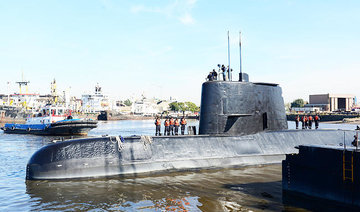
MAR DEL PLATA/BUENOS AIRES, , Argentina: Failed satellite calls that probably came from an Argentine navy submarine missing in the South Atlantic raised hopes that its 44 crew members are alive, but stormy conditions on Sunday complicated the search.
Boats searching for the German-built ARA San Juan on the ocean surface struggled against waves of up to 6 meters, navy spokesman Enrique Balbi said. The submarine was 432 kilometers off Argentina’s southern Atlantic coast when it sent its last communication early on Wednesday.
“Luckily we have been able to continue with the air search,” Balbi told reporters on Sunday. “Unfortunately, we have not yet had contact with the San Juan submarine, and we will keep working.”
More than a dozen boats and aircraft from Argentina, the United States, Britain, Chile and Brazil had joined the effort.
The submarine probably tried to make seven satellite calls on Saturday between late morning and early afternoon, the Argentine defense ministry said.
“Yesterday’s news was something of a respite for us, to know that there is life,” Claudio Rodriguez, the brother of a crew member, said on television channel A24 on Sunday morning.
Stormy weather probably interfered with the calls, and the government was working with an unidentified US company specialized in satellite communication to trace the location.
“We are checking and confirming that information, and we are trying to squeeze out any information that may result in something concrete to detect the location,” Balbi said.
A search of 80 percent of the area initially targeted for the operation turned up no sign of the vessel on the ocean surface, he said, but the crew should have ample supplies of food and oxygen.
The navy said an electrical outage on the diesel-electric-propelled vessel might have downed its communications. Protocol calls for submarines to surface if communication is lost.
The US Navy said early on Sunday morning that it would send an aircraft with 21 personnel from Jacksonville, Florida, to assist with the search. It had previously said it would deploy a deep-sea mission with a remotely operated vehicle and two vessels capable of rescuing people from submarines.
Crew members’ relatives gathered at a naval base in the coastal city of Mar del Plata, where the submarine had been expected to arrive around noon on Sunday from Ushuaia. However, it would not be unusual for storms to cause delays, Balbi said.
Argentine-born Pope Francis mentioned the missing vessel in his Sunday noon prayer.
“I also pray for the men of the crew of the Argentine military submarine which is missing,” the pontiff said.
The dramatic search has captivated the nation of 44 million, which recently mourned the loss of five citizens killed when a truck driver plowed through a bicycle path in New York City.
The ARA San Juan was inaugurated in 1983, making it the newest of the three submarines in the navy’s fleet. Built in Germany by Nordseewerke, it underwent midlife maintenance in 2008 in Argentina.


![]()

Satellite signals raises hope for missing Argentine submarine
Satellite signals raises hope for missing Argentine submarine

Latest updates


© 2026 SAUDI RESEARCH & PUBLISHING COMPANY, All Rights Reserved And subject to Terms of Use Agreement.