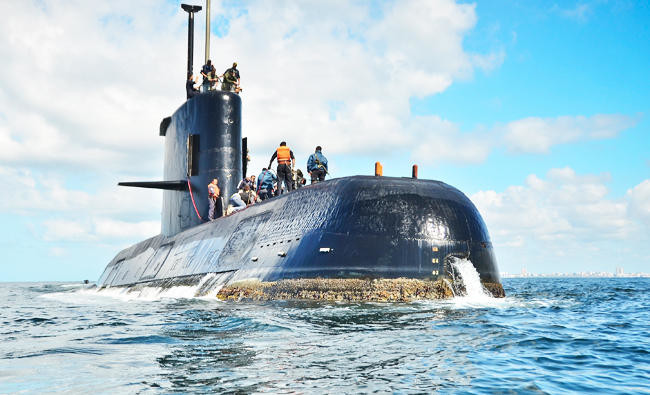
BUENOS AIRES: An Argentine submarine with 44 crew on board was missing in the South Atlantic two days after its last communication, prompting the navy to step up its search efforts late on Friday in difficult, stormy conditions.
The ARA San Juan was in the southern Argentine sea 432 km (268 miles) from the Patagonian coast when it sent its last signal on Wednesday, naval spokesman Enrique Balbi said.
The emergency operation was formally upgraded to a search-and-rescue procedure on Friday evening after no visual or radar contact was made with the submarine, Balbi said.
"Detection has been difficult despite the quantity of boats and aircraft" involved in the search, Balbi said, noting that heavy winds and high waves were complicating efforts.
"Obviously, the number of hours that have passed - two days in which there has been no communication - is of note."
The navy believes the submarine, which left Ushuaia en route to the coastal city of Mar del Plata in Buenos Aires province, had communication difficulties that may have been caused by an electrical outage, Balbi said. Navy protocol would call for the submarine to come to the surface once communication was lost.
"We expect that it is on the surface," Balbi said.
The German-built submarine, which uses diesel-electric propulsion, was inaugurated in 1983, making it the newest of the three submarines in the navy's fleet, according to the navy.
President Mauricio Macri said the government was in contact with the crew's families.
"We share their concern and that of all Argentines," he wrote on Twitter. "We are committed to using all national and international resources necessary to find the ARA San Juan submarine as soon as possible."
Argentina accepted an offer from the United States for a NASA P-3 explorer aircraft, which had been stationed in the southern city of Ushuaia and was preparing to depart to Antarctica, to fly over the search area, Balbi said.
A Hercules C-130 from the Argentine Air Force was also flying over the operational area. Brazil, Uruguay, Chile, Peru, Britain and South Africa had also formally offered assistance.

Argentina intensifies search for missing submarine with 44 crew
Ethiopian troops mobilize on Tigray border
ADDIS ABABA: Ethiopian federal and Tigrayan troops have massed along the border of the country’s northern Tigray region, a Western diplomatic source told AFP on Tuesday, raising fears of renewed war.
The Tigray civil war of 2020-2022 pitted federal troops — backed by local militias and the Eritrean army — against rebels from the Tigray People’s Liberation Front (TPLF), and killed at least 600,000 people according to estimates from the African Union.
A peace deal was never fully implemented and there was renewed fighting in January, prompting the suspension of flights to and from Tigray for several days.
“The ENDF (the federal army) is encircling Tigray,” a Western diplomatic source told AFP on condition of anonymity, adding that Tigrayan forces “are also deploying toward their borders.”
“Such large numbers of troops positioning themselves face to face is not a good sign,” he said.
A local source in Tigray, also speaking on condition of anonymity, described it as “a massive mobilization of federal forces and Tigrayan forces.”
“If the international community does not exert pressure on the parties to the conflict to resolve their dispute through dialogue, the risk of war increases,” the Tigrayan source added.
Relations between Ethiopia and Eritrea have deteriorated since they fought together against Tigrayan rebels.
The Ethiopian government now accuses Eritrea of supplying the rebels with weapons, which the Eritrean government has denied.
Last week, Volker Turk, the United Nations High Commissioner for Human Rights, called on the parties to the conflict in Tigray to take urgent de-escalation measures “before it is too late.”
Eritrea gained independence in 1993 after decades of armed struggle against Ethiopia.
The two Horn of Africa countries later fought a 1998-2000 border war in which tens of thousands died.
The Tigray civil war of 2020-2022 pitted federal troops — backed by local militias and the Eritrean army — against rebels from the Tigray People’s Liberation Front (TPLF), and killed at least 600,000 people according to estimates from the African Union.
A peace deal was never fully implemented and there was renewed fighting in January, prompting the suspension of flights to and from Tigray for several days.
“The ENDF (the federal army) is encircling Tigray,” a Western diplomatic source told AFP on condition of anonymity, adding that Tigrayan forces “are also deploying toward their borders.”
“Such large numbers of troops positioning themselves face to face is not a good sign,” he said.
A local source in Tigray, also speaking on condition of anonymity, described it as “a massive mobilization of federal forces and Tigrayan forces.”
“If the international community does not exert pressure on the parties to the conflict to resolve their dispute through dialogue, the risk of war increases,” the Tigrayan source added.
Relations between Ethiopia and Eritrea have deteriorated since they fought together against Tigrayan rebels.
The Ethiopian government now accuses Eritrea of supplying the rebels with weapons, which the Eritrean government has denied.
Last week, Volker Turk, the United Nations High Commissioner for Human Rights, called on the parties to the conflict in Tigray to take urgent de-escalation measures “before it is too late.”
Eritrea gained independence in 1993 after decades of armed struggle against Ethiopia.
The two Horn of Africa countries later fought a 1998-2000 border war in which tens of thousands died.
© 2026 SAUDI RESEARCH & PUBLISHING COMPANY, All Rights Reserved And subject to Terms of Use Agreement.