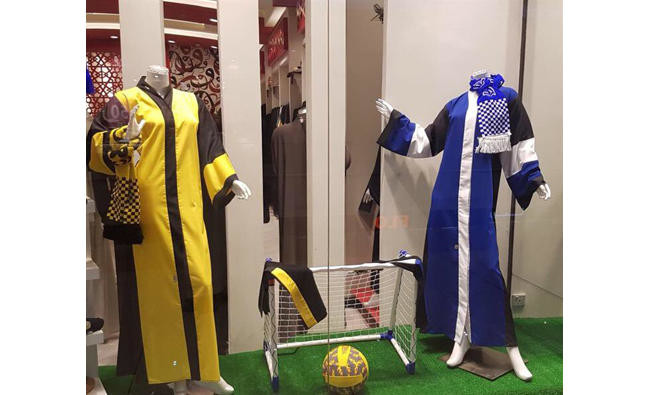
JEDDAH: It seems that women looking to support their favorite soccer teams in Saudi Arabia will have a chance to do so with abayas in the style of their club’s colors.
Images across social media show stores selling abayas in the famous colors worn by some of the top teams in the Saudi Pro League, the top flight of the country's soccer setup.
Women residing in the Saudi Arabia are expected to wear a loose, full-length garment known as an abaya whenever they are in a public place.
Stores have been quick to take advantage of last month announcement by Turki Al-Asheikh, chairman of the General Sports Authority, that families will be permitted inside the Kingdom’s stadiums and other sports facilities at the start of 2018.
The decision came as part of efforts aimed at supporting and stimulating the sports sector.
In September, families were allowed to part take in Saudi National Day celebrations inside King Fahd Stadium in the capital.

Gearing up to support their team: Women in Saudi can now don abayas in club colors
Saudi ministers welcome next phase of Gaza plan, Trump’s Board of Peace
- Officials highlight the urgent need for a ceasefire and humanitarian aid in Gaza
- Kingdom’s Cabinet reiterate support for ceasefire agreement, integration of Syrian Democratic Forces into the Syrian state
RIYADH: The Saudi Cabinet welcomed the second phase of the peace plan for the Gaza Strip, supporting the establishment of a Palestinian committee to administer the region and the announcement of the Board of Peace by US President Donald Trump.
The session was held on Tuesday in Riyadh and was chaired by King Salman, according to the Saudi Press Agency.
Ministers highlighted the urgent need for a ceasefire and humanitarian aid in Gaza. They called for the return of the Palestinian Authority to the territory and the end of the Israeli occupation, to establish an independent Palestinian state in line with UN resolutions, the Arab Peace Initiative, and the two-state solution.
The Saudi Council of Ministers supported the ceasefire agreement and the integration of the Syrian Democratic Forces into the Syrian state, reaffirming their commitment to civil peace and Syria's sovereignty.
In Yemen, they noted that Saudi Arabia continues its efforts to end the crisis and has launched a package of projects and programs worth $507 million to develop key sectors of health, education, and infrastructure.
In 2025, Saudi Arabia ranked first among Arab countries and second globally on a UN list of donors to Yemen, the SPA added.
The ministers also highlighted that most non-oil activities in the Kingdom have achieved annual growth rates ranging from five to ten percent over the past five years, in line with promoting sustainability and the Vision 2030.
They reviewed and approved several memoranda of understanding signed with Pakistan, Iraq, and Kyrgyzstan, as well as the promotion of multiple Saudi officials to senior positions across various ministries.