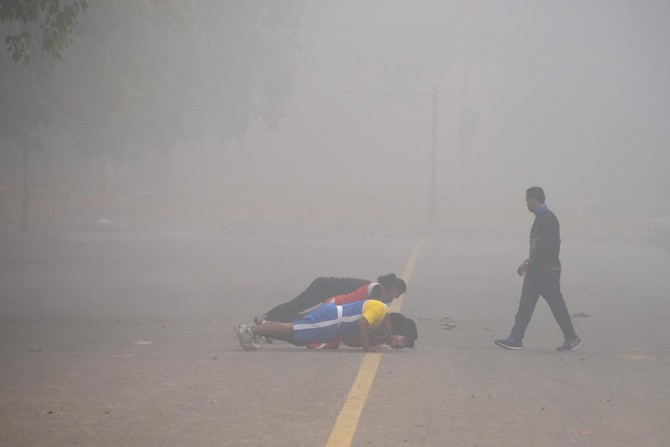
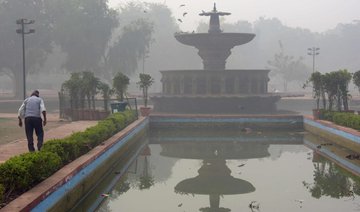
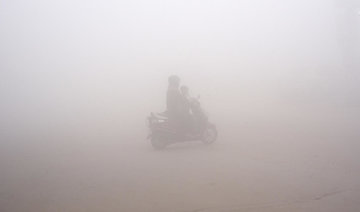
NEW DELHI: A thick cloud of toxic smog 10 times the recommended limit enveloped India's capital New Delhi on Monday, as government officials struggled to tackle a public health crisis that is well into its second week.
A US Embassy measure showed levels of poisonous airborne particles, known as PM 2.5, had reached 495 on Monday morning, compared with the upper limit of “good” quality air at 50.
India’s weather office said the forecast rain over the next three days could help clear the smog. “Light rainfall is likely in states surrounding Delhi and in Delhi over the next three days, and this could result in a change in wind pattern in the region,” Charan Singh, a scientist at India Meteorological Department, told Reuters.
“Smog will start to abate starting tomorrow.”
The Delhi state government declared a public health emergency last week after pollution levels in the city spiked, a yearly phenomenon blamed on a combination of illegal crop burning in northern states, vehicle exhausts and dust.
Over the weekend, the government said it planned to use fire trucks to spray water in parts of the capital, but the moves have had little effect.
A senior federal government official said there was little more the government could do.
“We can only do this much, and now we will have to wait for rains to clean the atmosphere,” said Prashant Gargava, an official at the Central Pollution Control Board, a federal body.
Gargava said Delhi’s air has been consistently in the “hazardous” zone, despite measures such as a halt to construction and increasing car-parking charges four-fold to encourage people to use public transportation.
The PM 2.5 airborne particles are about 30 times finer than a human hair. The particles can be inhaled deep into the lungs, causing respiratory diseases and other ailments. Hospitals in the capital have seen a spike in the number of patients coming in with respiratory complaints, according to media reports.
“Every second we are damaging our lungs, but we cannot stop breathing,” said Arvind Kumar, the head of the chest and lung surgery department at the Sir Ganga Ram hospital in the city.
United Airlines said it had resumed flights from Newark, New Jersey to New Delhi, India on Sunday, after suspending the service temporarily over concerns about poor air quality in the Indian capital.
State and federal governments decided to reopen schools on Monday after closing them temporarily for a few days last week. The move, however, is likely to add more vehicles on the road. Enforcement agencies said they were also unable to impose a blanket ban on movement of commercial trucks.
Aarti Menon, a teacher at a primary school in New Delhi, said her family was wearing masks even when they were indoors during the weekend.
“Not everyone can afford an air purifier or air-conditioned car. We are all living in hell,” said Menon, a mother of two teenage daughters.
The National Green Tribunal, an environment court, has directed the Delhi government and neighboring states to stop farmers from burning crop residue. But the federal and state governments have not been able to do so yet.
A New Delhi-based non-governmental organization, TARA Homes for Children, which supports 60 poor children, said it was seeking donations to buy at least five air purifiers. “Some of the children have breathing issues and couldn’t go to school,” said a volunteer at the NGO.

Delhi choked by smog as emergency steps fail to offer respite
‘People will vote for us’: Bangladesh’s Tarique Rahman confident of win in landmark election
- In first 180 days, Tarique Rahman plans democratic reform, restoring law and order, focusing on job creation
- He says he admires Vision 2030, wants to visit Kingdom as one of the first countries and perform Umrah
DHAKA: After almost two decades in self-exile, Tarique Rahman, the leader of the Bangladesh Nationalist Party, is expecting victory in Thursday’s election following a change in regime that for years restricted his supporters’ voting rights.
Rahman left Bangladesh in 2008 and settled in London, facing various convictions brought against him by the administration of Sheikh Hasina, the BNP’s archenemy who led the country until mid-2024, when she was toppled in a student-led uprising.
He returned in late December, received by millions of people who lined his route from the airport to the center of Dhaka. He believes they will back his party at the polls.
“BNP is the most popular party in the country. We have been struggling for the people’s voting rights for more than 17 years. We represent the people’s expectations and aspirations,” he told Arab News in Dhaka on Tuesday.
“I believe the people will vote for us and, inshallah, we will achieve a landslide victory.”
Rahman, 60, is the son of BNP’s founder, Ziaur Rahman, a 1971 Liberation War hero, who became president in 1977. After his assassination in 1981, Rahman’s mother, Khaleda Zia, took over the party’s helm and in 1991 became the country’s first woman prime minister.
Rahman assumed the BNP’s chairmanship following her death from a prolonged illness, just days after his return to Bangladesh.
In Thursday’s election, the BNP will race against another 50 parties, including Bangladesh Jamaat-e-Islami, which is forecast to emerge as the main opposition party in the next government. The Awami League, led by the ousted premier Hasina, has been banned from contesting, following deadly unrest that led to the party’s removal from power in August 2024.
An interim administration led by Nobel laureate Muhammad Yunus, which has been tasked with preparing the general election, banned Awami League’s activities, citing national security and a war crimes investigation against the party’s top leadership.
The UN Human Rights Office has accused the former government and its security apparatus of systematic rights violations to suppress the student-led protests between July 15 and Aug. 5, 2024. An estimated 1,400 people were killed.
If Rahman wins the election, he wants his administration to pursue accountability for the former leadership and meet the political and economic expectations of the youth movement that brought about the change.
In the first six months, his party’s immediate priorities include restoring law and order, democratic reform and creating a business-friendly environment.
“Our 180-day program includes development plans across key sectors, including employment for 10 million people,” he said.
“We will also accelerate private sector growth, ensure employment-oriented economic recovery and develop the blue economy. We will focus heavily on the ICT sector and AI-driven technological innovation.”
In international cooperation, he will prioritize partnerships with Gulf Cooperation Council countries, especially Saudi Arabia — home to more than 3 million Bangladeshis — with whom strong commercial relations were established during his father’s rule, and which is likely to be one of the first countries he would visit if he becomes prime minister.
“The highest number of Bangladeshi migrant workers are employed in Saudi Arabia, and the remittances they send significantly contribute to our economy,” he said.
“I admire the Saudi Vision 2030, and I am sincerely looking forward to working with the leadership of the Kingdom of Saudi Arabia ... I would definitely like to visit Saudi Arabia early in my term. Personally, I also wish to visit the holy mosque, Al-Masjid Al-Haram, Makkah, to perform Umrah.”
In relations with other countries, especially the regional powers India and Pakistan, the BNP government’s policy would be guided by national interest, which “is not about any specific country,” Rahman said.
“We want good relations with all our foreign friends, particularly our neighbors. We are committed to building relations of equality, cooperation and friendship with our neighbors. The foundation of that relationship will be mutual respect and understanding, which will ensure our collective progress.”
Exchanges with Pakistan, from which Bangladesh gained independence in 1971, have improved following Hasina’s removal — after decades of unease. At the same time, ties with India, where the former premier fled after the 2024 unrest, have since deteriorated.
In November, a special tribunal in Dhaka convicted the former prime minister of crimes against humanity, and Bangladesh requested that the Indian government extradite her.
“We want to establish justice in the country,” Rahman said. “No one is above the law. Anyone who has committed crimes must face trial. This is not about any specific political party; it is about justice and rule of law.”
During Hasina’s time in office, Rahman faced multiple corruption cases — allegations he has denied, saying they were politically motivated.
“There were so many false charges filed against me, and the situation in the country was not stable in terms of law and order,” he said. “Despite all the odds — as I have committed and communicated to my countrymen and women — I have returned back to my beloved Bangladesh before the historic national election and (I am) looking forward to it eagerly.”