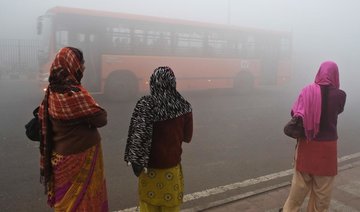
NEW DELHI/MUMBAI: Air pollution in New Delhi worsened again on Sunday and officials warned of little relief in sight from the smog, which has even caused one airline to cancel flights to the world’s most polluted capital.
The US Embassy website on Sunday showed levels of the smallest and most harmful airborne pollutants reached 676, about 27 times the World Health Organization’s (WHO) safe maximum, after falling slightly late last week.
Delhi authorities have halted all construction, shut brick kilns and banned lorries from entering the city but pollution levels have remained stubbornly high, hovering around hazardous levels for six days in the city and other parts of north India.
An effort to restrict private cars collapsed on Saturday after India’s top environmental court objected to exemptions for women, VIPs and motorcycles. The city government will appeal the decision on Monday.
Doctors have declared a public health emergency and more than 30,000 schools across northern India have closed, though classes are scheduled to resume on Monday.
Air quality typically worsens before the onset of winter as cooler air traps pollutants near the ground and prevents them from dispersing into the atmosphere, a phenomenon known as inversion.
The meteorological department said on Sunday more foggy weather was expected in the coming days, and the rain forecast for Wednesday would do little to clear the skies.
“It may help subside the smog a little. But it will be light rain, drizzle, not heavy showers. So, maybe it might not help that much,” Mrutyunjay Mohapatra, additional director general of meteorology, told AFP.
United Airlines has suspended all flights to Delhi from Newark until Monday due to the air quality and was offering alternatives to passengers booked on the route to India, the US airline said on its website.
The filthy air, with little wind to disperse it, partly stems from the annual post-harvest burning of crop stubble in India’s northern farming states of Punjab and Haryana. The level of dangerous pollutants in the air has soared.
Doctors say microscopic particles known as PM2.5 — which spiked at over 1,000 on Wednesday in Delhi — can penetrate deep into the lungs, increasing the risk of heart attacks and strokes.
Some hospitals in Delhi are reporting patient numbers have more than tripled since a dense layer of smog settled over the city of 20 million last week.
Temporary measures to curb pollution have so far had little effect.
Sanitation drive
The Indian government has rejected criticism of its ambitious sanitation program by a UN official who said lower-caste communities had their rights violated by being left to clean toilets built in a nationwide drive.
Prime Minister Narendra Modi launched the Swachh Bharat Abhiyan, or Clean India Mission, with much fanfare after he took office in 2014. The main aim is to eliminate open defecation by October 2019 by building individual and public toilets.
But activists say the campaign has failed to end the practice of manual scavenging, or clearing feces by hand, and has even exacerbated the problem because the toilets are not connected to water supplies or the sewage system.
The UN special rapporteur on the human rights to safe drinking water and sanitation affirmed those observations.
The emphasis on building toilets should not “contribute to violating fundamental rights of others, such as those engaged in manual scavenging, or ethnic minorities and people living in remote rural areas,” Leo Heller said in a statement on Friday.
“Eliminating open defecation is not only about building latrines, but requires adequate methods for behavior change, and sufficient water supply is a pre-requisite for the sustainable and safe use of adequate, low-cost latrines.”
The Indian government dismissed Heller’s “sweeping judgments” as “either factually incorrect, based on incomplete information, or grossly misrepresent (ing) the situation.”
The campaign fully conforms to human rights principles established by the UN, it said in a statement, adding that it “strongly rejected his mostly baseless assertions.”